Bachelor of Physiotherapy (BPT) 2026 – Admission, Eligibility, Fees, Syllabus, Salary & Scope
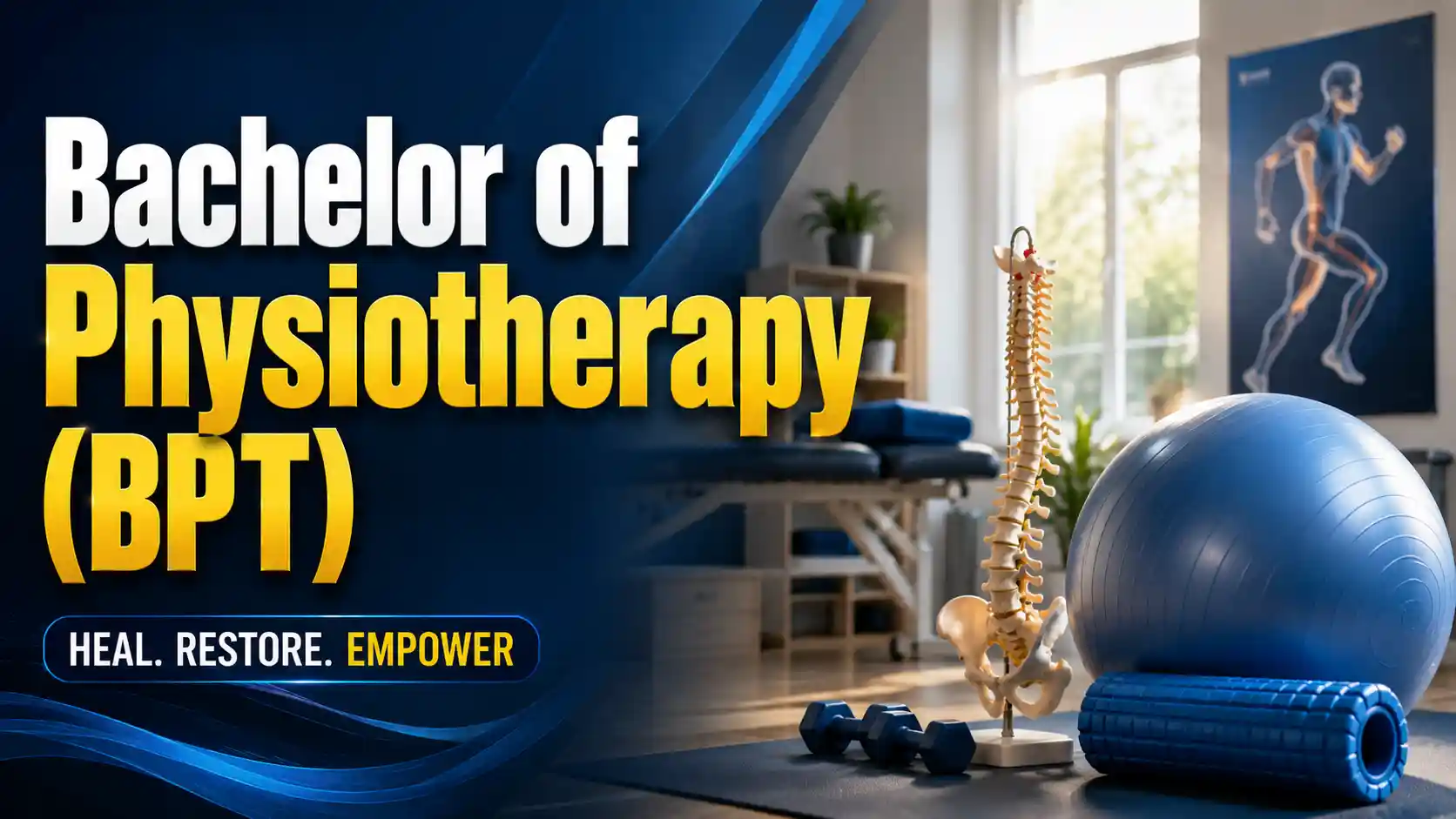
Bachelor of Physiotherapy or BPT is an undergraduate healthcare programme that trains students to assess and manage movement problems, pain, injury, disability and physical-function limitations through exercise therapy, rehabilitation, manual techniques and other physiotherapy methods.
The National Commission for Allied and Healthcare Professions framework describes physiotherapists as professionals involved in examination, assessment, physical diagnosis, treatment, rehabilitation and health promotion, working independently or as part of multidisciplinary healthcare teams.
One of the biggest changes students must understand for 2026 is course duration. The national physiotherapy curriculum recommends a 5-year BPT programme consisting of four academic years followed by one year of compulsory rotatory clinical internship.
Students who are comparing Physiotherapy with Nursing can separately understand the B.Sc Nursing course.
BPT Course 2026 – Quick Facts
The national curriculum recommends 10+2 Science with Physics, Chemistry and Biology with a minimum of 50% marks as the entry standard. Individual universities can apply category relaxations and their own notified selection rules.
Quick Decision Snapshot
- BPT is now moving towards a 5-year structure: 4 years academics + 1-year internship.
- Physiotherapy is not only about massage or exercises; it is a clinical rehabilitation profession.
- PCB is normally required after Class 12.
- NEET is not mandatory for BPT admission in 2026-27.
- Under the current NCAHP decision, mandatory NEET has been deferred to 2027-28.
- BPT is especially suitable for students interested in orthopaedics, sports injuries, neurological rehabilitation and movement science.
- Practical exposure and patient load are more important than a luxurious college campus.
- Private BPT fees vary greatly—from around ₹6–7 lakh total at some universities to ₹2 lakh+ per year at others.
- A BPT graduate can later specialise through MPT in areas such as musculoskeletal, neurological, sports and cardiopulmonary physiotherapy.
Planning BPT admission in 2026? WhatsApp “BPT 2026” to 9090171704 with your PCB percentage, preferred city and budget for free college-shortlisting support.
What Is Bachelor of Physiotherapy?
Physiotherapy is a healthcare profession focused on restoring movement, reducing pain, improving physical function and helping patients recover after injury, illness, disability or surgery.
The national physiotherapy framework includes areas such as:
- Examination and assessment
- Physical diagnosis
- Exercise prescription
- Rehabilitation
- Mobilisation
- Manual therapy
- Electrotherapy
- Pain management
- Movement retraining
- Functional rehabilitation
- Fitness and prevention
Physiotherapists can work independently within their professional scope or as part of teams involving doctors, nurses, occupational therapists and other healthcare professionals.
Course Reality
BPT is not a general B.Sc course.
It prepares students for a patient-facing rehabilitation profession requiring substantial practical and clinical training.
BPT Course Duration 2026
The most important recent change is the move towards a 5-year Bachelor of Physiotherapy programme.
The national curriculum recommends:
4 Years Academic Education + 1 Year Compulsory Rotatory Internship = 5 Years
The one-year internship itself is prescribed at approximately 2,016 minimum clinical hours.
Current 2026 programmes at universities such as Parul and Noida International University are already displaying the five-year / 4+1 structure.
Important 2026 Reality
Older websites may still show:
- 4 years
- 4.5 years
- 4 years + 6 months internship
These can reflect earlier university structures.
For a new 2026 applicant, the current NCAHP-aligned programme duration and the university's latest 2026 curriculum should receive priority.
Why Has BPT Become 5 Years?
The national curriculum is designed to prepare the graduate as an entry-level independent physiotherapy professional, with deeper clinical exposure before graduation.
It specifically recommends beginning clinical practice from the second year and continuing it throughout the programme before the final rotatory internship.
Decision Insight
The extra internship period should not be viewed simply as “one more year”.
For a clinical profession, a structured internship gives students more time to:
- Assess real patients
- Build clinical reasoning
- Learn treatment progression
- Work across specialties
- Gain confidence before independent practice
Is NEET Required for BPT in 2026?
No. NEET UG is not mandatory for BPT admission for academic year 2026-27.
This needs to be stated clearly because many websites still carry outdated or partially updated information.
NCAHP had initially communicated that BPT admission would move to NEET. However, on 2 March 2026, the Commission deferred the mandatory NEET requirement for BPT and BOT until academic year 2027-28 because implementation at the NEET-2026 stage would create logistical difficulties.
What Happens in 2026 Instead?
Admission depends on the applicable:
- University entrance examination
- State/university counselling
- Class 12 PCB merit
- Other valid admission mechanism
For example, GGSIPU changed its 2026 BPT process from the originally planned NEET route to its own CET after the NCAHP deferment.
Important Rule
BPT without NEET does not automatically mean admission without any selection process.
The college may still require an entrance examination or counselling.
Will NEET Be Required for BPT From 2027?
Under the current NCAHP decision, mandatory NEET appearance has been deferred to academic year 2027-28.
Students applying in 2027 should therefore not depend on the 2026 rule.
Admission policy can also receive further official updates before the next cycle.
2026 Student Advantage
A student who did not appear for NEET 2026 can still have legitimate BPT options this year.
BPT Eligibility 2026
The national physiotherapy curriculum recommends the following basic academic background:
The NCAHP-aligned curriculum specifies Physics, Chemistry and Biology with a minimum 50% marks as the entry standard.
Parul University's current 2026 BPT criteria also use 50% PCB for unreserved/general-EWS students and 40% for specified reserved/PwD categories.
Eligibility Reality
Do not use one universal percentage for every BPT college.
Some institutions may impose additional requirements under their university or state regulations.
Can I Do BPT Without Biology?
For the standard current BPT pathway, Biology is normally required along with Physics and Chemistry.
The national curriculum specifies PCB as the qualifying science combination.
A student without Biology should therefore examine other healthcare programmes whose eligibility accepts their subject combination rather than assuming BPT is automatically available.
Can PCM Students Do BPT?
Under the current national entry framework, BPT is primarily designed around Physics, Chemistry and Biology.
A PCM-only student should not assume eligibility unless the specific current university admission regulations explicitly permit it.
Student Mistake
Do not rely on an old admission portal saying “Science stream”.
Check whether Biology is specifically required.
BPT Admission 2026
Unlike MBBS, there is no single uniform 2026 BPT counselling system across India.
Students may encounter:
- CET
- University entrance examination
- Merit based on PCB
- State counselling
- University counselling
- Institution-specific selection allowed under current rules
The correct admission pathway depends on the institution.
BPT Admission Process Step by Step
Step 1: Confirm PCB Eligibility
Check:
- Physics
- Chemistry
- Biology
- PCB aggregate
- Category relaxation
- Age
- University-specific conditions
Step 2: Identify the Admission Route
Ask:
Does this college use CET, PCB merit, university entrance or another valid route for 2026?
Step 3: Apply to the Correct Authority
The application may be through:
- University
- State admission authority
- Common entrance portal
- College admission portal
Step 4: Take the Entrance Exam if Required
For example, IP University uses its own BPT CET process in 2026 after NEET was deferred.
Step 5: Attend Counselling / Merit Allocation
Choice filling and rank can influence which college is offered.
Step 6: Verify the Exact BPT Programme
Check the current:
- Programme duration
- Clinical setup
- Hospital
- Physiotherapy OPD
- Internship structure
Step 7: Check Complete Fees
Do not compare only the first year.
Step 8: Complete Admission and Reporting
Submit documents and fee through the proper admission system.
BPT Admission Status – 25 August 2026
The 2026 admission cycle is already well advanced at many institutions.
For example, GGSIPU announced Round 1 choice filling for BPT and other allied-health programmes in August 2026.
Parul University's current BPT page shows 25 August 2026 as the applicable admission deadline and lists a five-year BPT programme with 60 seats.
Admission Reality
Students looking for BPT now should focus on:
Current Application Status + Counselling Round + Vacancy + Valid Admission Route
rather than old March or April application information.
BPT Syllabus 2026
The updated curriculum gives students a strong medical-science base before moving into specialised physiotherapy.
Major Subjects in BPT
Foundation Medical Sciences
- Human Anatomy
- Human Physiology
- Biochemistry
- Pathology
- Microbiology
- Pharmacology
Movement Sciences
- Biomechanics
- Kinesiology
- Exercise Science
Core Physiotherapy
- Exercise Therapy
- Electrotherapy
- Physiotherapy Assessment
- Therapeutic Exercise
- Manual Therapy concepts
Clinical Physiotherapy
- Musculoskeletal Physiotherapy
- Orthopaedic Rehabilitation
- Neurological Physiotherapy
- Cardiopulmonary Physiotherapy
- Paediatric Physiotherapy
- Community Physiotherapy
- Sports Physiotherapy
- Women's Health
- Geriatric Rehabilitation
Professional & Research Areas
- Psychology
- Sociology
- Research methodology
- Evidence-based practice
- Ethics
- Communication
- Clinical decision-making
The national curriculum has been designed around competency-based education rather than theory alone.
Is BPT Difficult?
BPT can be demanding because students need to understand both:
Human body science + practical treatment
Subjects such as Anatomy and Physiology require significant study during the early phase.
Later, students need to apply that knowledge when assessing real patients.
Course Difficulty
The challenge is not only examinations.
Students must learn to:
- Assess posture and movement
- Understand pain
- Identify functional limitations
- Select treatment
- Perform exercises correctly
- Communicate with patients
- Modify rehabilitation over time
What Happens During the BPT Internship?
The final-year rotatory internship is one of the most important parts of the new programme structure.
The national curriculum prescribes 12 months of internship with a minimum of around 2,016 hours.
Internship rotations include areas such as:
- Musculoskeletal Physiotherapy
- Neurological Physiotherapy
- Cardiopulmonary Physiotherapy
- Rehabilitation
- Other clinical specialties
Students are expected to apply skills learned during the academic programme to real clinical practice.
Internship Reality
A good internship should make the graduate more capable of assessing and treating patients—not simply provide an internship certificate.
How to Choose a Good BPT College
A practical BPT comparison formula is:
Current Programme + Physiotherapy OPD + Hospital Exposure + Clinical Faculty + Internship + Total Fees + Admission Route
1. Check the Physiotherapy Department
The national framework expects physiotherapy colleges to provide dedicated physiotherapy facilities rather than functioning as classroom-only institutions.
2. Check Patient Load
The curriculum discusses a student-to-patient ratio and sets expectations around clinical workload.
A physiotherapy department without sufficient patients limits practical learning.
3. Check Hospital Exposure
The framework describes extensive exposure to areas including:
- Orthopaedics
- Medicine
- Surgery
- Neurology
- Paediatrics
- Respiratory medicine
- Cardiology
- Critical care
For institutions using an attached hospital, the national framework describes substantial hospital infrastructure expectations.
4. Check Internship
Ask where the full one-year internship takes place.
5. Check Total Five-Year Cost
Five years of tuition, hostel and living expenses can be significantly higher than the headline annual fee.
Hospital Exposure Is More Important Than Campus Size
A BPT student needs real rehabilitation exposure.
Before paying, ask:
- Is there a functioning Physiotherapy OPD?
- How many patients come daily?
- Is Orthopaedics available?
- Is Neurology available?
- Is ICU/cardiorespiratory exposure available?
- Are paediatric cases available?
- Is sports rehabilitation available?
- Is community rehabilitation available?
Decision Insight
A photogenic campus cannot replace patients.
For Physiotherapy:
Clinical Case Exposure > Campus Marketing
BPT Fees 2026
BPT fees vary substantially between universities.
Current examples show how wide the range can be.
Noida International University lists ₹6,76,500 as the current full BPT course fee under its 2026-27 domestic structure.
Parul University lists BPT at ₹2.40 lakh per year for its current five-year programme.
Sharda's 2026-27 fee page lists ₹2.60 lakh in Year 1, with scheduled increases in subsequent academic years.
How Much Can a 5-Year BPT Degree Really Cost?
Do not calculate only:
Annual Tuition × 4
The programme may now run for five years including internship.
Families should calculate:
Total BPT Cost = Academic Fee + Internship-Period Charges + Hostel + Mess + Examination Fees + Clinical Charges + Transport + Deposits − Confirmed Scholarship
Example
If tuition is ₹2 lakh per year and the student requires ₹1 lakh per year for hostel and mess:
₹3 lakh annual living/academic cost × 5 years ≈ ₹15 lakh
depending on the fee charged during internship.
Financial Reality
Always ask whether full tuition continues during the internship year.
BPT College Example – Noida International University
Noida International University currently lists:
- Course: BPT
- Duration: 4 + 1 years
- Total fee: ₹6,76,500
- Allied Healthcare Sciences school
- MPT options available after BPT
This can be relevant for students looking for a Greater Noida/Delhi NCR private university option.
Financial Insight
Its published total figure is easier to compare than a college showing only first-year tuition.
But hostel, mess and refundable/security charges still need separate calculation.
BPT College Example – Parul University
Parul University currently offers BPT with:
- Duration: 5 years
- Seats: 60
- Fee: ₹2.40 lakh per year
- General PCB requirement: 50%
- Applicable category relaxation: 40% under the stated criteria
At an unchanged ₹2.40 lakh annual rate, five years would represent ₹12 lakh in headline annual programme fees, although the actual final payment structure should reflect how internship-year fees are treated.
Student Mistake
Do not compare Parul's annual figure directly with NIU's complete-course figure.
Convert both to the same basis first.
BPT College Example – MIT University Shillong
MIT University Shillong currently lists Bachelor of Physiotherapy under its School of Allied Health Science, and its 2026-27 admission system is active.
This is particularly relevant for students who are open to studying BPT outside the traditional Delhi NCR/Bangalore/Chennai markets.
Decision Insight
Before choosing a distant BPT college, compare:
- Clinical hospital
- Physiotherapy OPD
- Hostel
- Total five-year living cost
- Internship arrangements
- Travel home
For a five-year professional course, location has a large financial effect.
BPT College Example – HRIT University Ghaziabad
Current 2026 programme information submitted in the university/admission framework includes Bachelor of Physiotherapy, with Class 12 PCB and a listed minimum of 50% marks.
HRIT University Ghaziabad can therefore be considered by Delhi NCR students seeking another nearby Physiotherapy option.
Location Insight
A nearby college can save substantial hostel expenditure over five years.
But that saving is valuable only if clinical exposure is satisfactory.
What Does a Physiotherapist Do?
A physiotherapist helps patients restore or improve physical function.
Common situations include:
- Back pain
- Neck pain
- Joint injury
- Fractures after immobilisation
- Joint-replacement rehabilitation
- Sports injuries
- Stroke rehabilitation
- Spinal-cord conditions
- Parkinson's disease
- Cerebral palsy
- Respiratory conditions
- Post-operative recovery
- Elderly mobility problems
- Women's health rehabilitation
- Chronic pain
The profession includes assessment, diagnosis within physiotherapy scope, treatment planning and physical rehabilitation.
Jobs After BPT
Common career options include:
- Clinical Physiotherapist
- Musculoskeletal Physiotherapist
- Orthopaedic Physiotherapist
- Neurological Physiotherapist
- Sports Physiotherapist
- Paediatric Physiotherapist
- Cardiopulmonary Physiotherapist
- Geriatric Physiotherapist
- Rehabilitation Physiotherapist
- Community Physiotherapist
- Home Healthcare Physiotherapist
- Fitness/Rehabilitation Consultant
- Research Assistant
- Academic roles after higher qualification
Career Reality
BPT graduates are not limited to hospitals.
Physiotherapy services are also used in rehabilitation centres, sports, home healthcare, elderly care and private clinics.
BPT Salary in India 2026
There is no guaranteed BPT salary.
Pay depends on:
- City
- Employer
- Clinical skill
- Experience
- Specialisation
- Home visits/private practice
- Hospital vs rehabilitation centre
- MPT qualification
Indeed's current India salary tracker reports an average physiotherapist base salary of approximately ₹19,644 per month, based on hundreds of reported salaries and updated in May 2026.
Salary Reality
This is a broad market average—not a guaranteed BPT fresher package.
A newly graduated physiotherapist in a small clinic and an experienced specialist running private consultations can have completely different earnings.
Can Physiotherapists Earn More Through Private Practice?
Potentially, yes.
Unlike some allied-health roles that are strongly tied to hospitals or laboratories, experienced physiotherapists may develop income through:
- Home visits
- Private clinic
- Sports rehabilitation
- Personalised rehabilitation programmes
- Corporate ergonomics
- Geriatric care
- Post-operative rehabilitation
However, independent practice requires:
- Strong clinical skill
- Professional reputation
- Patient referrals
- Ethical practice
- Applicable registration/compliance
Career Insight
Physiotherapy can have a relatively modest starting salary but potentially stronger long-term income flexibility for clinically skilled professionals.
Is BPT a Good Career in 2026?
BPT can be a strong choice for students who genuinely like:
- Human Anatomy
- Movement
- Exercise science
- Rehabilitation
- Patient interaction
- Sports
- Orthopaedics
- Neurology
Its advantage is the growing need for rehabilitation across:
- Ageing populations
- Sports injuries
- Orthopaedic surgery
- Stroke
- Lifestyle disorders
- Chronic pain
- Home healthcare
But it is not the right course for everyone.
Who Should Choose BPT?
BPT may suit you if you:
- Like Biology
- Are interested in Anatomy
- Enjoy understanding body movement
- Want patient interaction
- Like sports and rehabilitation
- Prefer non-surgical treatment
- Are comfortable working physically with patients
- Want a clinical healthcare career
- May want private practice later
Who May Struggle With BPT?
Think carefully if you:
- Do not enjoy direct patient interaction
- Want mainly laboratory work
- Want a desk-only job
- Dislike Anatomy
- Do not want practical/manual work
- Expect MBBS-style earnings immediately
- Are selecting BPT only because you did not get MBBS
Profile Fit
BPT should not be treated as a “backup medical course”.
It is a separate profession with its own work style.
BPT vs B.Sc Nursing
Students who like rehabilitation more than continuous bedside Nursing may prefer BPT.
Those comfortable with full patient care, medication, wards and hospital shifts may find B.Sc Nursing more suitable.
BPT vs BMLT/BMLS
BPT and Medical Laboratory Sciences involve very different daily work.
Students who prefer:
- Blood/sample testing
- Lab equipment
- Diagnostics
- Less continuous patient interaction
may prefer B.Sc Medical Laboratory Technology / BMLS.
Simple Difference
BPT = Patient Movement & Rehabilitation
BMLS = Laboratory Diagnosis
BPT vs Radiology & Medical Imaging
Radiology students work more with imaging equipment such as:
- X-ray
- CT
- MRI
- Imaging procedures
Physiotherapists work more with:
- Movement
- Functional assessment
- Exercise
- Rehabilitation
Students interested more in medical technology than rehabilitation can explore B.Sc Radiology & Medical Imaging Technology.
BPT vs Anaesthesia & Operation Theatre Technology
BAOTT focuses on:
- Operation theatre
- Anaesthesia support
- Surgical environment
BPT focuses on rehabilitation before or after injury, disease or surgery.
A student attracted specifically to surgery and OT technology may prefer B.Sc Anaesthesia & Operation Theatre Technology.
BPT vs Optometry
Optometry is specialised around:
- Vision
- Eye examination
- Optical correction
- Eye-care services
Physiotherapy is much broader across musculoskeletal, neurological and cardiorespiratory rehabilitation.
Students interested primarily in eye care can explore B.Sc Optometry.
BPT vs Dialysis Technology
Dialysis Technology is a much narrower renal-care technology profession.
Physiotherapy provides broader independent rehabilitation opportunities.
Students attracted to renal care and dialysis machines can compare B.Sc Dialysis Technology.
Higher Studies After BPT
The most common professional higher degree is:
MPT – Master of Physiotherapy
Common specialisation areas include:
- Musculoskeletal Physiotherapy
- Neurological Physiotherapy
- Sports Physiotherapy
- Cardiopulmonary Physiotherapy
- Paediatric Physiotherapy
- Women's Health
- Community Rehabilitation
The national curriculum recommends a minimum two-year MPT structure.
Is MPT Necessary After BPT?
No, not for every career.
A BPT graduate can begin working after completing the required academic programme and internship.
MPT can become useful when the student wants:
- Deeper clinical specialisation
- Teaching
- Academic progression
- Research
- Senior specialist roles
Career Decision
BPT = Entry into the profession
MPT = Specialisation
Can BPT Graduates Work Abroad?
Potentially yes, but an Indian BPT degree does not create automatic professional registration abroad.
Countries may require:
- Credential assessment
- Professional registration
- English-language test
- Licensing/competency assessment
- Clinical documentation
- Immigration permission
Requirements vary greatly between countries.
Student Mistake
Do not pay a high BPT fee simply because a college advertises:
“International placement.”
Professional registration abroad is a separate process.
BPT vs MBBS
BPT and MBBS should not be compared as though one is a shorter version of the other.
Important Reality
Choose BPT because you want to become a physiotherapist, not merely because MBBS was unavailable.
BPT College Selection Checklist
Before paying, score every college on:
- Current 2026 BPT programme
- Five-year/NCAHP-aligned structure
- Physiotherapy OPD
- Patient load
- Hospital exposure
- Orthopaedic exposure
- Neurological exposure
- Cardiorespiratory exposure
- Clinical faculty
- One-year internship
- Complete fees
- Hostel and location
Best College Formula
Good BPT College = Strong Clinical Exposure + Proper Curriculum + Affordable Cost + Valid Admission
Common BPT Admission Mistakes
Using Old 4.5-Year Course Information
New applicants should check the latest 2026 programme structure.
Thinking NEET Is Compulsory in 2026
Mandatory NEET has been deferred to 2027-28.
Thinking No NEET Means No Entrance
Some universities still use CET or another admission process.
Choosing Only by University Brand
Physiotherapy needs real clinical training.
Ignoring the Physiotherapy OPD
Patient exposure matters.
Comparing Annual Fee With Total Fee
Convert every college to the same five-year basis.
Ignoring Internship
One full year of clinical training is now a major part of the recommended programme structure.
Choosing BPT Only Because MBBS Was Not Available
BPT has a very different professional role.
FAQs – Bachelor of Physiotherapy 2026
1. What is the full form of BPT?
BPT stands for Bachelor of Physiotherapy.
2. What is BPT?
BPT is an undergraduate professional healthcare degree that prepares students for physiotherapy, rehabilitation and movement-related patient care.
3. How many years is BPT in 2026?
The current national curriculum recommends 5 years including one year of compulsory internship.
4. Is BPT 4.5 years or 5 years?
Older university structures may show 4.5 years. The current national physiotherapy curriculum recommends a five-year structure including a one-year internship.
5. How long is the BPT internship?
The national curriculum prescribes 12 months, with approximately 2,016 minimum hours.
6. What is the eligibility for BPT in 2026?
The national curriculum recommends Class 12 with Physics, Chemistry and Biology with at least 50% PCB.
7. Is Biology compulsory for BPT?
Yes, Biology is part of the standard current BPT entry requirement.
8. Can PCM students apply for BPT?
PCM-only students should check the exact university rules because the national curriculum specifies PCB.
9. Is NEET compulsory for BPT in 2026?
No. Mandatory NEET has been deferred for academic year 2026-27.
10. When will NEET become compulsory for BPT?
Under the current NCAHP decision, the mandatory requirement has been deferred to 2027-28.
11. Can I get BPT admission without NEET in 2026?
Yes. Universities and states may use PCB merit, CET or another applicable admission process.
12. Does IP University require NEET for BPT in 2026?
No. After the NCAHP deferment, GGSIPU moved BPT admission to its own CET for the 2026-27 cycle.
13. Is BPT a medical course?
BPT is an allied healthcare/professional rehabilitation programme, not an MBBS medical degree.
14. Is BPT a degree?
Yes. Bachelor of Physiotherapy is an undergraduate degree.
15. What subjects are taught in BPT?
Major areas include Anatomy, Physiology, Biomechanics, Exercise Therapy, Electrotherapy, Pathology, Pharmacology and specialised musculoskeletal, neurological and cardiopulmonary physiotherapy.
16. Is BPT difficult?
It can be demanding because students study medical sciences and must apply them during practical and clinical training.
17. Does BPT have hospital training?
Yes. Clinical training is a major part of the programme and should begin before the internship year.
18. What is the BPT fee in India?
Fees vary greatly. Current private examples range from around ₹6.77 lakh total at NIU to ₹2.40 lakh per year at Parul University.
19. What is Noida International University's BPT fee?
Its current 2026-27 structure lists ₹6,76,500 total.
20. What is Parul University BPT fee?
Parul currently lists ₹2.40 lakh per year.
21. What is Sharda University BPT fee?
Its 2026-27 structure lists ₹2.60 lakh for the first year, with higher fees in later years.
22. Is BPT available at MIT University Shillong?
Yes. MIT University Shillong currently lists Bachelor of Physiotherapy under its School of Allied Health Science.
23. Is BPT available at HRIT University?
Current 2026 programme information includes BPT with a 50% PCB eligibility criterion.
24. What jobs can I get after BPT?
Graduates can work in hospitals, physiotherapy clinics, rehabilitation centres, sports facilities, home healthcare and community rehabilitation.
25. What is the salary after BPT?
Indeed reported an average physiotherapist salary of about ₹19,644 per month in India in May 2026. Actual salaries vary widely.
26. Can a BPT graduate open a clinic?
Physiotherapists may move into independent clinical practice subject to applicable registration and professional regulations.
27. Is BPT good for sports?
Yes. Sports Physiotherapy is an important career and postgraduate specialisation area.
28. Can BPT graduates work in hospitals?
Yes. Hospitals are one of the main employment settings for physiotherapists.
29. Can BPT graduates work in ICU?
Cardiorespiratory/chest physiotherapy can form part of critical-care rehabilitation within professional scope and hospital teams.
30. What can I study after BPT?
The major professional postgraduate option is MPT.
31. How long is MPT?
The current national framework recommends a minimum two-year postgraduate physiotherapy programme.
32. Is BPT better than B.Sc Nursing?
It depends on career fit. BPT focuses on rehabilitation and movement, while Nursing involves broader bedside patient care.
33. Is BPT better than BMLT?
Neither is universally better. BPT suits patient rehabilitation; BMLT/BMLS suits laboratory diagnostics.
34. Is BPT better than Radiology?
BPT suits students interested in movement and rehabilitation. Radiology suits students more interested in diagnostic imaging technology.
35. Is BPT good for girls?
Yes. Physiotherapy is suitable for eligible students of any gender.
36. Is BPT good for boys?
Yes. There is no general gender restriction on the profession.
37. Can BPT graduates work abroad?
Potentially yes, but foreign professional registration, credential and licensing requirements apply.
38. Is BPT a good career in 2026?
It can be a strong healthcare career for students interested in rehabilitation, orthopaedics, sports, neurology and patient interaction.
39. Can I still get BPT admission in August 2026?
Possibly. Admission stages differ by university. Some counselling systems are already advanced, while individual universities may still have current admission activity.
40. What should I check before paying BPT fees?
Check the latest programme duration, valid admission route, physiotherapy OPD, hospital exposure, internship, complete five-year cost and hostel requirements.
Final Decision – Is BPT Worth It in 2026?
BPT can be an excellent professional healthcare course for students who genuinely want to work in rehabilitation, movement science and direct patient recovery.
The 2026 landscape is especially important because BPT is moving towards a stronger five-year professional structure with a full one-year clinical internship, while mandatory NEET has been postponed to 2027-28.
A good BPT decision should therefore be based on:
PCB Eligibility + Valid 2026 Admission + Strong Physiotherapy OPD + Hospital Exposure + One-Year Internship + Affordable Five-Year Cost + Career Fit
Do not choose BPT merely because it is “medical without MBBS”.
Choose it if you can realistically see yourself helping patients recover movement after injury, surgery, neurological illness or long-term disability.
Need a personalised BPT college shortlist for 2026? WhatsApp “BPT 2026” to 9090171704 with your PCB marks, state, preferred city and maximum budget.