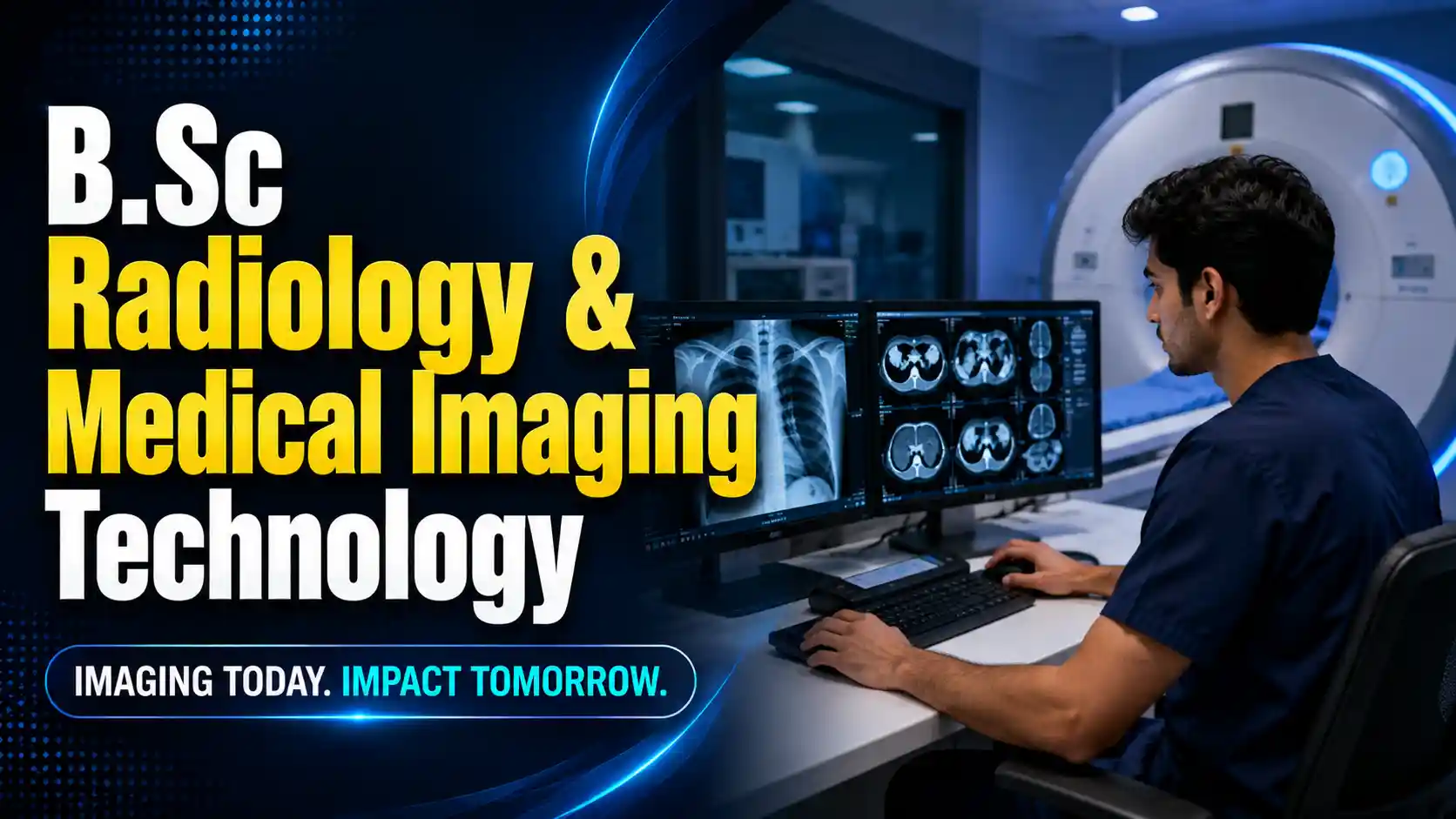

B.Sc Radiology & Medical Imaging Technology 2026 – Admission, Eligibility, Fees, Syllabus, Salary & Scope
B.Sc Radiology & Medical Imaging Technology is a professional allied-health degree for students who want to work with diagnostic imaging systems such as X-ray, CT and MRI.
An important change for students joining from 2026-27 is the standardisation of allied-health programmes under the National Commission for Allied and Healthcare Professions. The current programme name being adopted is Bachelor of Medical Radiology and Imaging Technology (BMRIT).
The recommended programme duration is 4 years, normally 3 years of academic/clinical education plus 1 year of internship. Noida International University and Parul University both currently publish four-year BMRIT programmes for the 2026 cycle.
Students comparing different healthcare careers should not confuse this course with becoming a radiologist.
A BMRIT graduate is a Medical Imaging Technologist/Radiographer. A radiologist is a medical doctor specialising in Radiology.
B.Sc Radiology & Medical Imaging Technology 2026 – Quick Facts
The Ministry of Health describes medical imaging technologists as professionals who produce diagnostic medical images and operate technologies including X-ray, CT, MRI, mammography and fluoroscopy.
Quick Decision Snapshot
- Choose BMRIT if you are interested in medical technology, imaging equipment and hospital diagnostics.
- The programme is now generally 4 years including a 1-year internship.
- PCB is the safest standard eligibility combination for new 2026 admissions.
- BMRIT is not an MBBS or radiologist degree.
- Students can develop skills across X-ray, CT and MRI instead of remaining limited to basic radiography.
- A hospital with active CT/MRI/X-ray departments is more important than a fancy university campus.
- Radiation protection and patient safety are essential parts of professional training.
- Private BMRIT fees vary significantly; current examples range from about ₹4.29 lakh total at NIU to ₹1.15 lakh per year at Parul University.
- Advanced CT/MRI skills and experience can improve career opportunities.
- Students who dislike machines, anatomy and hospital work should consider another allied-health course.
Planning BMRIT admission in 2026? WhatsApp “RADIOLOGY 2026” to 9090171704 with your PCB marks, preferred city and budget for free college shortlisting.
What Is B.Sc Radiology & Medical Imaging Technology?
B.Sc Radiology & Medical Imaging Technology trains students to help produce diagnostic images that doctors use to detect or monitor disease and injury.
The professional may work with equipment such as:
- Digital X-ray
- CT scanner
- MRI scanner
- Fluoroscopy
- Mammography
- C-arm
- DEXA
- Mobile radiography
- PACS and digital imaging systems
The Ministry of Health's Medical Radiology and Imaging Technology curriculum specifically identifies CT, MRI, DSA, mammography, fluoroscopy, CR/DR and mobile X-ray among the technologies used by trained imaging professionals.
Course Reality
This is not merely an “X-ray technician course”.
A good BMRIT programme should progress from basic radiography to advanced diagnostic imaging, patient positioning, image quality, CT, MRI and radiation safety.
What Is the Correct Course Name in 2026?
Students will find many different names online:
- B.Sc Radiology
- B.Sc Radiology & Imaging Technology
- B.Sc Medical Imaging Technology
- B.Sc MRIT
- BMRIT
- BRIT
- B.Sc Radiography
This happens because universities historically used different nomenclature.
From academic year 2026-27, NCAHP's standardisation is moving institutions towards:
Bachelor of Medical Radiology and Imaging Technology – BMRIT
Universities such as Dr. D. Y. Patil now separately show their older programme framework up to 2025-26 and the Bachelor of Medical Radiology and Imaging Technology framework from 2026-27 onwards.
Important Rule
For new admission, compare the current 2026-27 programme, not only an old B.Sc RIT brochure.
BMRIT Course Duration 2026
The standard bachelor's pathway is now 4 years.
A common structure is:
3 Years Academic + Clinical Training + 1 Year Internship = 4 Years
Noida International University's current 2026 BMRIT page lists 3+1 years including internship.
Atal Bihari Vajpayee Medical University's BMRIT structure similarly uses 3 years plus 1 year of internship.
Student Mistake
Be careful with websites still advertising a 3-year B.Sc Radiology course without clearly explaining internship.
For a student joining in 2026-27, compare the programme with the current NCAHP-aligned four-year structure.
BMRIT Eligibility 2026
For the current standard BMRIT pathway, students should normally have:
- Class 12 / 10+2
- Physics
- Chemistry
- Biology
- Recognised board
- Required college/university percentage
Noida International University's current 2026 BMRIT programme requires 10+2 with PCB and minimum 50% marks.
Parul University's current BMRIT programme requires 10+2 with PCB or an equivalent recognised qualification.
BMRIT Eligibility at a Glance
Eligibility Reality
Do not use an old website stating that any Science stream is enough.
For the current standardised programme, PCB is the safer benchmark.
Can PCM Students Do B.Sc Radiology?
For the current NCAHP-aligned BMRIT structure, PCB is the standard entry combination.
Therefore, a student with Physics, Chemistry and Mathematics but without Biology should not automatically assume eligibility.
Older programmes may have used different eligibility conditions, which is another reason students must check the current 2026 course rather than old information.
Can I Do BMRIT Without NEET in 2026?
Yes, depending on the university or state admission system.
There is not one nationwide NEET-only admission system covering all BMRIT colleges.
For example, Uttar Pradesh currently admits students to BMRIT and other allied-health bachelor's programmes through CAHET 2026 – Common Allied Healthcare Entrance Test under ABVMU.
Other universities can use their own merit or entrance system subject to applicable rules.
Important Distinction
Without NEET ≠ without admission rules.
A college may still require:
- University entrance
- State entrance
- Merit
- Counselling
- Interview/selection
BMRIT Admission 2026
The admission process varies by institution.
A typical route is:
Class 12 PCB → Application → Entrance/Merit → Counselling/Selection → Document Verification → Fee Payment → Admission
Students should first identify the exact college and then check its admission route.
BMRIT Admission Process Step by Step
Step 1: Check PCB Eligibility
Confirm:
- Physics
- Chemistry
- Biology
- Required percentage
- Age requirement
- Category conditions
Step 2: Identify the Exact Course
Prefer the current programme nomenclature and curriculum.
Ask whether the university is offering:
BMRIT / Bachelor of Medical Radiology and Imaging Technology
for the 2026-27 intake.
Step 3: Check the Entrance Route
It may be:
- University examination
- State entrance
- CAHET
- PCB merit
- Another formally notified route
Step 4: Check Hospital and Imaging Facilities
Verify access to:
- X-ray
- CT
- MRI
- C-arm
- Mammography where available
- PACS/digital imaging
Step 5: Apply
Submit academic and identity documents.
Step 6: Complete Counselling or Selection
Entrance rank or merit may determine allotment.
Step 7: Check Complete Fees
Do not compare only one semester.
Step 8: Confirm Internship
Ask where the one-year internship will be completed.
BMRIT Admission in Uttar Pradesh 2026
Uttar Pradesh provides a useful example of how allied-health admission is becoming more structured.
Atal Bihari Vajpayee Medical University currently lists BMRIT among the bachelor's programmes admitted through:
CAHET 2026 – Common Allied Healthcare Entrance Test.
ABVMU also publishes affiliated institutions offering BMRIT, including government and private colleges.
Admission Reality
A student targeting an ABVMU-affiliated BMRIT college should follow the CAHET/counselling route, not rely on an informal direct-admission promise.
What Do Students Study in BMRIT?
The curriculum combines:
Medical Science + Radiation Physics + Imaging Technology + Patient Care + Clinical Practice
Common subjects include:
- Anatomy
- Physiology
- Pathology
- Medical terminology
- Radiation physics
- Radiographic equipment
- Radiographic positioning
- Image processing
- Radiation protection
- Contrast procedures
- CT
- MRI
- Mammography
- Digital imaging
- PACS
- Quality assurance
- Patient care
- Medical ethics
- Research methodology
Current ABVMU examination material for BMRIT includes subjects such as clinical radiography, patient positioning, modern radiological and imaging equipment and contrast/special procedures.
BMRIT Year-Wise Learning
Early Stage
Students build the basic science foundation:
- Anatomy
- Physiology
- Healthcare systems
- Medical terminology
- Radiation physics
Middle Stage
Students move towards:
- Patient positioning
- Conventional radiography
- Image processing
- Radiographic procedures
- Radiation safety
- Equipment operation
Advanced Stage
Training becomes more focused on:
- CT
- MRI
- Mammography
- Advanced imaging
- Quality assurance
- Digital imaging systems
- Clinical case exposure
Final Internship
Students work in real diagnostic imaging environments under supervision.
Learning Reality
A strong BMRIT degree cannot be taught properly from classrooms alone.
Students need hands-on imaging exposure.
What Is X-Ray Training in BMRIT?
X-ray imaging forms one of the basic foundations of radiography training.
Students learn areas such as:
- Patient positioning
- Exposure factors
- Digital radiography
- Image quality
- Radiation protection
- Portable/mobile X-ray
- Trauma radiography
- C-arm procedures
AERB specifically regulates medical diagnostic X-ray facilities and publishes qualification, training, radiation-protection and personnel-monitoring requirements for radiographers and X-ray technologists.
What Is CT Training?
CT or Computed Tomography creates cross-sectional images of the body.
A Medical Imaging Technologist may learn:
- Patient preparation
- Positioning
- CT protocols
- Contrast procedures
- Scan acquisition
- Image reconstruction basics
- Radiation-dose awareness
- Emergency patient handling
CT skills can become important because CT is widely used in:
- Trauma
- Stroke assessment
- Chest imaging
- Abdomen
- Oncology
- Emergency diagnostics
What Is MRI Training?
MRI uses strong magnetic fields and radiofrequency technology rather than ionising X-ray radiation.
Students may learn:
- MRI safety
- Patient screening
- Positioning
- Coils
- Scan protocols
- Basic MRI physics
- Image acquisition
- Patient monitoring
MRI can become an attractive skill area for experienced imaging technologists.
Indeed's India data currently reports around ₹38,379 per month as the average MRI Technologist base salary, although this is based on a very small sample and should not be treated as a guaranteed salary.
Career Insight
A student who becomes genuinely competent in X-ray + CT + MRI can have broader opportunities than someone whose practical experience remains limited to basic radiography.
What Is Mammography?
Mammography is specialised breast imaging using X-rays.
Training requires particular attention to:
- Patient positioning
- Image quality
- Radiation dose
- Equipment handling
- Patient communication
NCAHP's medical imaging profession includes mammography within the wider diagnostic imaging field, while AERB separately publishes quality-assurance and radiation-safety requirements for mammography facilities.
Is Ultrasound Included in BMRIT?
Students may study principles related to ultrasound and imaging.
However, learning ultrasound technology is not the same as having unrestricted legal authority to independently perform or report every ultrasound examination.
Ultrasound practice in India also intersects with separate legal and professional requirements.
Important Career Rule
Do not choose a college merely because it promises:
“Become X-ray + CT + MRI + Ultrasound doctor/technician.”
Ask exactly what training and professional scope the programme provides.
Radiographer vs Radiologist – What Is the Difference?
This is one of the most important distinctions.
Important Rule
BMRIT does not make you a radiologist doctor.
It prepares you to become an imaging professional.
BMRIT and Radiation Safety
Students often worry:
“Will working with X-rays harm me?”
Ionising-radiation work requires strict safety practices.
AERB provides regulatory guidance covering:
- Radiation protection
- X-ray installation safety
- Personnel qualifications
- TLD badges/personnel monitoring
- Protective devices
- Equipment quality assurance
- Facility shielding
Course Selection Insight
Radiation safety should be a serious part of the curriculum.
A college that treats it as a small theory topic is not enough.
Does MRI Have Radiation?
MRI does not use ionising X-ray radiation.
It uses magnetic fields and radiofrequency energy.
However, MRI has its own safety risks, especially relating to:
- Ferromagnetic objects
- Implants
- Pacemakers/devices
- Projectile hazards
- Patient screening
This is why MRI technologists also need specialist safety training.
BMRIT Fees 2026
Fees vary widely across universities.
Two current 2026 examples show this clearly.
Noida International University's 2026-27 domestic fee structure lists BMRIT as 3+1 years with ₹4.29 lakh total fee.
Parul University's current 2026 programme lists ₹1.15 lakh per annum, four-year duration and 60 seats.
Financial Reality
Do not automatically decide that NIU is cheaper or Parul is cheaper without checking:
- Whether all four years are charged equally
- Hostel
- Mess
- University/examination charges
- Deposits
- Scholarship
BMRIT College Example – Noida International University
Noida International University is a relevant private option for students considering Delhi NCR.
Its current 2026 programme lists:
- BMRIT
- Duration: 3+1 years
- PCB: minimum 50%
- On-campus 900+ bedded hospital
- Clinical rotations
- Training in diagnostic imaging environments
Its 2026-27 domestic fee page lists ₹4,29,000 total programme fee.
Profile Fit
This type of option is particularly relevant for a student who wants:
Delhi NCR + Private University + Hospital-Based Training + Moderate Published Academic Fee
BMRIT College Example – Parul University
Parul University currently offers Bachelor of Medical Radiology & Imaging Technology with:
- Duration: 4 years
- Intake: 60
- Fee: ₹1.15 lakh/year
- PCB eligibility
- 2026 admission cycle active
Parul University's allied-health ecosystem also has a dedicated Medical Radiology, Imaging and Therapeutic Technology department.
Decision Insight
A university course should still be judged by:
Actual Imaging Exposure + Hospital Equipment + Internship + Complete Cost
rather than only fee or university size.
BMRIT College Example – Lingaya's Vidyapeeth
Lingaya's Vidyapeeth has offered Radiology and Medical Imaging Technology programmes, and its university examination records show active B.Sc Radiology and Medical Imaging Technology subjects including:
- CT and MRI
- Radiographic patient positioning
- Image processing
- Radiation hazards and safety
- Quality assurance
For a new 2026 applicant, however, the important question is whether the admission being offered follows the current 2026-27 BMRIT/NCAHP-aligned structure rather than an older three-year programme format.
Student Mistake
A course being historically available does not automatically prove that the same old structure should be used for a new 2026 batch.
How to Choose a Good BMRIT College
Use:
Current 2026 Programme + Hospital + X-Ray + CT + MRI Exposure + Internship + Radiation Safety + Total Fee
1. Check Current Course Duration
Prefer the current four-year structure.
2. Check the Radiology Department
Ask if the hospital has:
- Digital X-ray
- CT
- MRI
These are the minimum major technologies you should compare.
3. Check Patient Volume
A machine without patients gives limited clinical learning.
4. Check Internship
Where will the student spend the one-year internship?
5. Check Radiation Safety
AERB-standard radiation-safety practices should be visible in the clinical environment.
6. Check Fees
Calculate all four years.
Attached Hospital vs Diagnostic Centre Tie-Up
For BMRIT, an attached hospital can offer:
- Emergency imaging
- In-patient imaging
- Trauma cases
- Portable radiography
- ICU exposure
- CT cases
- MRI cases
A diagnostic-centre tie-up can also provide excellent learning, especially when it has advanced CT/MRI equipment.
Better Question
Do not ask only:
“Does the college have a hospital?”
Ask:
“How many X-ray, CT and MRI cases will I actually see during training?”
Jobs After B.Sc Radiology & Medical Imaging Technology
Graduates can work under job titles such as:
- Medical Imaging Technologist
- Radiographer
- Radiologic Technologist
- X-ray Technologist
- CT Technologist
- MRI Technologist
- Mammography Technologist
- Imaging Department Technologist
- PACS-related roles
- Application Specialist
- Clinical Applications Support
- Imaging Quality-Control roles after suitable experience
The national curriculum identifies careers in hospitals, diagnostic centres, research, imaging equipment companies, PACS, applications support and specialised modalities.
Where Can BMRIT Graduates Work?
Employment environments include:
- Government hospitals
- Private hospitals
- Medical colleges
- Diagnostic centres
- Imaging centres
- Trauma centres
- Specialty hospitals
- Orthopaedic hospitals
- Oncology hospitals
- Medical equipment companies
- Healthcare technology companies
Career Advantage
Medical imaging is used across almost every major hospital speciality.
That gives imaging technologists opportunities beyond one clinical department.
BMRIT Salary in India 2026
There is no guaranteed salary after BMRIT.
Income depends on:
- X-ray/CT/MRI skills
- Hospital
- City
- Experience
- Shift duties
- Government/private employer
- Equipment expertise
Current job listings on Indeed include radiology/radiographer positions around ₹25,000–₹35,000 per month in some locations, while specialised MRI/CT roles can be higher.
Indeed's MRI Technologist salary page reports about ₹38,379 per month, but this figure comes from only six reported salaries and should be treated as an indicative figure rather than a guaranteed national average.
Salary Reality
A fresher trained mainly on basic X-ray equipment and an experienced MRI/CT technologist are not equivalent profiles.
Modality Skills + Experience + Employer = Salary Difference
Can BMRIT Graduates Get Government Jobs?
Yes, imaging/radiography professionals are recruited in government healthcare organisations.
Job titles can include:
- X-Ray Technician
- Radiographer
- Radiologic Technologist
- Imaging Technologist
- Technical posts in radiology departments
However, every government recruitment can prescribe its own:
- Qualification
- Course recognition
- Experience
- Registration
- Age
- Examination
Career Rule
Do not assume that every BMRIT degree automatically qualifies for every government Radiographer post.
Read the exact recruitment rules.
Is BMRIT Good for Girls?
Yes.
Medical imaging technology is suitable for eligible students of any gender.
Work can involve:
- Hospitals
- Diagnostic centres
- Emergency imaging
- Shift duties
The relevant question is career fit rather than gender.
Is BMRIT Good for Boys?
Yes.
There is no general reason male students cannot build careers in:
- X-ray
- CT
- MRI
- Diagnostic imaging
- Medical equipment/application support
Is BMRIT Difficult?
BMRIT can be challenging for students who dislike:
- Physics
- Anatomy
- Technology
- Patient positioning
- Hospital work
The course requires a combination of:
Biology + Physics + Technology
That makes it different from many other allied-health programmes.
Course Fit
A student who enjoys machines and medical science together can find this course particularly interesting.
BMRIT vs B.Sc Nursing
Students who prefer diagnostic technology over continuous bedside care may find BMRIT more suitable than B.Sc Nursing.
BMRIT vs BPT
Students who enjoy movement and rehabilitation should compare the Bachelor of Physiotherapy (BPT) course rather than choosing imaging only because it sounds more technical.
BMRIT vs BMLT/BMLS
Both are diagnostic healthcare programmes, but the workplace is different.
BMRIT
Works with:
- X-ray
- CT
- MRI
- Patients
- Imaging equipment
BMLS/BMLT
Works more with:
- Blood
- Tissue
- Samples
- Laboratory instruments
- Pathology testing
Simple Difference
BMRIT = Images
BMLS = Laboratory Samples
Students who prefer laboratory diagnostics can consider B.Sc Medical Laboratory Technology / Medical Laboratory Sciences.
BMRIT vs Anaesthesia & Operation Theatre Technology
BAOTT students work mainly around:
- Surgery
- Operation theatres
- Anaesthesia
- Surgical equipment
BMRIT students work mainly around:
- X-ray
- CT
- MRI
- Imaging departments
Students who enjoy the surgical environment may prefer B.Sc Anaesthesia & Operation Theatre Technology.
BMRIT vs B.Sc Optometry
Optometry is focused on:
- Eye testing
- Vision
- Refraction
- Optical care
BMRIT covers full-body diagnostic imaging.
Students interested specifically in eye care should explore B.Sc Optometry.
BMRIT vs Dialysis Technology
Dialysis Technology is a specialised renal-care field focused around dialysis machines and kidney-failure treatment.
BMRIT offers a broader diagnostic-technology environment covering multiple body systems.
Students interested specifically in renal care can compare B.Sc Dialysis Technology.
BMRIT vs Radiotherapy Technology
These courses sound similar but are not the same.
BMRIT
Primarily focuses on diagnostic imaging.
Examples:
- X-ray
- CT
- MRI
- Mammography
Radiotherapy Technology
Primarily focuses on cancer treatment using therapeutic radiation.
Important Rule
Radiology/Imaging ≠ Radiotherapy
Do not select one believing they lead to exactly the same work.
Can BMRIT Graduates Work in MRI?
Yes, BMRIT provides a foundation for MRI work.
Actual employment can depend on:
- Clinical training
- Internship
- Employer requirements
- MRI equipment experience
- Modality competency
A student should therefore prefer a college that provides genuine MRI exposure rather than only teaching MRI theory.
Can BMRIT Graduates Work in CT?
Yes.
CT is a major Medical Imaging career route.
Experienced technologists may develop deeper expertise in:
- Routine CT
- Trauma CT
- CT angiography
- Contrast studies
- Advanced protocols
Can BMRIT Graduates Work Only as X-Ray Technicians?
No.
The purpose of a modern four-year Medical Radiology and Imaging Technology programme is broader than basic X-ray work.
Career progression can include:
X-Ray → CT → MRI → Specialist Imaging / Supervisory / Applications Roles
The exact pathway depends on training and experience.
Higher Studies After BMRIT
The main postgraduate route is generally:
MMRIT / M.Sc Medical Radiology and Imaging Technology
Possible areas can include:
- CT Imaging Technology
- MR Imaging Technology
- Breast Imaging
- Advanced Medical Imaging
- Research
Noida International University currently lists a two-year MMRIT with specialisation pathways in CT Imaging Technology, MR Imaging Technology and Breast Imaging Technology.
ABVMU's current curriculum similarly identifies postgraduate specialisations in CT, MR and Breast Imaging.
Can BMRIT Graduates Do MBA?
Yes, after completing a recognised bachelor's degree and meeting the particular MBA admission requirements.
Students who later want to move from technical imaging into:
- Hospital administration
- Healthcare operations
- Business development
- Medical equipment industry
- Healthcare management
may explore MBA in Healthcare Management.
Career Fit
A technically strong imaging professional with management education can move towards roles beyond routine scanning.
Can BMRIT Graduates Work Abroad?
Potentially yes.
But overseas employment can require:
- Credential evaluation
- Professional registration
- Radiation-safety requirements
- Employer competency standards
- Experience
- Visa/work permission
- Country-specific examinations
Student Mistake
Do not believe:
BMRIT = Guaranteed overseas job
International professional recognition is separate from Indian college admission.
Will AI Replace Radiology & Imaging Technologists?
AI is increasingly used in medical imaging, but imaging still requires humans for:
- Patient preparation
- Positioning
- Equipment operation
- Safety screening
- Contrast-related workflow
- Patient communication
- Image acquisition
- Quality checks
- Emergency situations
AI can change workflow, but producing safe, diagnostically useful images remains a physical clinical process.
Career Insight
The stronger future profile is likely to be:
Imaging Technologist + Advanced Modality Skills + Digital/PACS Knowledge + AI-Aware Workflow
rather than someone trained only in basic X-ray operation.
How to Future-Proof a BMRIT Career
During college, try to gain real exposure to:
- Digital radiography
- CT
- MRI
- PACS
- Radiation safety
- Quality assurance
- Patient care
- Contrast procedures
- Emergency imaging
Career Strategy
Do not graduate after four years saying:
“I have studied MRI but never worked on an MRI scanner.”
Clinical exposure is what converts the degree into employable skill.
Common BMRIT Admission Mistakes
Choosing an Old 3-Year Course Without Checking 2026 Structure
Current BMRIT is moving towards a four-year NCAHP-aligned format.
Thinking You Will Become a Radiologist
BMRIT produces imaging professionals, not medical doctors.
Selecting by Fee Only
Imaging equipment is expensive, so practical exposure matters greatly.
Joining a College Without CT/MRI Exposure
Theory alone is insufficient.
Ignoring Internship
The one-year internship is a major part of the programme.
Believing NEET Is Mandatory Everywhere
Different admission systems operate.
Believing No NEET Means No Entrance
Some universities/states use their own tests.
Comparing Annual Fee With Total Fee
Put all colleges on the same four-year basis.
Ignoring Radiation Safety
AERB-compliant safety culture matters.
Paying for “Guaranteed MRI Job”
Modality employment depends on competency and employer requirements.
Who Should Choose BMRIT?
BMRIT can be a good fit if you:
- Like Biology
- Are comfortable with Physics
- Enjoy technology
- Want a hospital career
- Like diagnostic machines
- Prefer less continuous bedside care than Nursing
- Want to learn CT/MRI
- Can communicate with patients
- Are comfortable with hospital shifts
- Want an allied-health profession with technical specialisation
Who May Not Enjoy BMRIT?
Think carefully if you:
- Strongly dislike Physics
- Do not like machines
- Want no patient interaction
- Want to become a doctor
- Expect to diagnose scans independently as a radiologist
- Are uncomfortable working in hospitals
- Do not want to follow radiation-safety procedures
- Are choosing the course only because MBBS was unavailable
Profile Fit
BMRIT is a strong option when you genuinely like medical diagnostics + technology.
It should not be chosen merely as a generic “paramedical course”.
FAQs – B.Sc Radiology & Medical Imaging Technology 2026
1. What is BMRIT?
BMRIT stands for Bachelor of Medical Radiology and Imaging Technology, a professional allied-health degree focused on diagnostic medical imaging.
2. Is BMRIT the same as B.Sc Radiology?
Older universities use several names. From 2026-27, BMRIT is the standardised programme nomenclature being adopted under the NCAHP framework.
3. What is the duration of BMRIT?
The current bachelor's structure is generally 4 years including one year of internship.
4. Is BMRIT 3 years or 4 years?
For the current 2026-27 structure, students should generally expect 3 academic years + 1-year internship = 4 years.
5. What is the eligibility for BMRIT?
Students normally require Class 12 with Physics, Chemistry and Biology.
6. What percentage is required for BMRIT?
It varies. NIU currently requires 50% PCB, while other universities can prescribe their own criteria.
7. Is Biology compulsory for BMRIT?
Under the current standard BMRIT framework, PCB is the normal entry combination.
8. Can PCM students do BMRIT?
PCM-only students should check the exact 2026 university rules rather than assuming eligibility, because the current framework generally uses PCB.
9. Is NEET compulsory for BMRIT?
There is no single nationwide NEET-only admission system for every BMRIT college.
10. Can I get BMRIT admission without NEET?
Yes, where the university or state uses another valid admission route.
11. Which entrance exam is used for BMRIT in Uttar Pradesh?
ABVMU currently lists BMRIT admission under CAHET 2026.
12. What subjects are taught in BMRIT?
Students study Anatomy, Physiology, Radiation Physics, Radiography, positioning, CT, MRI, image processing, patient care, radiation safety and related subjects.
13. Does BMRIT teach X-ray?
Yes. X-ray and radiography form a major foundation of the course.
14. Does BMRIT teach CT scan?
Yes. CT is an important advanced imaging area within the programme.
15. Does BMRIT teach MRI?
Yes. MRI principles, safety, imaging and clinical exposure form part of modern imaging education.
16. Does MRI use radiation?
MRI does not use ionising X-ray radiation. It uses magnetic fields and radiofrequency energy.
17. Is working with X-rays dangerous?
Ionising radiation requires proper safety controls. AERB regulates medical diagnostic X-ray facilities and publishes radiation-protection requirements for personnel and equipment.
18. Does BMRIT make me a radiologist?
No. A radiologist is a doctor. BMRIT trains Medical Imaging Technologists/Radiographers.
19. Can a BMRIT graduate operate CT?
BMRIT graduates can develop CT Technologist skills subject to clinical training and employer requirements.
20. Can a BMRIT graduate operate MRI?
Yes, suitable BMRIT graduates can progress into MRI Technologist roles with proper training and competency.
21. What is the BMRIT fee?
Fees differ significantly. NIU currently lists ₹4.29 lakh total, while Parul lists ₹1.15 lakh per year.
22. What is NIU BMRIT fee in 2026?
Noida International University lists ₹4,29,000 total fee for its 3+1-year BMRIT programme.
23. What is Parul University BMRIT fee?
Parul University's current programme page lists ₹1,15,000 per year.
24. What jobs can I get after BMRIT?
Roles include Radiographer, Radiologic Technologist, X-ray Technologist, CT Technologist, MRI Technologist and other imaging-related positions.
25. What salary can I get after BMRIT?
Salary varies widely by modality, experience and employer. Current job listings show many technician/radiographer roles around the ₹20,000–₹35,000 monthly range, while specialised CT/MRI experience can command higher pay.
26. Is MRI better than X-ray for career growth?
Neither replaces the other, but MRI is a more specialised modality. Multi-modality skills can strengthen employability.
27. Can BMRIT graduates get government jobs?
Yes, subject to the qualification and other conditions specified in each recruitment.
28. Can BMRIT graduates work in diagnostic centres?
Yes. Diagnostic imaging centres are a major employment area.
29. Is BMRIT better than B.Sc Nursing?
It depends on career fit. BMRIT suits students interested in diagnostic technology; Nursing suits students who want broader direct patient-care responsibility.
30. Is BMRIT better than BPT?
BMRIT focuses on imaging and machines. BPT focuses on rehabilitation and physical recovery.
31. Is BMRIT better than BMLT?
BMRIT works mainly with medical images and equipment, while BMLT/BMLS works mainly with laboratory samples and diagnostic tests.
32. What can I study after BMRIT?
Students can pursue postgraduate Medical Radiology and Imaging Technology programmes, including CT, MRI and other imaging specialisations.
33. How long is MMRIT?
Current postgraduate programmes such as NIU's MMRIT are generally 2 years.
34. Can BMRIT graduates do MBA?
Yes, subject to the MBA programme's graduation and admission requirements.
35. Can BMRIT graduates work abroad?
Potentially, but country-specific credential, registration, licensing and immigration requirements may apply.
36. Is BMRIT suitable for girls?
Yes.
37. Is BMRIT suitable for boys?
Yes.
38. Will AI replace Radiology Technologists?
AI may change imaging workflow, but patient positioning, safety, equipment operation and image acquisition continue to require trained professionals.
39. What is the most important factor while choosing a BMRIT college?
Real access to X-ray + CT + MRI clinical training, along with a current four-year programme and proper internship, should receive very high priority.
40. Is BMRIT worth doing in 2026?
It can be a strong healthcare career for students who enjoy technology, medical science and diagnostic imaging and who choose a college with genuine clinical exposure.
Final Decision – Is B.Sc Radiology & Medical Imaging Technology Worth It in 2026?
BMRIT can be one of the stronger allied-health choices for students interested in medical technology rather than continuous bedside Nursing or physical rehabilitation.
The course offers a clear technical progression:
X-Ray → Advanced Radiography → CT → MRI → Specialised Imaging
The biggest 2026 change is that students should increasingly look for the four-year NCAHP-aligned Bachelor of Medical Radiology and Imaging Technology programme, rather than blindly joining an older three-year B.Sc Radiology format.
Before paying fees, check:
Current BMRIT Structure + PCB Eligibility + Valid Admission + X-Ray/CT/MRI Exposure + One-Year Internship + Radiation Safety + Complete Four-Year Cost
A strong BMRIT college is not the one with the biggest advertisement.
It is the one where the student actually becomes confident working around patients, imaging equipment and real diagnostic cases.
For personalised BMRIT admission guidance, WhatsApp “RADIOLOGY 2026” to 9090171704 with your PCB marks, state, preferred city and maximum budget.