
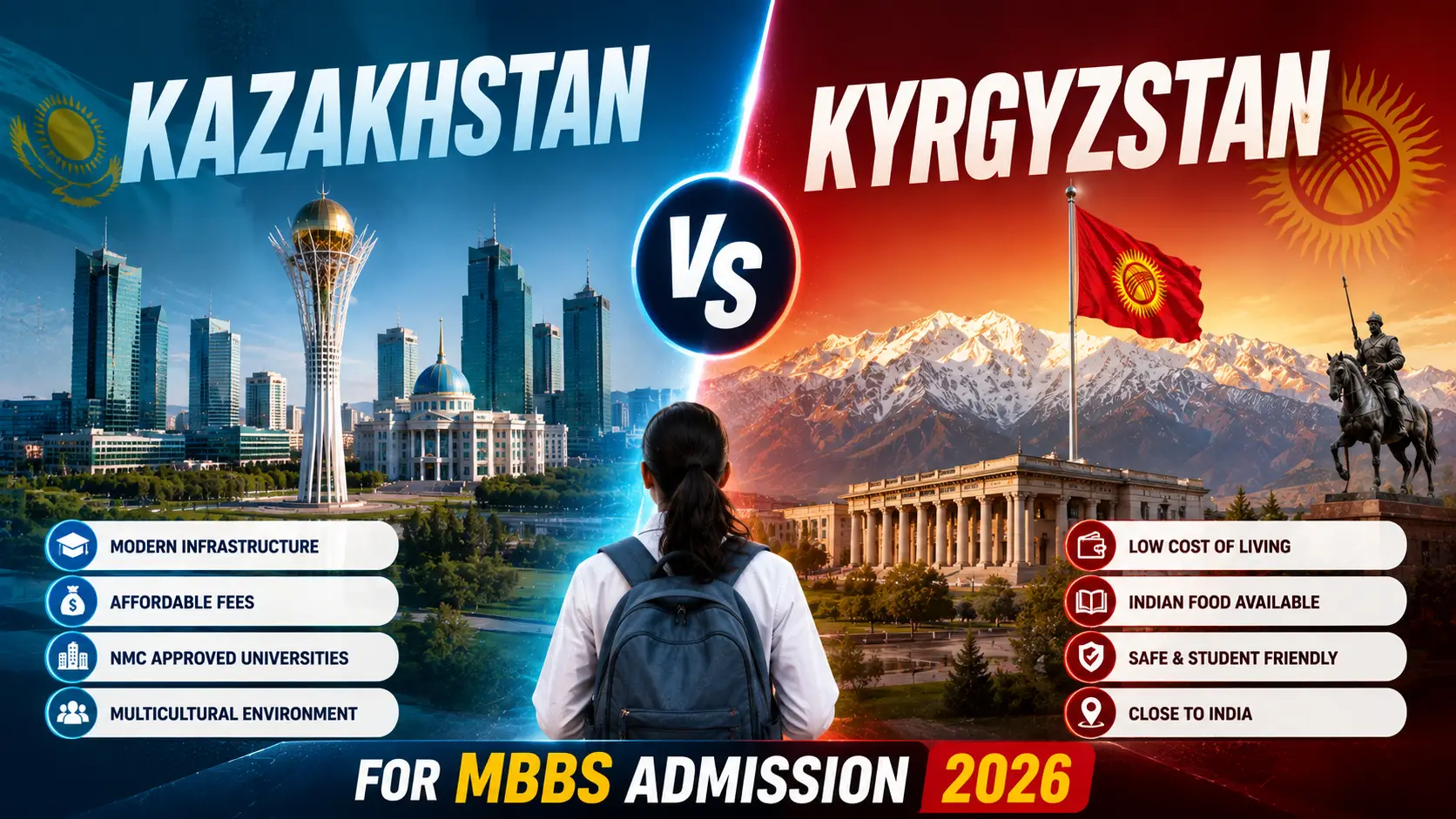

Kazakhstan vs Kyrgyzstan for MBBS Admission 2026: Fees, FMGE, Universities and NMC Rules
Kazakhstan currently has the stronger risk-adjusted profile for most Indian students because it offers a common six-year CIME framework, a defined 13-institution Embassy list and a higher FMGE pass rate. Kyrgyzstan may offer a lower tuition starting point, but its five-year programmes and 2026 accreditation changes require stricter university-level checks.
Kazakhstan recorded 1,072 passes among 3,655 candidates, giving it a 29.33% pass rate in FMGE December 2025. Kyrgyzstan recorded 1,503 passes among 7,437 candidates, giving it a 20.21% pass rate. Kazakhstan led by 9.12 percentage points, while Kyrgyzstan produced more total passes because its candidate group was much larger.
The countries have overlapping cost ranges. A realistic six-year planning budget is about ₹45–80 lakh in Kazakhstan and ₹40–85 lakh in Kyrgyzstan. Kyrgyzstan can be cheaper at its official minimum tuition, but a higher-priced private programme, separate internship charge or forced transfer can remove that advantage.
Written and researched by: Dr. Shikha Mudgal, PhD, Co-Founder & Director (Academic & Research) | BoostMyTalent
Table of Content
- Kazakhstan vs Kyrgyzstan for MBBS: Quick Comparison
- Kazakhstan or Kyrgyzstan: Which Is Better for MBBS?
- Accreditation and Regulatory Evidence
- Who Should Choose Kazakhstan or Kyrgyzstan?
- Kazakhstan vs Kyrgyzstan MBBS Fees
- Complete Cost of MBBS in Kazakhstan vs Kyrgyzstan
- Course Duration and Degree
- NMC Rules for Kazakhstan and Kyrgyzstan
- Internship and Clinical Training
- Host-Country Licensing and Residency
- English-Medium Teaching and Local Language
- FMGE Results: Kazakhstan vs Kyrgyzstan
- Medical Universities and Current Fee Evidence
- Eligibility for MBBS in Kazakhstan and Kyrgyzstan
- Admission Process
- Visa, Hostel, Climate and Student Life
- Advantages and Risks Comparison
- BoostMyTalent Weighted Decision Scorecard
- Seven-Document Admission Test
- Automatic Rejection Conditions
- Final Checklist Before Paying Fees
- Final Verdict: Kazakhstan or Kyrgyzstan for MBBS?
- Frequently Asked Questions
- Official Government and Regulatory Sources
Kazakhstan offers the clearer country-level course structure and higher recent FMGE performance. Kyrgyzstan offers the lower official tuition floor and a larger Indian graduate ecosystem. Kyrgyzstan’s 2026 accreditation reset, however, makes the exact institution, programme and accreditation validity especially important.
Kazakhstan’s current Embassy page lists 13 institutions reported by Kazakhstan authorities as possessing licences in the Bachelor, Master and Residency fields of CIME as of 11 December 2025.
Kyrgyzstan’s 8 June 2026 Embassy advisory separates institutions into accreditation valid for six years, accreditation valid for one year, institutions outside the new process and institutions that did not pass.
Compare My MBBS Options
Share your NEET score, PCB percentage, preferred universities and complete family budget.
Get a profile-based comparison of course structure, accreditation, complete costs, FMGE evidence, internship and licensing risks.
Call or WhatsApp: 9090171704
Kazakhstan is the better overall option for most Indian students in 2026. Kyrgyzstan can be the better value choice only when the programme has valid current state accreditation, qualifying international programme accreditation, a separate 12-month internship and a complete fee structure.
Kazakhstan Has an Advantage In:
- Common six-year CIME structure
- Higher country-level FMGE percentage
- Defined 13-institution Embassy list
- Fewer identified country-level disruptions in the sources reviewed
- Lower risk of choosing a five-year programme without separate internship
- More consistent country-level programme terminology
Kyrgyzstan Has an Advantage In:
- Lower official tuition starting point
- Larger recent Indian graduate ecosystem
- Government-backed foreign-student admission platform
- Programme-language and fee information through the admission system
- Several institutions with large FMGE candidate samples
- Established Indian student communities
Direct Decision
Choose Kazakhstan when programme continuity, six-year structure and recent FMGE performance matter more than finding the lowest fee.
Choose Kyrgyzstan when affordability is the main priority and the exact programme passes every current accreditation, internship and licensing check.
Choose neither when the institution cannot prove the internship, hospitals, teaching language or host-country registration pathway.
For detailed country guidance, read:
Kazakhstan currently has fewer identified country-level disruptions in the official evidence reviewed. Kyrgyzstan’s accreditation reform may improve quality, but it creates immediate continuity concerns for institutions with one-year validity, failed accreditation or unclear legal exemption.
Kazakhstan CIME Evidence
Kazakhstan’s Embassy page describes CIME as a six-year integrated structure combining:
- Bachelor-level education
- Master-level education
- Internship
- Master of Medicine qualification
The Embassy list contains 13 institutions reported as possessing CIME licences. The same page also refers to mandatory residency in Medicine, Paediatrics and Dentistry, which requires programme-level clarification.
Being on the CIME list does not prove:
- NMC approval
- Exact English-medium delivery
- Separate 12-month internship
- Adequate hospital exposure
- Local licensing eligibility for every foreign graduate
- Future FMGE success
Kyrgyzstan State Accreditation
Kyrgyzstan required medical institutions covered by the new process to undergo state accreditation by 1 June 2026. Institutions that failed could lose the right to operate and issue diplomas.
Important distinction: “Accredited for six years” refers to the validity period of accreditation. It does not mean that every medical programme lasts six academic years.
Accreditation Valid for Six Years
The Embassy decision clearly separates accreditation tenure from course duration. For example, IHSM appears under accreditation valid for six years, but its General Medicine programme is shown as five years.
Accreditation Valid for One Year
One-year accreditation is not the same as rejection. However, it can expire years before a medical student graduates. The family must check the exact validity date, renewal status, refund protection and transfer consequences.
Institutions That Did Not Pass
The June 2026 advisory names 13 institutions that did not pass state accreditation, including:
- Avicenna International Medical University
- ADAM University
- Royal Metropolitan University
- Altamimi International University
- Ala-Too International University
- International Medical University
- Kyrgyz Medical and Dental Institute
- Salymbekov University
- Eurasian International University
- Bishkek International Medical Institute
- International University of Medicine and Science
- Central Asian International Medical University
- Osh International Medical University
A new applicant should not pay one of these institutions unless a newer official decision confirms valid re-accreditation and permission to enrol students.
International Programme Accreditation Is a Separate Test
Kyrgyzstan’s state accreditation and international programme accreditation are different.
Kyrgyz authorities state that admission plans for foreign students are approved only for medical programmes holding international programme accreditation for at least three years through qualifying agencies under the applicable WFME framework.
For each Kyrgyz programme, collect:
- Accrediting agency
- Agency’s current WFME-recognition position
- Exact programme name
- Campus
- Certificate number
- Effective date
- Expiry date
- Programme language
- Whether the foreign-student programme is covered
Official “MANAS” Naming Clarification
The Embassy advisory uses the wording:
“Kyrgyz Technical University (KTU) ‘MANAS’”
The exact legal institution identity should be confirmed through an official Kyrgyz record before this line is used to support a university shortlist. The wording should not be silently converted into the name of another institution.
Kazakhstan may suit students who value a common six-year structure and stronger recent FMGE performance. Kyrgyzstan may suit students seeking the lowest verified tuition, but only when the selected programme has adequate accreditation validity, international programme accreditation and a separate internship.
Choose Kazakhstan When You:
- Have qualified NEET
- Can plan at least ₹45 lakh
- Prefer a common six-year CIME framework
- Want a country with a higher December 2025 FMGE rate
- Can learn Kazakh or Russian
- Can manage severe winters
- Will verify the internship and residency wording
- Want fewer immediate accreditation complications
- Can obtain a current programme fee letter
- Will begin FMGE preparation early
Choose Kyrgyzstan When You:
- Have qualified NEET
- Need a lower tuition starting point
- Can still arrange a complete ₹40–85 lakh budget
- Have selected a programme with valid state accreditation
- Can verify international programme accreditation
- Have a separate 12-month internship document
- Can learn Kyrgyz or Russian
- Prefer a larger Indian student ecosystem
- Accept regular accreditation rechecks
- Can protect against transfer and refund risk
Avoid Kazakhstan When You:
- Cannot manage at least ₹45 lakh
- Do not want to learn a local language
- Cannot clarify internship and residency
- Need to fund the programme through student work
- Expect an Embassy-list entry to prove NMC compliance
Avoid Kyrgyzstan When You:
- Are considering an institution that failed accreditation
- Are joining a five-year course without separate internship
- Cannot verify international programme accreditation
- Have only an old WDOMS listing
- Are being promised a future transfer
- Cannot manage unexpected regulatory costs
- Have received only a verbal package fee
Kyrgyzstan has the lower official tuition floor. Its April 2026 Embassy advisory states a minimum annual tuition of USD 3,000 and a USD 3,500 minimum for Kyrgyz State Medical Academy. Kazakhstan has no single national fee, so students need a current institution- and programme-specific fee letter.
Current Fee Evidence
Kyrgyzstan’s official briefing says the admission platform separates document-processing payment from education payment and displays programmes, fees and teaching language.
Current Kazakhstan Example
Astana Medical University’s official 2026–27 price list shows 3,000,000 KZT for first-year Medicine taught in English for foreign citizens. This is one current institution example, not a national fee.
Karaganda Medical University currently lists 1,550,000 KZT per year for its six-year CIME Medicine programme. The applicability of that figure to a new international English-medium applicant must be confirmed directly in the foreign-student fee letter.
Annual Planning Conversion
Using a planning value of approximately ₹0.203 per KZT:
Using approximately ₹96.19 per USD:
These are planning conversions. The actual bank rate, transfer fee and university exchange policy may change.
University-Wise Fee Evidence Status
Osh State University’s official site shows that a foreign-student fee schedule exists for 2026–27, while Asian International University reports that its 2026–27 tuition was approved. Neither indexed page reviewed here displayed a reliable programme amount suitable for publication.
What the Fee Letter Must Show
- Legal institution name
- Exact programme
- Campus
- Five-year or six-year duration
- Academic cycle
- Tuition currency
- Year-wise tuition
- Hostel and food
- Clinical charges
- Internship charges
- Insurance
- Examination fees
- Annual increase rule
- Refund deductions
Fee Evidence Labels
Use these labels in university tables:
- Official published tuition
- Current university-issued fee letter
- Partner-channel quotation; university confirmation required
- BoostMyTalent planning estimate
A consultant package must not be presented as university tuition.
A safe six-year planning budget is approximately ₹45–80 lakh for Kazakhstan and ₹40–85 lakh for Kyrgyzstan. Kyrgyzstan has a cheaper minimum, but the complete ranges overlap because private tuition, living expenses, internship charges and accreditation-related transfers can increase the total.
Six-Year Cost Comparison
These are BoostMyTalent editorial planning estimates, not university quotations.
Why Kyrgyzstan Can Cost Less
- Tuition remains near USD 3,000
- Shared university hostel is available
- Food expenses stay controlled
- The course finishes on time
- No transfer is required
- Internship does not carry a separate major charge
- The rupee remains stable
Why Kyrgyzstan Can Become Expensive
- Private tuition is much higher than the official floor
- First-year charges are higher
- Hostel and food are separate
- Accreditation problems force a transfer
- Internship is billed separately
- A contractor charges a bundled package
- FMGE coaching and travel costs rise
Why Kazakhstan’s Current Planning Range Is Narrower
The editorial Kazakhstan range is narrower than the stress-tested Kyrgyzstan range. This does not prove that Kazakhstan’s fees are inherently more predictable.
Predictability can be assessed only after comparing:
- Current fee letters
- Annual increase clauses
- Hostel charges
- Internship costs
- Refund rules
- Payment currency
- Transfer risk
Education-Loan Illustration
These figures are illustrations, not lender quotations.
Kazakhstan mainly uses a six-year CIME structure leading to a Master of Medicine qualification. Kyrgyzstan offers both five-year and six-year General Medicine programmes. Kazakhstan therefore has clearer country-level duration terminology, but neither country should be accepted without separate 54+12 evidence.
Kazakhstan
The Embassy describes CIME as:
- Six years
- Bachelor stage
- Master stage
- Internship
- Master of Medicine degree
The list also shows Bachelor, Master and Residency licence fields for the 13 institutions.
Kyrgyzstan
The June 2026 decision includes:
- Five-year General Medicine
- Six-year General Medicine
- Institutions offering both formats
- Different accreditation-validity periods
The accreditation period and course duration must be checked separately.
Five-Year Programme Risk
A five-year programme may contain 60 calendar months, but this does not prove:
- 54 months of academic medical study
- A separate 12-month internship
- Same-institution training
- Same-country training
- A separate internship certificate
IHSM’s General Medicine programme is shown as five years even though its accreditation is valid for six years.
Six-Year Programme Risk
A six-year label also does not prove compliance.
The university must identify:
- Academic study months
- Internship months
- Internship hospitals
- Department schedule
- Assessment method
- Final degree
- Internship certificate
- Local registration eligibility
The same NMC Foreign Medical Graduate Licentiate Regulations apply to both countries. NMC does not publish a universal list of approved universities in Kazakhstan or Kyrgyzstan. Every programme must independently satisfy the course, internship, language, clinical and licensing conditions.
The main conditions include:
- At least 54 months of medical education
- At least 12 months of internship
- English as the medium of instruction
- Required medical subjects
- Hands-on clinical training
- Course and internship at the same institution
- Training in the same foreign country
- Eligibility to enter the host-country registration system
- Completion within the permitted period
- Passing the applicable Indian examination
- Completing the applicable supervised internship in India
NMC currently lists the FMGL Regulations, 2021 and updated FAQs dated 8 June 2026.
Is the Kazakhstan CIME List NMC Approval?
No.
The list supports programme screening under Kazakhstan’s system. It does not prove full compliance with Indian regulations.
Is Kyrgyz State Accreditation NMC Approval?
No.
State accreditation confirms a domestic regulatory position. It does not independently prove:
- 54+12 structure
- English teaching
- Same-institution internship
- Local licensing
- Indian registration eligibility
Is WDOMS Enough?
No.
A directory listing does not prove:
- Current accreditation
- Internship compliance
- Clinical quality
- English delivery
- Local registration
- FMGE eligibility
- Indian registration
NMC expressly states that it does not endorse a list of foreign medical institutions and asks students to obtain fee, course, duration and internship details directly.
Kazakhstan has the stronger national starting point because CIME expressly includes internship. Kyrgyzstan requires closer institution-level review because several accredited programmes are five years. Students in both countries still need a separately documented 12-month internship.
Kazakhstan Internship Questions
Collect:
- Internship start and end dates
- Total months
- Department allocation
- Hospital names
- Attendance requirements
- Supervision
- Clinical logbook
- Assessment
- Completion certificate
- Same-institution confirmation
- Same-country confirmation
The word “internship” in CIME does not prove that every university structures it identically.
Kyrgyzstan Internship Questions
The internship check is especially important for:
- IHSM’s five-year General Medicine programme
- Osh State University’s five-year foreign programme
- Five-year programmes at institutions with one-year accreditation
- Any programme where internship is said to be “included” inside five years
Clinical Rotations Are Not Internship
Hospital Evidence Required
Ask for:
- Teaching-hospital names
- Ownership or affiliation
- Bed strength
- Outpatient volume
- Approved intake
- Actual international intake
- Clinical group size
- Students sharing one patient
- Start year of rotations
- Hands-on procedures
- Patient-language training
- Practical assessment
A large Indian student community can provide support, but large batches can also increase competition for clinical cases.
Both countries have regulated professional-entry systems. Kazakhstan requires professional assessment and specialist certification for clinical practice. Kyrgyzstan requires a diploma, specialist certificate, attestation and registration. The exact pathway available to a newly graduated foreign student must be confirmed in writing.
Kazakhstan
Kazakhstan’s rules cover specialist certification, including foreign specialists, and require professional-readiness assessment for access to clinical practice.
The unresolved issue is the Embassy page’s reference to mandatory residency.
Ask:
- Is residency inside or after the six-year CIME programme?
- Is it required for general medical practice?
- Is it required only for specialisation?
- Can an international graduate enter residency?
- Which examination follows the degree?
- What certificate permits practice?
- Is Kazakh or Russian compulsory?
Kyrgyzstan
Kyrgyzstan states that medical professionals need a diploma and specialist certificate and must complete attestation and registration before practical work. Foreign-educated applicants may also require recognition of qualifications.
Ask:
- What status follows General Medicine?
- Is internship sufficient for registration?
- Is residency compulsory?
- Can foreign citizens enter the same route?
- Is a local examination required?
- Which language is used?
- What certificate proves the right to practise?
Which Country Has the Clearer Path?
Kazakhstan has a more visible public certification framework.
However, the residency wording and the rights of a newly graduated international student remain unresolved. Neither country receives automatic clearance.
Both countries offer English-medium programmes, but neither provides an English-only hospital environment. Kyrgyzstan has an admission-language information advantage because its government-backed platform is designed to display programme language. This does not prove better classroom or clinical English delivery.
Kazakhstan Checks
Confirm:
- Are all academic years taught in English?
- Are examinations in English?
- Do teachers switch to Russian?
- Are clinical discussions in English?
- What language is used in internship?
- What language is used for certification?
- How much medical Russian or Kazakh is taught?
Kazakhstan introduced an English-proficiency certificate requirement for foreign medical applicants. The exact accepted test and score must come from the selected programme.
Kyrgyzstan Checks
Confirm:
- Lecture language
- Examination language
- English-speaking faculty
- Clinical-teaching language
- Russian or Kyrgyz curriculum
- Internship language
- Licensing language
The Kyrgyz admission platform is designed to display fees and language of instruction and is available in English and Russian.
Countrywide Result
Admission-language information advantage: Kyrgyzstan
Actual English teaching quality: University-specific; no countrywide winner
Actual English teaching quality: University-specific; no countrywide winner
Why Russian Matters in Both Countries
Without Russian, Kazakh or Kyrgyz, students may struggle to:
- Take patient history
- Understand symptoms
- Speak with nurses
- Read clinical records
- Join bedside discussions
- Explain procedures
- Build clinical confidence
Kazakhstan had the stronger FMGE pass percentage in December 2025. Kyrgyzstan had more candidates and more total passes. Kazakhstan performed better proportionally, while Kyrgyzstan had the larger Indian graduate ecosystem.
Country-Level Results
Kazakhstan led by 9.12 percentage points. Kyrgyzstan recorded 431 more successful candidates because its candidate group was more than twice as large.
Selected Kazakhstan Results
NBEMS contains current and historical institution-name variations. Similar-looking rows should not be combined without official mapping.
Selected Kyrgyzstan Results
The IHSM, Osh and Jalal-Abad rows were among the largest institution-level candidate groups in the report.
How to Use FMGE Data
Check:
- Sample size
- Exact institution name
- Current accreditation
- Programme duration
- Graduation year
- Internship
- Clinical exposure
- Language ability
- Student preparation
Historical FMGE participation cannot override a current failed accreditation result.
Kazakhstan offers a defined CIME screening list. Kyrgyzstan requires students to combine state-accreditation tenure, programme duration and international programme accreditation. University fees should be published only when the exact programme, academic cycle and source type are clear.
Selected Kazakhstan Evidence
The CIME list supports institutional screening but does not prove the fee, internship or English position for a particular applicant.
Selected Kyrgyzstan Evidence
Separate Kyrgyz Accreditation Tests
For every named programme, verify both:
- State accreditation
- International programme accreditation
Get My University Comparison
Upload the offer letter and fee letter you have received.
BoostMyTalent will compare:
- Accreditation
- Programme duration
- Internship
- Complete costs
- Hospitals
- FMGE evidence
- Licensing questions
- Refund risk
Call or WhatsApp: 9090171704
Indian applicants generally need Class 12 with Physics, Chemistry, Biology or Biotechnology and English. Indian citizens and OCI candidates must qualify NEET. The selected institution may also conduct an interview, science assessment, English test or document review.
Can Students Apply with a Low NEET Score?
Yes, when the official scorecard confirms that the student qualified.
The final choice should then depend on:
- Academic readiness
- Complete budget
- Programme evidence
- Local-language ability
- FMGE preparation discipline
- Ability to live abroad
Can Students Apply Without NEET?
A foreign institution may have its own local admission rules.
That does not remove the applicable Indian eligibility requirement for students who plan to seek registration in India.
The safe admission process begins with eligibility, accreditation and programme verification—not seat booking. Students should receive the curriculum, internship, hospital, fee and refund records before making a major payment.
Kazakhstan-Specific Checks
- Current CIME-list position
- Exact six-year programme
- English-medium evidence
- Internship schedule
- Residency position
- Teaching hospitals
- Foreign-student tuition
- Hostel availability
- C9 visa support
- Certification pathway
Kyrgyzstan-Specific Checks
- June 2026 state-accreditation category
- Accreditation validity period
- Programme duration
- International programme accreditation
- WFME-agency evidence
- Separate internship
- Official admission-platform record
- Tuition and processing payments
- Refund protection
- Student visa
Kyrgyzstan’s government-backed admission framework is intended to coordinate applications, documents, visa support, payments and enrolment.
Kazakhstan uses the C9 education visa. Kyrgyzstan uses the Student visa, type S. Both countries require lawful stay registration and reliable accommodation. Kazakhstan is generally colder, while Kyrgyzstan has the larger recent Indian graduate ecosystem.
Kazakhstan Visa
Kazakhstan’s C9 category covers entry for education. It may be issued as a single-entry visa for up to 90 days or a multiple-entry visa for up to one year, subject to the applicable process.
Kyrgyzstan Visa
Kyrgyzstan’s Student visa, type S, is issued for study and may initially be valid for up to 90 calendar days. Foreign nationals who are not exempt generally need to register their place of stay within five working days after entry.
Hostel Comparison
Climate
Kazakhstan is generally colder, especially in Astana and northern cities.
Kyrgyzstan also has cold winters, but conditions differ between Bishkek, Osh and mountain regions.
Indian Student Ecosystem
Kyrgyzstan had 7,437 FMGE candidates in December 2025 compared with Kazakhstan’s 3,655. This shows a larger recent graduate cohort, not necessarily the exact number currently enrolled.
Indian students in Kyrgyzstan are encouraged to register with the Embassy of India after arrival.
Kazakhstan offers stronger course-structure clarity and higher recent FMGE performance. Kyrgyzstan offers lower minimum tuition and a larger Indian ecosystem. Both require local-language learning, internship proof and host-country licensing clarification.
Kazakhstan Strengths
- Common six-year CIME framework
- Defined 13-institution Embassy list
- Higher FMGE pass percentage
- Current official university-fee examples
- Fewer identified country-level disruptions
- Formal professional-certification rules
Kazakhstan Risks
- CIME list is not NMC approval
- Residency wording remains unclear
- Internship must still be separately documented
- Kazakh or Russian is needed clinically
- Winters can be severe
- Local licensing requires programme-level clarification
Kyrgyzstan Strengths
- Official minimum tuition of USD 3,000
- Large Indian student ecosystem
- Government-backed admission platform
- English programme options
- Six-year accreditation validity for selected institutions
- Several large FMGE samples
Kyrgyzstan Risks
- Several institutions failed accreditation
- Some institutions have one-year validity
- Five-year programmes need separate internship
- International programme accreditation is a second test
- Large batches may reduce patient exposure
- Transfer risk can increase total cost
The scorecard gives Kazakhstan a moderate lead because programme structure, current regulatory evidence and FMGE performance receive significant weight. Kyrgyzstan leads on minimum affordability and the size of its Indian graduate ecosystem.
This is a BoostMyTalent editorial decision framework. It is not an NMC, NBEMS, Embassy or government ranking.
Scoring Rule
Weighted points are calculated as:
Factor score ÷ 5 × factor weight
Evidence Basis
Weighted Result
Interpretation
Kazakhstan: 70/100
Kyrgyzstan: 64/100
Kyrgyzstan: 64/100
The six-point difference is meaningful but not large enough to make Kazakhstan the automatic winner for every student.
Confidence level: Moderate
The final result can change significantly based on:
- Exact university
- Programme duration
- Internship
- Fee letter
- Batch size
- Hospital exposure
- Accreditation expiry
- Student language ability
Do not choose either country through verbal promises. Seven current documents should be available for the exact programme before the family makes a major payment.
This is a BoostMyTalent decision tool, not regulatory approval.
Additional Kazakhstan Documents
- Current CIME-list evidence
- Exact Medicine programme
- Internship schedule
- Residency clarification
- C9 visa support
- Foreign-student fee letter
Additional Kyrgyzstan Documents
- State-accreditation decision
- Accreditation-validity dates
- Exact five- or six-year programme
- International programme accreditation
- Accrediting agency’s WFME status
- Official admission-platform record
One major unresolved issue involving accreditation, course duration, internship, clinical exposure, licensing or payment is enough to stop the admission.
Reject or pause the offer when:
- NEET is not qualified
- Legal university name is unclear
- Exact campus is missing
- Programme accreditation cannot be shown
- A Kyrgyz institution failed the June 2026 process
- One-year accreditation has expired
- International programme accreditation is missing
- The accrediting agency’s status is unclear
- A five-year course has no separate internship
- A six-year course does not separate study and internship
- Internship will occur in another country
- Part of the programme is online
- A compulsory transfer is planned
- Teaching hospitals cannot be named
- Approved intake is hidden
- Teaching language is unclear
- Local-language training is absent
- Host-country registration is unexplained
- Kazakhstan’s residency position is hidden
- Kyrgyz specialist certification is hidden
- The university is described as NMC approved
- FMGE success is guaranteed
- Indian registration is guaranteed
- Payment is requested in a personal account
- Fee documents do not match
- Refund rules are absent
- Scholarship support is only verbal
- Original documents are withheld
Do not pay a large admission or tuition amount until every question below has a documented answer. Country popularity, FMGE percentage, WDOMS listing or an agent’s assurance cannot replace current evidence.
Kazakhstan currently has the stronger risk-adjusted country profile because the reviewed official evidence shows a defined CIME institution list, a common six-year framework and a higher December 2025 FMGE percentage. However, internship, residency, English delivery and international-graduate licensing still require programme-level clarification.
Kyrgyzstan remains a valid lower-cost option when the exact programme has:
- Valid state accreditation
- Adequate accreditation tenure
- Current international programme accreditation
- A qualifying accreditation agency
- Separate 12-month internship
- Clear teaching hospitals
- Transparent complete fees
- Written local-registration pathway
Choose Kazakhstan When:
- You can plan ₹45–80 lakh
- A common six-year structure matters
- You prefer the stronger FMGE percentage
- You want fewer identified country-level disruptions
- Internship and residency are clarified
- The current fee letter is affordable
Choose Kyrgyzstan When:
- You need the lowest verified tuition
- The programme has a strong accreditation position
- International accreditation is current
- The separate internship is documented
- The family accepts regular rechecks
- A large Indian community matters
Final Profile Ranking
Final Answer in One Line
Choose Kazakhstan for stronger course-structure clarity and FMGE performance. Choose Kyrgyzstan only for a lower-cost programme with valid state and international accreditation, a separate internship and clear fee protection.
Start My Kazakhstan vs Kyrgyzstan Shortlist
Share your:
- NEET score
- PCB percentage
- Complete family budget
- Preferred universities
- Offer letters
- Fee letters
BoostMyTalent will identify missing evidence and help build a safer shortlist.
Call or WhatsApp: 9090171704
Kazakhstan or Kyrgyzstan: which is better for MBBS?
Kazakhstan currently has the stronger overall profile because of its common CIME structure, higher FMGE rate and fewer identified country-level disruptions.
Kyrgyzstan may suit a carefully verified lower-budget profile.
Which country is cheaper?
Kyrgyzstan has the lower official tuition floor.
The complete cost ranges overlap because private tuition, internship charges and regulatory transfers can raise the total.
What is the complete cost in Kazakhstan?
A safe six-year planning range is approximately ₹45–80 lakh.
The actual amount depends on tuition, city, hostel, exchange rate and additional charges.
What is the complete cost in Kyrgyzstan?
A safe planning range is approximately ₹40–85 lakh.
A low-fee programme may cost less, while a private programme or transfer can cost more.
What are Kazakhstan medical-course fees?
There is no single national fee.
Astana Medical University currently lists 3,000,000 KZT for first-year English Medicine for foreign students in 2026–27.
What are Kyrgyzstan medical-course fees?
The April 2026 Embassy advisory stated a minimum annual tuition of USD 3,000 and USD 3,500 for KSMA.
The final fee must come from the exact programme letter.
Which country has a better FMGE pass rate?
Kazakhstan recorded 29.33% in December 2025.
Kyrgyzstan recorded 20.21%.
Which country produced more FMGE passes?
Kyrgyzstan produced 1,503 passes.
Kazakhstan produced 1,072, but Kyrgyzstan had a much larger candidate group.
What is CIME in Kazakhstan?
CIME means Continuous Integrated Medical Education.
The Embassy describes it as a six-year Bachelor, Master and internship structure leading to a Master of Medicine degree.
Is the Kazakhstan CIME list equal to NMC approval?
No.
It cannot replace NMC course, internship, English, clinical and licensing checks.
What changed in Kyrgyzstan in 2026?
Kyrgyzstan introduced a new state-accreditation process for medical institutions.
The Embassy published the results on 8 June 2026.
Does “accredited for six years” mean a six-year course?
No.
It refers to the accreditation-validity period. The course itself may be five or six years.
Which Kyrgyz institutions have accreditation valid for six years?
Osh State University, IHSM, Asian International University and International University of Kyrgyzstan appear in this category for the programmes listed in the advisory.
Which institutions have accreditation valid for one year?
The list includes Kyrgyz National University, Jalal-Abad State University, Kyrgyz-Uzbek International University, Issyk-Kul State University, Jalal-Abad International University, University of South Asia and International European University.
What does one-year accreditation mean?
It is not the same as rejection.
However, the term can expire long before graduation, so renewal and refund protection are essential.
Which Kyrgyz institutions failed accreditation?
The list includes Avicenna, International Medical University, Salymbekov University, Bishkek International Medical Institute, CAIMU and Osh International Medical University, among others.
Is international programme accreditation also required in Kyrgyzstan?
Yes.
State accreditation and international programme accreditation are separate checks for foreign-student admission.
Is NEET compulsory in both countries?
Yes, for Indian citizens and OCI candidates covered by current Indian rules.
A foreign admission letter cannot replace NEET qualification.
Can students apply with a low NEET score?
Yes, when the official scorecard shows that the student qualified.
Programme quality, budget and academic readiness should then guide the decision.
Is the course six years in Kazakhstan?
Kazakhstan’s current CIME structure is described as six years.
The university must still separate academic study and internship in writing.
Is the course five or six years in Kyrgyzstan?
Both formats exist.
The exact programme must match the accreditation decision and admission letter.
Is a five-year Kyrgyz programme suitable for Indian students?
Only when it provides at least 54 months of medical education and a separate 12-month internship at the same institution in Kyrgyzstan.
Do not assume this automatically.
Which country has clearer internship evidence?
Kazakhstan has the stronger country-level starting point because CIME expressly includes internship.
A separate university document is still required.
Do students need Russian in Kazakhstan?
Russian or Kazakh is important for patient communication and clinical training.
An English academic programme does not create an English-only hospital environment.
Do students need Russian in Kyrgyzstan?
Russian or Kyrgyz is important for clinical work.
Weak language ability may reduce meaningful patient exposure.
Which country is better for English-medium study?
Kyrgyzstan provides stronger admission-language visibility through its portal.
Actual classroom, examination and hospital English remain university-specific in both countries.
Which country offers better clinical exposure?
The university, hospitals, batch size and language ability matter more than the country.
Neither country wins automatically.
Can graduates practise medicine in Kazakhstan?
Professional assessment and specialist certification apply.
The exact pathway for an international graduate must be confirmed.
Can graduates practise medicine in Kyrgyzstan?
Attestation, registration and a specialist certificate apply.
Further training may also be relevant.
Is residency compulsory in Kazakhstan?
The Embassy’s CIME page mentions mandatory residency, but its position after the six-year degree requires written clarification.
Is residency compulsory in Kyrgyzstan?
The specialist-certificate pathway may involve postgraduate professional training.
The rule for the exact degree and foreign-graduate category must be confirmed.
Which country has more Indian students?
Kyrgyzstan has the larger recent graduate ecosystem based on FMGE candidate numbers.
Current enrolment differs by institution.
Which country is colder?
Kazakhstan is generally colder, particularly in Astana and northern regions.
Kyrgyzstan also has cold winters.
Can a student transfer between the two countries?
A transfer can create serious problems with course continuity, internship and NMC rules.
Do not plan one without written regulatory clarification.
What is the safest university-selection method?
Verify accreditation, course duration, internship, hospitals, language, licensing, fees and refund rules.
Do not select only by WDOMS, rankings, FMGE percentages or agent claims.
- Kyrgyz Government International Medical-Admission Rule
- Kyrgyz Medical-Education Licence Moratorium
- Kyrgyz Medical-Worker Registration
- Kyrgyz Specialist Certificate