Russia vs Georgia for MBBS Admission 2026: Fees, FMGE, Universities and NMC Rules for Indian Students
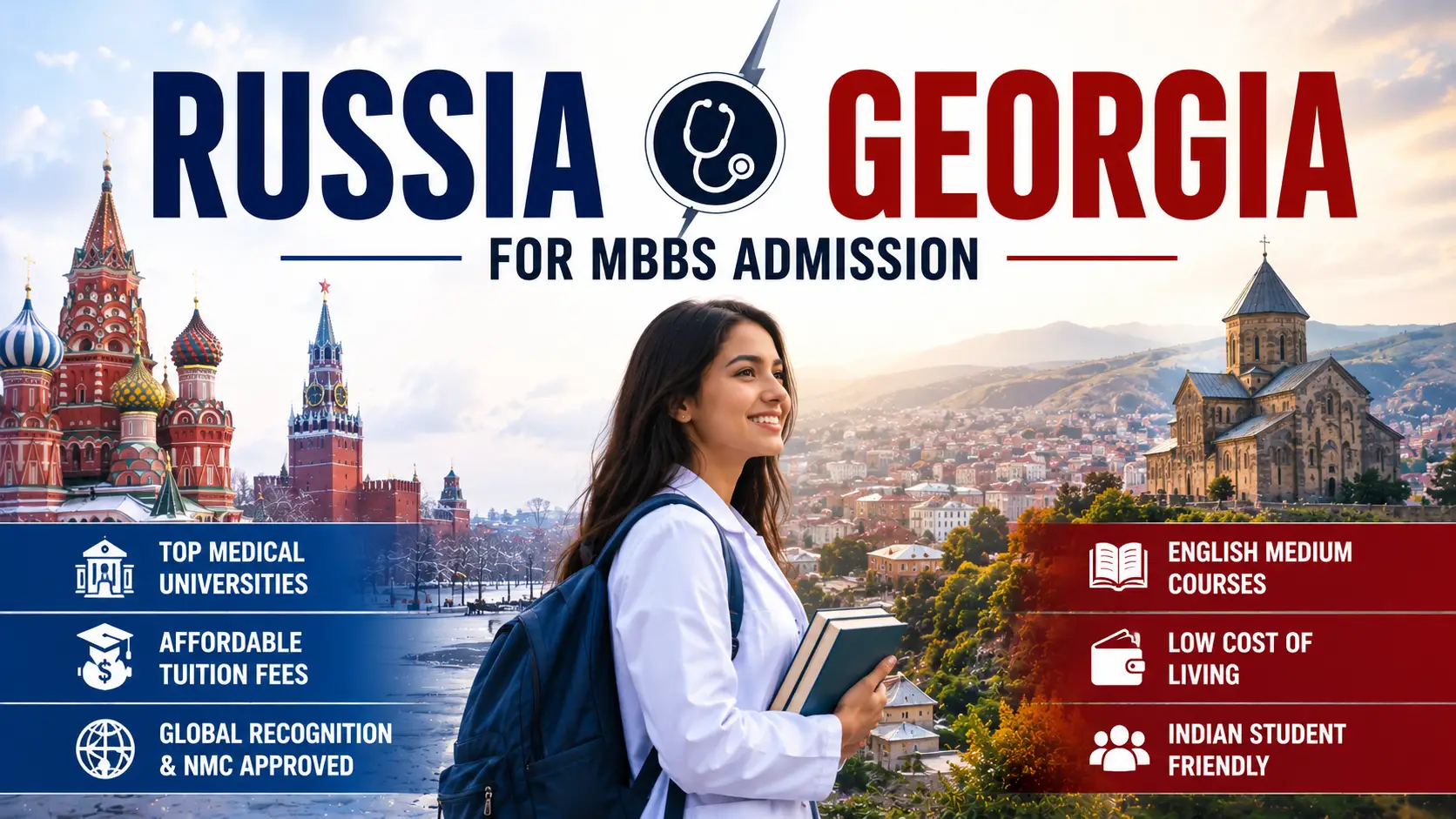
Russia is usually the better MBBS option for Indian students who want lower fees, more university choices and a smaller education-loan burden. Georgia may suit students with a higher budget who prefer clearer English-medium MD programmes, published tuition figures and a milder living environment.
Russia recorded a 30.94% pass rate in FMGE December 2025, with 2,128 successful candidates among 6,878 who appeared. Georgia recorded 32.36%, with 938 passes among 2,899 candidates. Georgia’s pass-rate lead was only 1.42 percentage points, while Russia produced 1,190 more successful candidates.
The correct decision cannot be made using country averages alone. Students must compare the exact medical programme, six-year budget, teaching language, internship, hospitals and eligibility to enter the host country’s medical-registration system.
Written and researched by: Dr. Shikha Mudgal, PhD, Co-Founder & Director | BoostMyTalent
Research role: Review of NMC rules, NBEMS FMGE data, official Russian education records, Georgian government programme information, accreditation evidence, fees and medical-practice laws
Verification method: Tuition, programme language, course duration, internship, FMGE evidence and licensing were assessed separately
Research role: Review of NMC rules, NBEMS FMGE data, official Russian education records, Georgian government programme information, accreditation evidence, fees and medical-practice laws
Verification method: Tuition, programme language, course duration, internship, FMGE evidence and licensing were assessed separately
Table of Content
- Russia vs Georgia for MBBS: Quick Comparison
- Russia or Georgia: Which Is Better for MBBS?
- Who Should Choose MBBS in Russia?
- Who Should Choose MBBS in Georgia?
- Russia vs Georgia MBBS Fees
- Complete Cost of MBBS in Russia vs Georgia
- Course Duration and Degree in Russia vs Georgia
- NMC Rules for MBBS in Russia and Georgia
- Internship in Russia vs Georgia
- Host-Country Medical Licensing in Russia vs Georgia
- English-Medium Teaching in Russia vs Georgia
- Clinical Training and Patient Exposure
- FMGE Results: Russia vs Georgia
- Medical Universities and Official Fee Evidence
- Eligibility for MBBS in Russia and Georgia
- Admission Process for Russia and Georgia
- Visa, Hostel, Climate and Student Life
- Advantages and Risks of MBBS in Russia
- Advantages and Risks of MBBS in Georgia
- BoostMyTalent Russia vs Georgia Weighted Scorecard
- Russia vs Georgia Decision Matrix
- Seven-Document Country Comparison Test
- Automatic Rejection Conditions
- Final Checklist Before Paying Fees
- Final Verdict: Russia or Georgia for MBBS?
- Frequently Asked Questions
- Editorial Verification and Disclosure
- Corrections and Updates
- Official Government and Regulatory Sources
Russia has the stronger cost-to-choice advantage. Georgia offers better public visibility of English MD programmes and tuition. Russia has a larger FMGE sample and more successful candidates, while Georgia recorded a slightly higher percentage. Neither country is automatically suitable under NMC rules.
Georgia’s official international-education portal lists one-cycle English medical programmes and tuition. Russia’s official education portal lists programme-specific fees and clearly identifies some programmes as English-taught.
Compare Russia and Georgia for Your Profile
Share your NEET score, PCB marks, preferred universities and complete family budget.
BoostMyTalent will help you compare total costs, programme language, FMGE evidence, internship and licensing risks.
Call or WhatsApp: 9090171704
Russia is the better overall choice for most budget-focused Indian students. Georgia can be better for a student who can comfortably spend more and strongly prefers a clearly listed English MD programme, milder climate and easier public fee comparison.
Russia has the advantage in:
- Lower likely complete cost
- More medical-university options
- Larger Indian student community
- Larger FMGE evidence sample
- More successful FMGE candidates
- Greater chance of finding a regional low-cost university
- A comparatively clearer basic professional-accreditation route
Georgia has the advantage in:
- Publicly listed English MD programmes
- Programme-level EQE accreditation records
- Government-published tuition
- Milder climate
- Smaller geographical scale
- Slightly higher FMGE pass percentage
- Consistent six-year, 360-ECTS structure
Direct Decision Answer
Choose Russia when affordability, university choice and lower loan pressure are the main priorities.
Choose Georgia when English academic clarity and lifestyle matter more than the higher complete cost.
Choose neither when the university cannot prove the internship, teaching hospitals or host-country registration route.
Russia may suit a NEET-qualified student with a complete budget of approximately ₹40–85 lakh who can manage severe winters and learn Russian for hospital communication. It is especially suitable when the family wants more public-university and regional-city options.
Russia May Suit You If You:
- Have a complete budget below ₹70 lakh
- Want multiple university choices
- Prefer a large Indian student ecosystem
- Can learn Russian seriously
- Are comfortable with cold weather
- Want lower tuition options
- Will begin FMGE preparation early
- Can verify the exact programme language
- Understand primary accreditation
- Can use official payment channels
Russia May Not Suit You If You:
- Refuse to learn Russian
- Expect all clinical interaction in English
- Cannot manage cold conditions
- Are choosing only by first-year tuition
- Cannot confirm the programme language
- Cannot obtain internship evidence
- Cannot clarify primary accreditation
- Expect guaranteed Indian registration
- Depend on unclear agent packages
- Are being offered a forced future transfer
Russia’s programmes vary significantly. A confirmed six-year English programme is different from a course where only the entrance examination is offered in English.
Georgia may suit a NEET-qualified student who can plan ₹60 lakh–₹1.15 crore, prefers a clearly listed English MD programme and is willing to learn Georgian for patient communication. Internship and independent-practice eligibility must still be checked separately.
Georgia May Suit You If You:
- Have a complete budget of at least ₹60 lakh
- Prefer a published English academic programme
- Want a six-year, 360-ECTS MD structure
- Prefer milder weather
- Want government-listed programme fees
- Can learn Georgian for hospitals
- Will examine the EQE programme record
- Understand junior-doctor limitations
- Can verify internship documentation
- Can manage higher accommodation costs
Georgia May Not Suit You If You:
- Have a budget below ₹60 lakh
- Are choosing it only as a “European” destination
- Assume sixth-year training proves the entire NMC internship condition
- Expect independent practice immediately after the MD
- Do not want to learn Georgian
- Need a large Indian community everywhere
- Are relying on a verbal scholarship
- Cannot confirm programme accreditation
- Expect guaranteed FMGE success
- Are selecting through promotional videos alone
Georgia’s official system states that MD programmes are six years and 360 ECTS, with internship during the graduating year. The law separately limits junior doctors from independent practice in ordinary circumstances.
Russia is generally cheaper. Current official Russian programme examples range from RUB 166,000 to RUB 470,100 annually. Georgia’s government portal lists selected English MD programmes from USD 4,000 to USD 8,000 annually, with some premium options costing more.
Annual Tuition Comparison
The Russia conversions use an editorial value of approximately ₹1.23 per RUB. This is derived from the RBI USD-INR reference rate of ₹96.1856 and the Bank of Russia rate of RUB 78.0308 per USD in late July 2026. Exchange rates and remittance charges will change before payment.
Selected Russia Tuition Evidence
Mari State University’s listing says the entrance examination may be taken in English or Russian. That does not prove that the complete six-year course is delivered in English. A current university document is required.
Syktyvkar State University, Immanuel Kant Baltic Federal University and Volga Research Medical University have programme listings that expressly describe the course as implemented in English or “Medicine in English.”
Selected Georgia Tuition Evidence
Georgia’s government portal also lists other medical programmes, including a USD 13,500 American MD programme at Tbilisi State Medical University. Students must compare the exact programme rather than the university name alone.
What Tuition May Exclude
In either country, ask whether tuition excludes:
- Application fee
- Admission processing
- Invitation documents
- Visa assistance
- Insurance
- Medical tests
- Translation
- Clinical charges
- Examination fees
- Hostel
- Food
- Local-language classes
- Internship charges
- Graduation documents
- FMGE preparation
- Transfer charges
- Refund deductions
The first-year tuition should never be presented as the complete MBBS cost.
A safe six-year planning range is approximately ₹40–85 lakh for Russia and ₹60 lakh–₹1.15 crore for Georgia. These ranges include tuition, living costs, travel, documents, insurance, examination preparation and an emergency reserve.
Correct Six-Year Cost Calculation
These are BoostMyTalent editorial estimates, not university quotations.
Why Russia Is Usually Cheaper
Russia commonly offers:
- Lower regional tuition
- University dormitories
- Lower-cost cities outside Moscow and St Petersburg
- More programme-price choices
- Greater scope to shortlist by budget
The official Study in Russia portal shows that dormitory prices vary widely by institution and room type. It also advises international students to keep extra funds for insurance, books and initial settlement.
Why Georgia Can Cost More
Georgia’s total can rise because of:
- Higher annual tuition
- Private accommodation
- Tbilisi rental costs
- Separate utility and food expenses
- USD-linked payments
- Limited university-hostel availability
- Frequent travel and insurance costs
Matched Mid-Range Comparison
In a matched mid-range example:
In this example, Georgia costs approximately ₹23 lakh more.
Editorial conclusion: In matched mid-range planning scenarios, Georgia may cost around ₹20–35 lakh more than a regional Russian programme. This is not a universal country-level difference. A premium Russian programme can cost as much as or more than a lower-fee Georgian option.
Education-Loan Illustration
These figures are simple illustrations. Actual loan rates, moratoriums and repayment terms differ.
Both countries commonly offer six-year medical education. Russia generally awards a specialist qualification in General Medicine. Georgia awards a one-cycle Medical Doctor qualification carrying 360 ECTS. The title of the degree does not independently prove NMC compliance.
Russia
Official Russian listings show six-year specialist medical programmes. Immanuel Kant Baltic Federal University expressly lists its English Medicine programme as six years.
The final qualification may use terms such as:
- General Medicine
- Medical Practice
- Physician
- Specialist degree
- Doctor or medical practitioner
Georgia
Georgia’s official medical-education information describes the undergraduate MD as a six-year, 360-ECTS one-cycle programme with internship during the sixth graduating year.
Degree Comparison
Students should collect:
- Full year-wise curriculum
- Programme duration
- Teaching language
- Required medical subjects
- Internship schedule
- Sample degree
- Sample internship certificate
- Local registration explanation
The same NMC Foreign Medical Graduate Licentiate Regulations apply to Russia and Georgia. NMC does not publish a universal approved-university list for either country. Every programme must independently satisfy the course, internship, language, subject, clinical and licensing conditions.
Important requirements include:
- At least 54 months of medical education
- At least 12 months of internship
- English as the medium of instruction
- Required medical subjects
- Hands-on clinical training
- Course and internship at the same institution
- Training completed in the same foreign country
- Eligibility for the host-country registration system
- Completion within the prescribed period
- Passing the applicable Indian examination
- Completing the required supervised internship in India
NMC’s official rules page lists the Foreign Medical Graduate Licentiate Regulations, 2021 and FAQs dated 8 June 2026.
Are Russian or Georgian Universities NMC Approved?
No foreign institution should be described as “NMC approved.”
Government ownership, WDOMS listing, six-year duration or historical FMGE results do not establish complete NMC suitability.
Is WDOMS Listing Enough?
No.
A WDOMS entry does not prove:
- Current programme accreditation
- Correct internship
- English teaching
- Clinical quality
- Host-country licensing
- FMGE eligibility
- Indian registration
Which Country Is Easier to Verify?
Georgia provides stronger public programme-level visibility through EQE and its government fee portal.
Russia offers much wider selection, but language, programme structure and fee evidence can differ significantly between universities.
Georgia’s EQE records show programme language, ECTS, accreditation decision and validity for individual MD programmes.
Neither country should be selected without a clear internship document. Georgia provides a more explicit national description of sixth-year internship and clinical training. Russian programmes include extensive clinical preparation, but the exact separately identifiable 12-month structure must be verified university by university.
Russia Internship Position
Russian programme listings may refer to practical training or internships during the six-year course.
This is useful, but Indian students still need written proof showing:
- A separately identifiable 12-month period
- Start and end dates
- Department schedule
- Hospital names
- Supervision
- Attendance
- Clinical logbook
- Assessment
- Completion certificate
- Same-institution control
- Training in Russia
Mari State University’s official listing says students undergo internships in medical institutions. The listing does not by itself prove a separately certified 12-month NMC-compliant internship.
Georgia Internship Position
Georgia’s official explanation says the six-year MD includes internship during the sixth graduating year and that clinical rotations begin from the fourth year.
This is stronger national-level evidence, but each university should still provide:
- Exact internship dates
- Twelve-month duration
- Hospitals
- Department allocation
- Logbook
- Assessment
- Certificate
Internship Comparison
Training Terms That Must Not Be Mixed
- Clinical class
- Rotation
- Clerkship
- Internship
- Junior-doctor work
- Residency
These are different stages and should not be treated as interchangeable.
Russia currently offers a clearer basic professional route because medical graduates must pass primary accreditation before entering practice. Georgia permits an MD graduate to work as a junior doctor under supervision, but independent medical practice requires a state certificate.
Russia Licensing Position
Russia’s Ministry of Health states that completing the degree and receiving a diploma are not sufficient for employment in the profession. Graduates must complete primary accreditation.
Students should obtain written clarification about:
- Foreign-citizen eligibility
- Accreditation language
- Status after passing accreditation
- Permitted general-practice role
- Russian-language requirement
- Access to residency
Georgia Licensing Position
Georgia’s law allows an MD graduate to work as a junior doctor.
However, junior doctors generally do not have the right to independent medical practice. A state certificate is the licence for independent practice, and certification assesses professional knowledge and practical skills.
Licensing Comparison
Important Regulatory Insight
Russia scores higher for host-country licensing clarity.
Georgia’s junior-doctor status is supervised and should not automatically be treated as equivalent to unrestricted independent registration.
Georgia generally offers greater English-programme clarity. Russia has genuine English medical programmes, but some listings mention English only as an entrance-examination language. In both countries, the local language remains essential for useful hospital training.
Russia
Confirmed English programme examples include:
- Syktyvkar State University
- Immanuel Kant Baltic Federal University
- Volga Research Medical University
Their official programme pages explicitly identify medicine or general medicine as taught in English.
Mari State University’s page confirms an English-or-Russian entrance examination, but does not independently establish complete English-medium delivery.
Ask:
- Are all six years in English?
- Are examinations in English?
- Are clinical discussions in English?
- Does teaching switch to Russian?
- What language is used in accreditation?
- How much medical Russian is taught?
Georgia
Georgia’s government portal lists many MD programmes with English as the programme language.
Ask:
- Are all written examinations in English?
- Are clinical records translated?
- Are bedside discussions in English?
- How many Georgian-language semesters are included?
- What language is used for state certification?
English-Medium Winner
Georgia wins for academic English clarity.
Neither country offers an English-only patient environment.
Clinical quality depends more on hospitals, patient numbers, batch size and local-language ability than on the country. A strong Russian programme can outperform a weak Georgian programme, while a well-accredited Georgian MD can provide better training than a poorly verified Russian course.
Evidence to Request
- Teaching-hospital names
- Ownership or affiliation
- Hospital bed count
- Outpatient volume
- Approved intake
- Actual batch size
- Students per clinical group
- Start year of rotations
- Department schedule
- Emergency exposure
- Surgery observation
- Hands-on procedures
- Logbook and assessment
Russia Clinical Reality
Russia has a large hospital system and many established medical institutions.
The main barrier for an English-programme student is often Russian communication. Students with stronger Russian can generally participate more meaningfully in patient history and clinical discussions.
Georgia Clinical Reality
Georgia’s medical-education guidance describes clinical training from the fourth year and sixth-year training in clinical settings.
The exact experience still depends on:
- University hospitals
- Affiliated hospitals
- Student numbers
- Georgian-language ability
- Rotation schedules
- Practical assessment
Campus photos and hospital logos are not sufficient evidence.
Georgia recorded the higher FMGE pass percentage in December 2025, but Russia had more than twice as many successful candidates. Russia recorded 2,128 passes from 6,878 candidates. Georgia recorded 938 passes from 2,899 candidates.
FMGE December 2025 Comparison
The figures appear in the official NBEMS country-performance table.
What Georgia’s Higher Percentage Means
It means a slightly larger share of Georgia’s candidates passed in that session.
It does not prove that:
- Every Georgian university is stronger
- Every programme is NMC-suitable
- Internship is compliant
- Future students will achieve the same outcome
What Russia’s Larger Pass Count Means
It reflects:
- A larger candidate group
- A larger Indian graduate ecosystem
- More successful candidates
- Greater university-level variation
It does not prove that every Russian programme is suitable.
How Students Should Use FMGE Data
Consider:
- Sample size
- Exact university result
- Programme followed
- Graduation year
- Internship structure
- Language ability
- Academic discipline
- Repeat candidates
- Current accreditation
FMGE should be one decision factor—not the only one.
Russia offers more university choice, while Georgia offers clearer public tuition and programme-language information. The examples below are evidence-led comparisons, not rankings or an NMC-approved list.
Selected Russian Programmes
The Study in Russia portal supports the fees and the stated English-programme status where expressly shown.
Selected Georgian Programmes
Georgia’s official programme portal supports the tuition figures. EQE provides programme-level accreditation records, including language, ECTS, decision and validity.
University Selection Rule
Do not select a programme until the following are available:
- Current accreditation record
- Exact programme title
- Teaching language
- Course duration
- Internship plan
- Hospital list
- Official fee letter
- Refund rules
- Local registration explanation
Compare Verified Universities and Complete Fees
Share the university names, offer letters or fee quotations you have received.
BoostMyTalent will help you compare tuition, total cost, programme evidence, FMGE performance, internship and licensing risks.
Call or WhatsApp: 9090171704
Indian applicants generally need Class 12 with Physics, Chemistry, Biology or Biotechnology and English. Indian citizens and OCI candidates must qualify NEET before joining undergraduate medical education abroad. Universities may also use entrance tests or interviews.
The official NEET portal confirms NEET UG as the uniform entrance examination for undergraduate medical education. Foreign-study eligibility should be read with the current NMC framework.
Can Students Apply with a Low NEET Score?
Yes, when the student has officially qualified.
The country decision should then consider:
- Academic readiness
- Complete budget
- Language ability
- University evidence
- FMGE discipline
- Ability to live abroad
Can Students Study Without NEET?
A foreign university may follow a separate local admission policy.
That does not remove the Indian NEET condition for students planning to use the Indian registration pathway.
The safe process in both countries begins with eligibility and programme verification—not seat booking. Students should receive the official programme, accreditation, internship and complete-fee documents before making a large payment.
Russia-Specific Checks
Confirm:
- Six-year specialist programme
- Complete English or bilingual status
- Entrance tests
- Tuition in RUB
- Dormitory
- Russian-language training
- Internship evidence
- Primary accreditation
- Invitation and student visa
- Migration registration
Georgia-Specific Checks
Confirm:
- English MD programme
- 360 ECTS
- EQE programme record
- Accreditation validity
- Tuition in USD or GEL
- Internship structure
- Hospitals
- Georgian-language training
- Junior-doctor status
- D3 visa and residence process
Never Pay When:
- The invoice does not name the programme
- Payment is requested in a personal account
- Refund rules are unavailable
- Internship is promised only verbally
- Accreditation cannot be shown
- A future transfer is compulsory
- A scholarship is not written
Russia commonly offers lower-cost university dormitories but harsher winters. Georgia usually offers a milder lifestyle, but private accommodation can raise the total cost. Both require the correct long-term study and residence process.
Russia Student Visa
Russia’s ordinary student visa may be issued for up to one year, with extensions during the study period. The initial visa can also be issued for a shorter period and extended through the applicable migration process.
Georgia D3 Visa
Georgia’s D3 category is used for long-term study. Official guidance describes a multiple-entry visa initially valid for 90 days for students joining authorised institutions.
Accommodation Comparison
Climate
Russia may have long, severe winters, particularly outside its southern regions.
Georgia is generally milder, although mountain and inland areas can still become cold.
Student Community
Russia has a larger established Indian medical-student ecosystem.
Georgia has a growing international population, but the number of Indian students and support systems varies between universities.
Russia offers lower-cost programmes, greater university choice and a larger Indian student community. The main risks are language dependence, severe winters, programme variation and uncertainty when the exact internship or English-medium structure is not documented.
Advantages
- Lower tuition options
- More university choices
- Larger FMGE sample
- More successful FMGE candidates
- Established Indian student community
- University dormitories
- Six-year specialist programmes
- Clear primary-accreditation concept
- Regional-city options
- Lower potential loan burden
Risks
- English delivery varies
- Russian is essential in hospitals
- Accreditation may require Russian
- Severe winter conditions
- Large programme-quality differences
- Low-cost options may offer limited support
- Internship evidence may be unclear
- Batch size may affect clinical exposure
- Payment routes may be difficult
- Advertised fees may exclude major charges
Georgia offers clearly listed English MD programmes, a six-year 360-ECTS structure and strong public fee visibility. The main concerns are higher total cost, expensive accommodation, Georgian-language patient care and the supervised nature of junior-doctor work.
Advantages
- Many English MD programmes
- Six-year, 360-ECTS structure
- Programme-level EQE records
- Government-published tuition
- Slightly higher FMGE percentage
- Milder climate
- Smaller country
- Clear international programme listings
- Multiple annual intakes at some institutions
- Easier academic-language adjustment
Risks
- Complete cost may exceed ₹1 crore
- Tbilisi accommodation may be expensive
- Georgian is needed in clinical settings
- Internship must still be separately verified
- Junior-doctor work is supervised
- Independent practice requires a state certificate
- Private-programme quality varies
- Accreditation conditions may apply
- High fees do not guarantee patient exposure
- Indian registration is not automatic
The scorecard gives Russia a narrow overall lead because cost, university choice and licensing clarity carry significant weight. Georgia leads in fee transparency, English-programme clarity, internship description and lifestyle.
This is a BoostMyTalent editorial framework. It is not an NMC, NBEMS, government or university ranking.
How the Scores Were Awarded
Russia receives stronger points for:
- Lower complete cost
- Wider selection
- More FMGE passes
- Larger FMGE sample
- Comparatively clearer primary-accreditation route
Georgia receives stronger points for:
- Public fee visibility
- English MD listings
- EQE programme records
- Clear six-year structure
- Milder climate
Confidence Level
Overall confidence: Medium-high
The country-level evidence is strong, but the final outcome can change significantly by university, programme, city, batch size and student language ability.
A four-point score difference is not large enough to make Russia the automatic choice for every student.
Russia is the practical choice for lower-budget students. Georgia is the profile-based choice for students who can afford more and strongly prefer an English academic environment.
Simple Student Profiles
Choose Russia when:
- Budget is ₹40–65 lakh
- The student can learn Russian
- A verified regional programme is available
- Loan pressure must stay low
Choose Georgia when:
- Budget is ₹70 lakh or more
- The student strongly prefers English academics
- The MD programme has a clear EQE record
- Internship and licensing questions are resolved
Reject both when:
- NEET is not qualified
- The family cannot fund the full course
- Internship evidence is missing
- Hospitals cannot be identified
- Local registration eligibility is hidden
Do not select Russia or Georgia using verbal promises. Seven written documents should be available for the exact university before the family pays a major amount.
This is a BoostMyTalent decision tool, not regulatory approval.
Evidence Rule
- A brochure is not enough.
- A WhatsApp message is not evidence.
- WDOMS cannot replace accreditation.
- FMGE results cannot replace internship.
- A consultant package is not a university fee letter.
- A six-year label cannot replace the curriculum.
- A university’s popularity cannot replace licensing evidence.
One major unresolved issue involving accreditation, internship, clinical exposure, language, licensing or payment is enough to stop the admission.
Reject or pause the offer when:
- NEET is not qualified
- The legal institution name is unclear
- The exact campus is missing
- Programme accreditation cannot be shown
- The university is described as NMC approved
- Part of the course is online
- A compulsory transfer is planned
- Internship is not separately documented
- Internship will occur in another country
- Teaching hospitals cannot be named
- Student intake is hidden
- Teaching language is unclear
- Local-language training is absent
- Host-country registration is unexplained
- Russia’s primary accreditation is hidden
- Georgia’s junior-doctor limitation is hidden
- FMGE success is guaranteed
- Indian registration is guaranteed
- Payment is requested personally
- Invoice and fee quotation do not match
- Hostel and food are shown as tuition
- Refund terms are missing
- Scholarship support is verbal
- Original documents are withheld
Do not pay a major amount until every question below has a documented answer. A famous name, directory listing, country FMGE rate or agent assurance cannot replace missing evidence.
Russia is the better overall option for most Indian students seeking an affordable foreign medical degree. Georgia may be the better personal choice for a higher-budget student who strongly values English academic clarity, programme transparency and a milder living environment.
Choose Russia When:
- Complete budget is below ₹70 lakh
- The student can learn Russian
- More university options are needed
- A larger Indian community is preferred
- Lower loan pressure matters
- Internship and primary accreditation are clear
Choose Georgia When:
- The family can plan ₹60 lakh–₹1.15 crore
- English academic clarity is a major priority
- A six-year, 360-ECTS MD is preferred
- Milder weather is important
- The programme has a clear EQE record
- Internship and licensing are confirmed
Final Ranking by Student Profile
Final Answer in One Line
Choose Russia for affordability, choice and lower financial risk. Choose Georgia for clearer English programmes and lifestyle only when the higher budget and licensing limitations are acceptable.
Start Your Russia vs Georgia Shortlist
Share your NEET score, PCB percentage, complete budget and current university offers.
BoostMyTalent will help you identify the stronger country and the missing programme evidence.
Call or WhatsApp: 9090171704
Russia or Georgia: which is better for MBBS?
Russia is generally better for budget-focused Indian students.
Georgia may be better for a higher-budget student who strongly prefers a clearly listed English MD programme.
Which country is cheaper for MBBS?
Russia is usually cheaper.
The safe complete range is approximately ₹40–85 lakh in Russia and ₹60 lakh–₹1.15 crore in Georgia.
What are MBBS fees in Russia?
Selected official tuition examples range from RUB 166,000 to RUB 470,100 annually.
The exact English programme and current fee letter must be verified.
What are MBBS fees in Georgia?
The government programme portal lists selected English MD programmes from USD 4,000 to USD 8,000 annually.
Premium programmes may cost more.
Which country has a higher FMGE pass rate?
Georgia recorded 32.36% in December 2025.
Russia recorded 30.94%, only 1.42 percentage points lower.
Which country produced more FMGE passes?
Russia produced 2,128 successful candidates.
Georgia produced 938.
Is the FMGE sample larger for Russia?
Yes.
Russia had 6,878 candidates compared with Georgia’s 2,899.
Is MBBS in Russia six years?
Many General Medicine specialist programmes are six years.
The exact internship and professional-accreditation route must still be checked.
Is MBBS in Georgia six years?
Yes.
Georgia’s one-cycle MD is generally six years and 360 ECTS.
Which degree is awarded in Russia?
The qualification may be described as General Medicine, Medical Practice, Physician or a specialist medical degree.
The exact title depends on the programme.
Which degree is awarded in Georgia?
Georgia generally awards a Medical Doctor qualification.
Indian students commonly compare this with MBBS.
Is NEET compulsory for Russia and Georgia?
Yes, for Indian citizens and OCI candidates covered by current Indian rules.
A foreign admission letter cannot replace NEET qualification.
Can a student apply with a low NEET score?
Yes, when the official result shows that the student qualified.
The student should then compare budget, academic readiness and programme quality.
Can an Indian student study without NEET?
A university may admit under its local policy.
That does not secure eligibility for the Indian registration pathway.
Are Russian universities NMC approved?
NMC does not publish a universal approved list of Russian universities.
The exact programme must meet the current rules.
Are Georgian universities NMC approved?
No universal NMC-approved list exists for Georgia.
Programme-level accreditation and NMC conditions must be assessed separately.
Is WDOMS listing sufficient?
No.
WDOMS cannot prove internship, accreditation, clinical quality or local licensing.
Which country is better for English-medium study?
Georgia generally has clearer English-programme listings.
Russia has confirmed English programmes, but the position varies by university.
Is Mari State University fully English-medium?
Its official portal listing confirms that the entrance examination can be taken in English or Russian.
That listing alone does not prove complete six-year English-medium delivery.
Do students need Russian in Russia?
Yes, especially for patient communication and clinical training.
Russian may also be important during professional accreditation.
Do students need Georgian in Georgia?
Yes.
Georgian is important for patient histories, hospital communication and useful clinical exposure.
Which country provides better clinical exposure?
The university, hospitals, batch size and language ability matter more than the country name.
Neither country wins automatically.
Does Russia provide a one-year internship?
Do not assume this from the six-year label.
The university must provide the exact internship schedule and certificate.
Does Georgia provide a one-year internship?
Georgia officially describes internship during the sixth year.
The exact university must still prove a separately documented 12-month structure.
Can a graduate practise medicine in Russia?
A graduate must complete the applicable primary accreditation before professional employment.
Foreign-student eligibility and language must be confirmed.
Can a graduate practise medicine in Georgia?
An MD graduate may work as a junior doctor under supervision.
Independent practice requires the applicable state certificate.
Which country has clearer host-country licensing?
Russia currently has the clearer basic route through primary accreditation.
The exact foreign-graduate conditions still require confirmation.
Which country has a milder climate?
Georgia is generally milder.
Many Russian medical cities experience severe winters.
Which country has more Indian students?
Russia has a larger and more established Indian medical-student population.
Which country has better hostel options?
Russia commonly has university dormitories.
Georgia does not provide university-owned hostels at every institution.
Is Georgia safer than Russia?
Safety depends on the city, region and current official guidance.
A general country label is not enough.
Can students work part-time?
Rules depend on immigration status and current law.
Families should not depend on student work to fund medical education.
Is Russia suitable for a ₹50 lakh budget?
A lower-cost regional Russian option may fit.
The family must still calculate living, travel and emergency expenses.
Is Georgia suitable for a ₹50 lakh budget?
Usually not.
Even lower-fee Georgian programmes may exceed ₹50 lakh after living and travel costs.
Is Georgia worth the higher cost?
It can be for an English-first student with a strong budget and a well-verified programme.
The extra cost is not justified when internship or clinical evidence is weak.
Which country is better for FMGE preparation?
The academic discipline of the university and student matters more than the country.
Preparation should begin during the course.
Can students transfer between Russia and Georgia?
Transfers can create serious course, internship and NMC problems.
Do not plan a transfer without written regulatory clarification.
What is the safest university-selection method?
Verify accreditation, programme language, internship, hospitals, licensing, fees and refund rules.
Do not choose only by rankings, reviews or consultant claims.