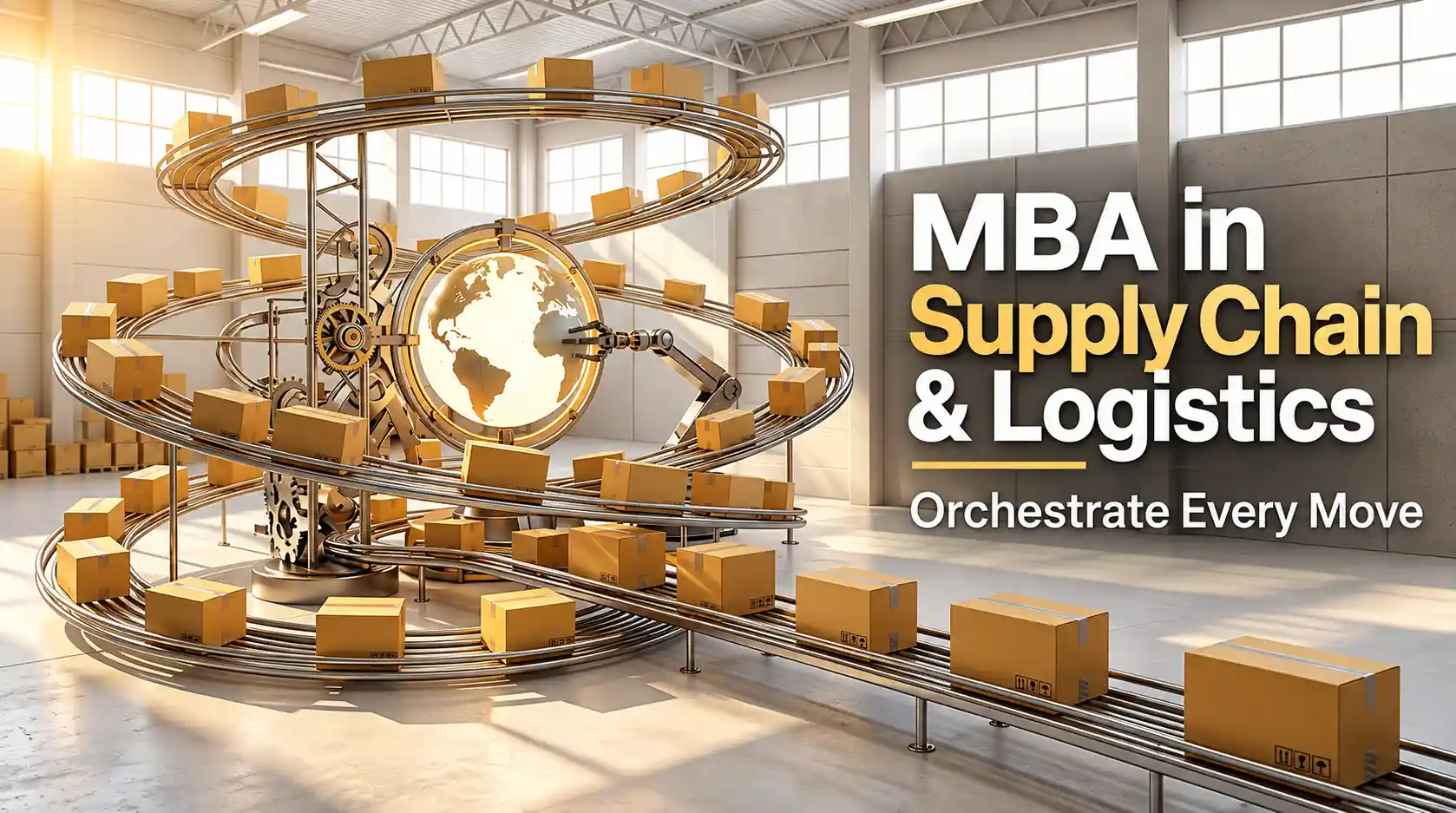

MBA in Supply Chain & Logistics 2026: Course, Fees, Eligibility, Subjects, Jobs, Salary & Colleges
An MBA in Supply Chain & Logistics is a postgraduate management specialisation focused on how materials, products, information and services move from suppliers to businesses and finally to customers.
Students study areas such as sourcing, procurement, demand planning, inventory, warehousing, transportation, distribution, global supply chains, logistics technology, supply-chain analytics and risk management.
The specialisation can be particularly useful for students targeting manufacturing, FMCG, retail, e-commerce, automobile, logistics, consulting, pharmaceuticals, shipping, aviation or procurement careers.
But Supply Chain Management should not be confused with simply moving goods from one place to another. A strong supply chain professional must balance:
Availability + Cost + Inventory + Speed + Quality + Risk
Students who are still comparing management institutes can first explore the top MBA colleges in India.
Quick Facts
Current 2026 partner programmes show why exact programme names matter. UPES offers a dedicated MBA in Logistics & Supply Chain Management with pathways in Logistics Planning/Supply Chain, Business Process in Supply Chain and Maritime Logistics. DBS Global University currently offers an MBA in Logistics & Supply Chain Management with SAP. ITM Navi Mumbai, meanwhile, offers Operations & Supply Chain Management as a combined MBA specialisation rather than a stand-alone MBA Logistics title.
Quick Decision Snapshot
- Choose MBA Supply Chain & Logistics if sourcing, inventory, transportation, planning and business networks interest you.
- Supply Chain Management is broader than Logistics.
- Operations and Supply Chain overlap strongly, but they are not identical.
- Engineering is useful in some sectors but is not compulsory for the specialisation.
- Excel, ERP/SAP, analytics and process understanding can materially strengthen employability.
- E-commerce has increased the importance of fulfilment, warehousing, last-mile delivery and inventory planning.
- Supply chains are increasingly affected by AI, automation, geopolitical risk and sustainability.
- A fresher should not expect an immediate Supply Chain Manager title simply because the MBA is completed.
- Compare actual placement roles such as Supply Chain Analyst, Demand Planner, Procurement and Logistics rather than only recruiter logos.
Planning an MBA in Supply Chain & Logistics for 2026?
Use Free MBA Counselling or share your graduation, percentage, entrance-exam score, preferred city, budget and whether your goal is Supply Chain, Procurement, Logistics, Warehousing or Demand Planning with BoostMyTalent on 9090171704.
What Is MBA in Supply Chain & Logistics?
Supply Chain Management coordinates the complete journey of products, materials, information and sometimes money across a business network.
Consider a smartphone.
Before the customer receives it, a company may need to:
- Forecast how many units customers will buy.
- Source components.
- Select suppliers.
- Purchase materials.
- Manufacture or assemble products.
- Store finished inventory.
- Move stock to distribution centres.
- Supply retailers or e-commerce warehouses.
- Deliver to customers.
- Manage returns.
All these decisions are connected.
That connection is the supply chain.
Students who are unsure whether this specialisation fits their goals should compare the wider MBA specializations.
What Is Logistics?
Logistics focuses more specifically on the movement and storage of goods.
It can include:
- Transportation
- Warehousing
- Distribution
- Freight
- Delivery
- Order fulfilment
- Reverse logistics
Logistics is therefore an important part of Supply Chain Management.
A simple relationship is:
Supply Chain Management > Logistics
Supply Chain is the wider network.
Logistics manages an important part of how goods move through that network.
MBA Supply Chain vs MBA Logistics
The terms are often used together because the fields overlap heavily.
However, there is a difference.
A student interested only in transportation and warehousing may prefer deeper Logistics study.
A student interested in the entire journey from supplier to customer should prefer a broader Supply Chain programme.
What Do You Study in MBA Supply Chain & Logistics?
A good curriculum can include:
- Supply Chain Management
- Logistics Management
- Procurement
- Strategic Sourcing
- Inventory Management
- Warehousing
- Transportation Management
- Demand Planning
- Supply Planning
- Production Planning
- Distribution Management
- Global Supply Chain
- Supply Chain Analytics
- Operations Management
- Materials Management
- Vendor Management
- Supply Chain Strategy
- Supply Chain Risk Management
- International Logistics
- E-commerce Logistics
- ERP
- Sustainable Supply Chain
- Project Management
- Quality Management
UPES's current curriculum covers procurement, inventory management, transportation, warehousing and distribution while also providing exposure to tools such as SAP, Six Sigma, Advanced Excel and analytics.
DBS Global University's current MBA Logistics & Supply Chain programme includes distribution, warehousing, transportation, inventory, procurement and global trade, with a specialised progression through SAP S/4HANA, Supply Chain Analytics, Global Sourcing, sustainability and supply-chain risk.
What Is Procurement?
Procurement is the process of acquiring the goods and services a company needs.
This may involve:
- Finding suppliers
- Comparing quotations
- Negotiating
- Contracts
- Purchase orders
- Supplier relationships
- Cost control
Procurement is not simply:
“Buy the cheapest.”
A cheap supplier who repeatedly delivers late or supplies poor-quality materials can become expensive.
The real decision may involve:
Price + Quality + Reliability + Lead Time + Risk
Procurement vs Purchasing
Purchasing usually refers more directly to the transaction of buying.
Procurement is broader.
Procurement may include:
- Requirement planning
- Supplier selection
- Negotiation
- Contracts
- Supplier performance
- Risk management
Purchasing sits inside the larger procurement process.
What Is Strategic Sourcing?
Strategic sourcing takes a longer-term view of suppliers.
A company may analyse:
- Total spending
- Supplier alternatives
- Countries
- Cost structures
- Quality
- Risks
- Future requirements
The aim is to create a stronger supply base rather than repeatedly choosing suppliers transaction by transaction.
What Is Inventory Management?
Inventory is stock held by a business.
This can include:
- Raw materials
- Work in progress
- Finished goods
- Spare parts
The challenge is balancing two risks.
Too Much Inventory
Can lead to:
- Capital blocked
- Storage cost
- Damage
- Obsolescence
- Expiry
Too Little Inventory
Can lead to:
- Stock-outs
- Lost sales
- Production stoppage
- Poor customer experience
Inventory Management tries to find the right balance.
What Is Demand Planning?
Demand Planning estimates how much customers are likely to buy.
A company may use:
- Historical sales
- Seasonality
- Promotions
- Market trends
- Customer orders
- Statistical forecasts
For example, an air-conditioner company may expect much higher sales before summer.
Poor demand forecasts can create either:
Too Much Stock
or:
Not Enough Stock
Both cost money.
What Is Supply Planning?
Once demand is estimated, the organisation must decide how to meet it.
Supply Planning can involve:
- Production
- Inventory
- Suppliers
- Capacity
- Lead times
The goal is to match:
Expected Demand ↔ Available Supply
Demand Planning vs Supply Planning
The two must work together.
What Is Warehousing?
Warehousing is much more than putting products inside a building.
Warehouse decisions can involve:
- Layout
- Receiving
- Put-away
- Storage
- Picking
- Packing
- Dispatch
- Safety
- Inventory accuracy
- Automation
Poor warehouse design can increase:
- Labour
- Processing time
- Errors
- Delivery delays
What Is Transportation Management?
Transportation Management deals with moving goods efficiently between locations.
It can include:
- Road
- Rail
- Air
- Sea
- Multimodal transport
Managers may evaluate:
- Cost
- Speed
- Reliability
- Capacity
- Route
- Product type
Air freight may be faster.
Sea freight may be cheaper.
The right choice depends on the business requirement.
What Is Distribution Management?
Distribution focuses on moving finished products from manufacturers or warehouses towards customers or retail channels.
A distribution network may contain:
Factory → Central Warehouse → Regional Warehouse → Distributor → Retailer → Customer
Different businesses use different structures.
Network design can materially affect:
- Delivery time
- Inventory
- Transportation cost
- Customer service
What Is Last-Mile Delivery?
Last-mile delivery is the final movement of a shipment to the customer.
It is especially important in e-commerce.
The last mile can be difficult because companies may have to deliver thousands of individual orders across:
- Cities
- Villages
- Apartment buildings
- Offices
- Difficult locations
Fast delivery expectations can make last-mile logistics expensive.
What Is Reverse Logistics?
Reverse Logistics manages goods moving back from the customer.
Examples include:
- Product returns
- Repairs
- Recycling
- Refurbishment
- Packaging recovery
E-commerce has made reverse logistics particularly important.
A company cannot consider a sale complete if a high percentage of orders later return.
MBA Supply Chain vs Operations Management
This is one of the most important comparisons.
Operations asks:
How efficiently does this process work?
Supply Chain asks:
How efficiently does the entire network work from supplier to customer?
The two overlap substantially.
Students who prefer broader process, quality and service-management roles should compare MBA in Operations Management.
MBA Supply Chain vs International Business
International Business is wider.
It includes:
- International markets
- Global Marketing
- International Finance
- Trade
- Cross-cultural management
Supply Chain focuses more deeply on:
- Sourcing
- Procurement
- Inventory
- Logistics
- Supply networks
The overlap is strong in:
- Global sourcing
- International logistics
- Imports
- Exports
- Shipping
Students attracted mainly by global business and overseas markets should compare MBA in International Business.
MBA Supply Chain vs Business Analytics
Supply Chain is a business domain.
Business Analytics is an analytical capability that can work across domains.
For example:
A Supply Chain professional may ask:
How much inventory should we keep?
An Analytics professional may build the forecast or model helping answer the question.
The two combine particularly well in:
- Demand forecasting
- Inventory analytics
- Supplier analytics
- Transportation optimisation
- Supply Chain Analytics
MBA Supply Chain vs MBA IT
Technology now runs a large part of modern supply chains.
Supply Chain professionals may work with:
- ERP
- Warehouse systems
- Transport systems
- Supplier platforms
- Analytics
- Automation
But MBA IT focuses more broadly on managing technology systems.
MBA Supply Chain focuses on managing the business network.
Students primarily interested in enterprise technology rather than procurement and logistics should compare MBA in Information Technology.
MBA Supply Chain Eligibility 2026
There is no single eligibility rule across all B-schools.
Most regular programmes require a bachelor's degree from a recognised institution.
Minimum marks vary.
UPES currently requires at least 50% in Class X, XII and graduation, with graduation accepted from a recognised university in any stream for its MBA Logistics & Supply Chain Management. Its selection routes include UPESMET and accepted national-level examinations followed by interview.
ISBR's current PGDM in Operations, Supply Chain & Logistics requires a recognised graduation degree with minimum 50% aggregate, reduced to 45% for SC/ST candidates, together with an accepted management entrance score or ISBR aptitude route.
Is Engineering Compulsory for MBA Supply Chain?
No.
Engineering can be useful but is not universally required.
Supply Chain needs people from multiple backgrounds because the function connects:
- Manufacturing
- Finance
- Commercial teams
- Procurement
- Technology
- Logistics
- Customers
Can BTech Students Do MBA Supply Chain?
Yes.
Engineering can be particularly useful for:
- Manufacturing supply chains
- Production planning
- Sourcing
- Quality
- Industrial procurement
- Operations
A BTech graduate may already understand technical specifications and manufacturing processes.
Can BCom Students Do MBA Supply Chain?
Yes.
Commerce graduates can be particularly relevant for:
- Procurement
- Commercial operations
- Vendor management
- Inventory
- Supply-chain finance
Can BBA Students Do MBA Supply Chain?
Yes.
BBA students already have a management foundation and can specialise further in Supply Chain, Logistics or Operations.
Can BA Students Do MBA Supply Chain?
Yes, where institutional eligibility permits.
The student may need to strengthen:
- Quantitative skills
- Excel
- Operations concepts
Can BSc Students Do MBA Supply Chain?
Yes.
Science graduates can pursue Supply Chain subject to the selected institution's admission requirements.
Is Mathematics Required for MBA Supply Chain?
Advanced Mathematics is not universally compulsory for admission.
But quantitative skills matter.
Supply-chain professionals may work with:
- Forecasts
- Inventory
- Lead times
- Costs
- Capacity
- Transportation rates
- Service levels
- Statistics
A student who strongly dislikes numbers may find some planning and analytics roles difficult.
MBA Supply Chain Admission Process 2026
A typical admission process can include:
- Complete graduation eligibility.
- Appear for an accepted MBA entrance examination.
- Apply to the B-school.
- Complete academic screening.
- Attend GD/WAT/PI or another selection process.
- Receive the admission offer.
- Pay the required fee and confirm the seat.
Common examination routes include:
- CAT
- XAT
- CMAT
- MAT
- NMAT
- GMAT
- ATMA
- State MBA tests
- Institute-specific tests
MBA Supply Chain Course Structure
A regular MBA/PGDM usually runs for around two academic years.
Students generally continue studying:
- Marketing
- Finance
- HR
- Economics
- Strategy
- Operations
Supply Chain managers need cross-functional understanding because their decisions affect almost every department.
What Is Supply Chain Analytics?
Supply Chain Analytics uses data to improve supply-network decisions.
Companies may analyse:
- Demand
- Inventory
- Supplier performance
- Delivery
- Warehouse productivity
- Transportation
- Returns
- Cost
Analytics can answer:
What happened?
Why did it happen?
What may happen next?
What should we do?
Current programmes increasingly reflect this trend. Alliance's Operations major includes Operations and Supply Chain Analytics, while IILM's current Greater Noida pathway explicitly identifies Supply Chain Analytics among its career directions.
Which Tools Should MBA Supply Chain Students Learn?
Excel
Excel remains useful for:
- Forecasting
- Inventory analysis
- Supplier comparison
- Procurement
- Planning
- Reporting
ERP/SAP
ERP platforms integrate business functions.
Supply Chain professionals may work with systems supporting:
- Procurement
- Materials
- Inventory
- Manufacturing
- Sales
- Warehousing
Power BI
Power BI can help visualise:
- Inventory
- Orders
- Vendors
- Delivery
- Forecast accuracy
- Supply-chain KPIs
SQL
SQL can be useful for analytical roles where professionals need to access operational databases.
Warehouse Management Systems
WMS platforms help manage warehouse processes.
Transportation Management Systems
TMS platforms support transportation planning and execution.
Students do not need to master every software system during an MBA.
The goal should be:
Understand Process + Learn Relevant Tools
Is SAP Useful After MBA Supply Chain?
Yes, particularly for enterprise supply-chain careers.
Relevant SAP areas can connect with:
- Materials Management
- Production Planning
- Warehouse processes
- Procurement
- Supply Chain Planning
DBS Global University's current MBA Logistics & Supply Chain programme directly integrates SAP S/4HANA into areas such as Materials Management, Global Supply Chain and other business processes.
ITM Navi Mumbai also currently lists SAP Materials Management certification among the value-added certifications for its Operations & Supply Chain specialisation.
However:
SAP Certificate ≠ Guaranteed SAP Career
Domain knowledge and implementation experience still matter.
Is Six Sigma Useful for Supply Chain?
It can be.
Lean and Six Sigma can help improve processes involving:
- Warehouses
- Order fulfilment
- Procurement
- Quality
- Logistics
But Supply Chain Management is broader than process improvement.
Students should not substitute one Six Sigma certificate for actual supply-chain knowledge.
Career Scope After MBA Supply Chain & Logistics
Supply chains exist across a huge range of industries.
Career opportunities can exist in:
- FMCG
- Retail
- E-commerce
- Manufacturing
- Automobile
- Pharmaceuticals
- Healthcare
- Logistics
- Shipping
- Aviation
- Technology
- Consulting
- Consumer durables
- Food
- Fashion
- Energy
- Infrastructure
A business that makes or sells physical products almost always needs supply-chain capability.
Service organisations can also have procurement and vendor-management functions.
Jobs After MBA Supply Chain & Logistics
Supply Chain Analyst
Supply Chain Analysts use data to study:
- Inventory
- Suppliers
- Orders
- Transportation
- Costs
- Demand
Useful skills can include:
MBA Supply Chain + Excel + Power BI + ERP + Analytical Thinking
Supply Chain Manager
Supply Chain Managers may oversee a larger part of the network.
Responsibilities can include:
- Planning
- Suppliers
- Inventory
- Logistics
- Cost
- Teams
- Supply-chain performance
Students should remember:
MBA Supply Chain does not automatically make a fresher a Supply Chain Manager.
Procurement Analyst
Procurement Analysts may work on:
- Spend analysis
- Suppliers
- Quotations
- Cost
- Contracts
- Procurement data
Procurement Manager
Experienced Procurement Managers may oversee:
- Supplier strategy
- Negotiation
- Cost savings
- Contracts
- Risk
- Teams
Demand Planner
Demand Planners estimate future demand.
They may work closely with:
- Sales
- Marketing
- Finance
- Production
- Supply planning
This is a more analytical Supply Chain career.
Supply Planner
Supply Planners decide how demand can be fulfilled.
They may coordinate:
- Production
- Suppliers
- Inventory
- Capacity
Inventory Planner
Inventory Planners try to maintain enough stock without creating unnecessary inventory.
Logistics Executive
A Logistics Executive may coordinate:
- Transport
- Deliveries
- Freight
- Documentation
- Vendors
Logistics Manager
Experienced Logistics Managers may oversee:
- Transportation networks
- Warehousing
- Distribution
- Service levels
- Logistics partners
Warehouse Manager
Warehouse Managers may be responsible for:
- Receiving
- Storage
- Picking
- Packing
- Dispatch
- Safety
- Productivity
Transportation Manager
Transportation Managers can manage:
- Fleet
- Transport vendors
- Routes
- Freight cost
- Delivery performance
Global Sourcing Professional
Global sourcing involves identifying suppliers internationally.
The role can combine:
- Procurement
- International Business
- Logistics
- Risk
- Negotiation
E-commerce Supply Chain Professional
E-commerce businesses need professionals in:
- Fulfilment
- Inventory
- Last-mile delivery
- Seller operations
- Returns
- Warehousing
- Planning
Students can examine the larger range of management roles through the MBA career paths.
MBA Supply Chain Salary in India 2026
There is no fixed salary after MBA Supply Chain & Logistics.
Compensation varies according to:
- College
- Role
- Industry
- Employer
- Previous experience
- Location
- Technical skills
- Team responsibility
Current Glassdoor India data for Supply Chain Analysts shows base pay broadly around ₹5 lakh to ₹10 lakh per year, with average base pay around ₹7 lakh in the current dataset. Recent 2026 submissions also show wide variation by location and experience.
Demand Planning can command higher compensation as experience grows. Current India data shows a broad ₹7 lakh to ₹15 lakh base-pay range and around ₹10 lakh average base pay for Demand Planners, again covering people with different levels of experience rather than only MBA freshers.
Procurement Manager data is higher still, with Glassdoor currently showing average base pay around ₹12.7 lakh and a broad ₹8–18.1 lakh range. This is a managerial job category and should not be treated as a fresher placement package.
The realistic formula is:
MBA Supply Chain + Role + Skills + Industry + Experience → Salary
not:
MBA Supply Chain = Fixed Package
Why Supply Chain Salaries Vary So Much
Consider three candidates.
Candidate A
Fresher joining as a Supply Chain Analyst.
Candidate B
Professional with five years of Demand Planning experience.
Candidate C
Senior Procurement Manager controlling a large sourcing budget.
All may have studied Supply Chain Management.
Their responsibilities are completely different.
Salary grows according to the value and complexity of the work, not simply the degree title.
MBA Supply Chain Fees in India 2026
There is no standard fee.
Current verified partner examples show significant variation.
DBS Global University's 2026–28 fee schedule totals ₹10.90 lakh across the four published semester totals after its stated combo scholarship, with SAP included and ISCEA optional. International immersion charges are listed separately.
IILM Greater Noida currently publishes ₹12.40 lakh as the total two-year MBA fee.
ITM's current 2026 MBA information gives an approximate programme fee of ₹13.45 lakh for the two-year MBA iConnect, while Alliance's current MBA fee schedule totals ₹15 lakh across its published instalments excluding the separately listed registration/value-proposition charges.
The currently accessible UPES programme page confirms the course but does not surface a sufficiently clear programme-specific two-year payable figure for this comparison, so – is safer than inventing a number.
What Is the Real Cost of an MBA Supply Chain?
Do not calculate only tuition.
Include:
- Tuition
- Registration
- Hostel
- Food
- Transportation
- Laptop
- Certifications
- International immersion
- Loan interest
- Lost salary if leaving a job
Then compare this with realistic career outcomes.
The MBA ROI Calculator can be more useful than simply ranking colleges from highest fee to lowest fee.
Is MBA Supply Chain Good for Freshers?
Yes.
Potential fresher roles can include:
- Supply Chain Analyst
- Procurement Analyst
- Logistics Executive
- Management Trainee
- Planning Executive
- Operations Analyst
However, practical exposure becomes especially important because freshers do not have previous supply-chain experience.
Useful additions include:
- Internship
- Excel
- ERP
- Supply-chain project
- Analytics
- Case competitions
Students should study actual MBA placements instead of assuming that every e-commerce or manufacturing recruiter offers Supply Chain roles.
Is MBA Supply Chain Good for Working Professionals?
It can be particularly valuable.
Examples:
Procurement Experience + MBA Supply Chain → Strategic Sourcing
Warehouse Experience + MBA Supply Chain → Distribution/Network Management
Manufacturing Experience + MBA Supply Chain → Planning
Logistics Experience + MBA Supply Chain → Supply Chain Management
Sales Planning Experience + MBA Supply Chain → Demand Planning
Existing domain experience can significantly strengthen the value of the MBA.
Is MBA Supply Chain Good for Engineers?
Yes.
Engineering can be especially useful in:
- Manufacturing
- Production planning
- Technical procurement
- Industrial sourcing
- Quality
- Supply-chain projects
But engineers should still develop commercial and financial understanding.
Is MBA Supply Chain Good for Commerce Students?
Yes.
Commerce students can perform well in areas such as:
- Procurement
- Vendor management
- Commercial operations
- Inventory
- Supply-chain finance
Is MBA Supply Chain Good for Entrepreneurs?
Yes, particularly for businesses involving physical products.
Entrepreneurs need to understand:
- Suppliers
- Inventory
- Cost
- Warehousing
- Delivery
- Returns
A business can have excellent Marketing and still fail if customers never receive the product on time.
Supply Chain Management in E-commerce
E-commerce has made Supply Chain highly visible.
Customers now expect:
- Fast delivery
- Accurate tracking
- Easy returns
- Product availability
Behind that simple customer experience are complex decisions involving:
- Forecasting
- Warehouse location
- Inventory
- Order fulfilment
- Delivery partners
- Reverse logistics
The customer sees:
“Order arriving tomorrow.”
Supply Chain makes that promise possible.
Supply Chain Management in FMCG
FMCG businesses often manage:
- Large product portfolios
- Distributors
- Retailers
- Warehouses
- Frequent replenishment
A stock-out can immediately create lost sales.
Too much inventory can increase expiry and working-capital pressure.
Planning therefore becomes critical.
Supply Chain Management in Automobile
Automobile supply chains can involve thousands of components and large supplier networks.
A delay in one critical component can disrupt production.
Relevant roles can include:
- Procurement
- Production planning
- Supplier development
- Logistics
- Inventory
Engineering knowledge can be particularly useful in this industry.
Supply Chain Management in Pharmaceuticals
Pharmaceutical supply chains may require particularly strong control over:
- Quality
- Compliance
- Temperature
- Traceability
- Expiry
- Inventory
A supply-chain decision can therefore affect patient access as well as business cost.
Supply Chain Management in Retail
Retail businesses must decide:
- Which products to stock
- How much
- At which location
- When to replenish
Poor inventory planning can create:
Empty shelves
or:
Unsold stock
Global Supply Chain Management
Global supply chains involve additional complexity.
Businesses may source from one country, manufacture in another and sell across many markets.
Challenges can include:
- Currency
- Customs
- Ports
- Shipping
- Trade regulations
- Long lead times
- Political risk
Students who specifically want cross-border trade and global markets should also understand the MBA in International Business.
What Is Supply Chain Risk Management?
Supply Chain Risk Management identifies and prepares for disruptions.
Risks can include:
- Supplier failure
- Port disruption
- War
- Natural disaster
- Cyberattack
- Transport strike
- Raw-material shortage
- Sudden demand surge
Businesses increasingly ask:
What happens if our normal supply route fails?
UPES currently includes Business & Supply Chain Risk Management in its Logistics & Supply Chain curriculum, while Woxsen's Operations electives include resilient supply chains and risk management.
Why Geopolitics Matters in Supply Chain
A conflict thousands of kilometres away can affect:
- Shipping routes
- Fuel prices
- Supplier availability
- Freight costs
- Lead times
This makes modern supply-chain management increasingly strategic.
The cheapest supplier is not necessarily the safest supplier.
Companies may now consider:
Cost + Resilience
rather than cost alone.
What Is Supply Chain Resilience?
Supply Chain Resilience is the ability to continue or recover when disruption occurs.
Businesses may improve resilience through:
- Multiple suppliers
- Safety stock
- Alternative transport routes
- Regional sourcing
- Better visibility
- Scenario planning
Resilience can increase cost.
The management challenge is deciding how much protection is economically justified.
Sustainable Supply Chain Management
Supply-chain decisions can affect:
- Carbon emissions
- Packaging
- Waste
- Transportation
- Supplier practices
Companies increasingly evaluate sustainability in sourcing and logistics.
A sustainable supply chain may look at:
- Cleaner transportation
- Ethical sourcing
- Lower packaging waste
- Circular economy
- Energy efficiency
AI in Supply Chain Management 2026
AI can support:
- Demand forecasting
- Inventory decisions
- Route optimisation
- Supplier analysis
- Warehouse planning
- Risk detection
AI does not eliminate the need for Supply Chain professionals.
It changes the tools available to them.
The future-oriented combination is:
Supply Chain Knowledge + Analytics + AI Tools + Business Judgement
Will AI Replace Supply Chain Jobs?
Some repetitive tasks may become increasingly automated.
Examples include:
- Routine reporting
- Basic forecasts
- Shipment updates
- Data entry
But businesses still need professionals who can:
- Manage suppliers
- Handle disruptions
- Negotiate
- Make trade-offs
- Understand customers
- Design networks
- Manage risk
AI can recommend.
Managers remain accountable for decisions.
Automation in Warehousing
Modern warehouses may use:
- Robotics
- Automated sorting
- Barcode/RFID
- Warehouse software
- AI-assisted planning
This does not mean warehouse management disappears.
Instead, professionals increasingly manage more technology-intensive environments.
Blockchain in Supply Chain
Blockchain has been explored for areas such as:
- Traceability
- Transaction records
- Supplier networks
However, students should not choose a Supply Chain MBA because a brochure contains fashionable technology words.
The better test is:
Does the curriculum teach technology in a way that solves real supply-chain problems?
Best MBA Supply Chain & Logistics Colleges: What Should You Compare?
Do not judge a college only by whether it says:
Supply Chain Management available.
Compare:
- Dedicated vs broader specialisation
- Procurement depth
- Demand planning
- Inventory
- Logistics
- Warehousing
- Supply Chain Analytics
- ERP/SAP
- Global Supply Chain
- Risk and resilience
- Internship
- Industry projects
- Placement roles
- Total cost
- ROI
The exact programme architecture matters.
UPES Dehradun MBA Logistics & Supply Chain Management
UPES Dehradun currently offers a dedicated MBA in Logistics & Supply Chain Management.For the 2026 cycle, its available pathways include:
- Logistics Planning / Supply Chain
- Business Process in Supply Chain
- Maritime Logistics
The broader programme covers procurement, inventory, transportation, warehousing, distribution and last-mile delivery, while also including internships, live projects and industry exposure.
The Logistics Planning/Supply Chain pathway provides deeper exposure to demand planning and forecasting, while the Business Process pathway covers demand planning, supply planning, procurement, manufacturing, warehousing, fulfilment and transportation processes.
This makes UPES particularly relevant for students who want a dedicated Supply Chain MBA rather than a general MBA with only one SCM elective.
DBS Global University / Doon Business School MBA Logistics & Supply Chain
Doon Business School Dehradun currently offers a dedicated MBA in Logistics & Supply Chain Management with SAP.Its 2026 curriculum includes:
- Materials Management on SAP S/4HANA
- Global Supply Chain Management
- Supply Chain Analytics
- Operations Strategy
- Global Sourcing
- Sustainable Supply Chain
- Supply Chain Risk Management
The programme also covers procurement, warehousing, transportation, inventory and global trade.
Its published 2026–28 academic fee plus compulsory value-added component totals ₹10.90 lakh after the stated combo scholarship, with SAP included and optional additional ISCEA/international immersion routes.
This can suit students who particularly want:
Supply Chain + SAP + Applied Enterprise Systems
ITM Business School Navi Mumbai Operations & Supply Chain
ITM Business School Navi Mumbai currently offers Operations and Supply Chain Management among its MBA iConnect specialisations.The programme combines Supply Chain with broader Operations rather than presenting Logistics as an independent degree.
Current learning and value-added certifications include:
- Supply Chain Management
- Project Management
- Quality
- Supply Chain Analytics
- Lean Six Sigma Green Belt
- SAP Materials Management
ITM also publishes a five-month industry-integrated internship as part of its wider MBA structure.
Students interested in Maharashtra can compare the broader top MBA colleges in Mumbai market before finalising.
IILM University Greater Noida Operations, Logistics & Supply Chain
IILM University Greater Noida currently publishes an MBA pathway in Operation, Logistics, and Supply Chain Management with Blue Ocean.Its current positioning focuses on:
- Supply-chain optimisation
- Logistics efficiency
- Lean management
- IoT
- AI
and identifies Logistics Management, Operations Analysis and Supply Chain Analytics among potential career directions.
The 2026 published total MBA fee for Greater Noida is ₹12.40 lakh.
This programme is relevant for students who want:
Operations + Logistics + Supply Chain
rather than Supply Chain in complete isolation.
Students comparing Greater Noida and nearby locations can also explore the broader top MBA colleges in Delhi NCR.
ISBR Bangalore PGDM Operations, Supply Chain & Logistics
ISBR Business School Bangalore currently lists a dedicated PGDM in Operations, Supply Chain & Logistics among its campus-based postgraduate programmes.Its current programme page lists minimum 50% graduation marks, with 45% for SC/ST applicants, and accepts routes including CAT, XAT, MAT, CMAT, NMAT, ATMA and other specified tests.
Published curriculum information includes:
- Supply Chain & Logistics Management
- Operations Research
- Sourcing Management
- Manufacturing Systems
This makes it a relevant partner option for students specifically searching for the combined Operations + Supply Chain + Logistics route.
Alliance University Bangalore: Operations With Supply Chain Depth
Alliance University Bangalore currently offers Operations as the formal MBA specialisation rather than a separate Supply Chain MBA.
However, its Operations major has substantial supply-chain content, including:
- Logistics and Supply Chain Management
- Operations and Supply Chain Analytics
- ERP and Business Blockchain
- Total Quality Management and Lean Methods
- Operations Risk Management and Resilience
Alliance is therefore relevant for students seeking a broader Operations MBA with meaningful Supply Chain depth.
It should not be described as identical to a dedicated MBA Logistics & Supply Chain Management programme.
Woxsen University Hyderabad: Operations With Supply Chain and Sourcing
Woxsen University Hyderabad currently places Supply Chain within its broader MBA Operations specialisation.
Its current Operations electives include:
- AI in Operations & Supply Chain
- Blockchain Supply Chain & Predictive Analytics
- Smart Sourcing and Procurement Automation
- Resilient Supply Chain and Risk Management
- Logistics Management
This can suit students interested in:
Operations + Supply Chain + Technology
rather than a traditional Logistics-only curriculum.
Dedicated Supply Chain MBA vs Operations With Supply Chain
Neither structure is automatically better.
Dedicated Supply Chain Programme
Can provide deeper exposure to:
- Procurement
- Logistics
- Planning
- Warehousing
- Supply-network design
Operations + Supply Chain
Can provide wider exposure to:
- Process management
- Quality
- Projects
- Supply Chain
- Service Operations
Choose based on career direction.
If the goal is specifically:
Demand Planning / Procurement / Logistics / Supply Chain
a dedicated programme may provide greater depth.
If the goal is broader:
Operations + Supply Chain
a combined programme can provide more flexibility.
Which City Is Best for MBA Supply Chain?
There is no universal winner.
Delhi NCR
Strong exposure to:
- E-commerce
- Consumer businesses
- Logistics
- Manufacturing
- Warehousing
- Corporate procurement
Mumbai
Useful for:
- Ports
- Shipping
- FMCG
- Corporate headquarters
- International trade
- Retail
Bangalore
Strong for:
- E-commerce
- Technology-enabled supply chains
- Consulting
- Analytics
- Start-ups
Pune
Relevant for:
- Automobile
- Manufacturing
- Engineering
- Industrial supply chains
Hyderabad
Useful for:
- Pharmaceuticals
- Technology
- Manufacturing
- Retail
The best city depends on the industry you want.
How to Choose an MBA Supply Chain College
Step 1: Decide Your Target Function
Do you want:
- Procurement?
- Planning?
- Logistics?
- Warehousing?
- Supply Chain Analytics?
- Global Sourcing?
Do not choose the programme before knowing the direction.
Step 2: Check the Exact Programme Name
Different structures include:
- MBA Supply Chain Management
- MBA Logistics & Supply Chain
- MBA Operations & Supply Chain
- PGDM Operations, Supply Chain & Logistics
Read beyond the title.
Step 3: Check the Curriculum
A strong programme should cover several of:
Procurement + Planning + Inventory + Logistics + Analytics + Technology
Step 4: Check ERP/SAP Exposure
Enterprise-system knowledge can strengthen Supply Chain profiles.
Step 5: Check Projects and Internships
Supply Chain is highly practical.
Industry exposure matters.
Step 6: Check Actual Placement Roles
Look for:
- Supply Chain Analyst
- Procurement
- Demand Planning
- Logistics
- Management Trainee
- Operations
Do not judge only by company logos.
Step 7: Calculate Total Cost
Compare:
Total MBA Expense ↔ Realistic Career Outcome
Does College Brand Matter for MBA Supply Chain?
Yes, especially for early career opportunities.
College can influence:
- Recruiters
- Internships
- Management trainee programmes
- Network
- Starting role
But Supply Chain is also highly experience-driven.
After several years, employers can evaluate measurable achievements such as:
- Cost reduction
- Forecast accuracy
- Inventory reduction
- Supplier improvement
- Delivery improvement
Practical business impact becomes increasingly important.
Does MBA Supply Chain Have Good ROI?
It can.
But ROI is profile-specific.
An engineer already working in procurement may use the MBA to move into higher Supply Chain responsibility.
A fresher may first enter an analyst or trainee role.
Therefore, calculate:
College Fee + Living Cost + Loan + Opportunity Cost
against:
Starting Role + Career Growth + Industry Fit
Students with budget constraints can compare genuine MBA scholarships, but an unconfirmed scholarship should be counted as ₹0 when planning affordability.
Who Should Choose MBA Supply Chain & Logistics?
The specialisation can suit:
- Engineers
- BBA graduates
- Commerce graduates
- Manufacturing professionals
- Logistics professionals
- Procurement professionals
- Warehouse professionals
- E-commerce professionals
- Retail professionals
- Entrepreneurs
- Family-business successors
- Students interested in planning
- Students interested in analytics
- Students interested in global sourcing
A strong aptitude generally combines:
Planning + Analytical Thinking + Coordination + Commercial Understanding
Who Should Think Carefully Before Choosing It?
Think carefully if:
- You strongly dislike numbers.
- You dislike structured processes.
- You are choosing Supply Chain only because e-commerce is growing.
- You assume Logistics means only courier companies.
- You want a creative brand career.
- You dislike coordinating vendors and teams.
- You expect a managerial title immediately.
- You are unwilling to learn ERP or data tools.
- Your main interest is Finance, HR or Marketing.
- You have not compared Supply Chain with Operations.
The field can be rewarding for problem-solvers.
It can frustrate students who dislike coordination and operational complexity.
Common Mistakes While Choosing MBA Supply Chain
Mistake 1: Thinking Supply Chain Means Logistics Only
Logistics is only part of the supply chain.
Mistake 2: Thinking It Is Only for Engineers
Graduates from multiple backgrounds can enter the field.
Mistake 3: Ignoring Procurement
Sourcing and suppliers are central to many Supply Chains.
Mistake 4: Ignoring Planning
Demand and supply planning can be major career areas.
Mistake 5: Ignoring Analytics
Modern Supply Chains are increasingly data-driven.
Mistake 6: Ignoring ERP/SAP
Enterprise systems are widely used in larger organisations.
Mistake 7: Collecting Certifications Without Experience
Certificates work best when supported by projects.
Mistake 8: Confusing Supply Chain With Operations
Understand the difference before specialising.
Mistake 9: Choosing College by Highest Package
The highest package may belong to another specialisation.
Mistake 10: Ignoring Total Cost
Hostel, certifications and immersion can materially change MBA ROI.
MBA Supply Chain Career Formula
For Supply Chain Analyst:
MBA Supply Chain + Excel + Power BI + ERP + Analytical Thinking
For Demand Planning:
MBA Supply Chain + Forecasting + Statistics + Excel + Business Understanding
For Procurement:
MBA Supply Chain + Sourcing + Negotiation + Cost Analysis + ERP
For Logistics:
MBA Supply Chain + Transportation + Warehousing + Vendor Management + Analytics
For Inventory Planning:
MBA Supply Chain + Forecasting + Inventory Models + Excel + ERP
For Global Sourcing:
MBA Supply Chain + Procurement + International Trade + Negotiation + Risk
For E-commerce:
MBA Supply Chain + Fulfilment + Inventory + Last Mile + Returns + Analytics
For future Supply Chain leadership:
Domain Experience + Analytics + Technology + Commercial Thinking + People Leadership
These combinations are much more realistic than:
MBA Supply Chain = Supply Chain Manager
Frequently Asked Questions About MBA in Supply Chain & Logistics
1. What is MBA in Supply Chain & Logistics?
It is a postgraduate management specialisation focused on procurement, planning, inventory, warehousing, transportation, distribution and end-to-end supply networks.
2. Is MBA Supply Chain a two-year course?
Most regular full-time MBA and PGDM programmes are around two academic years.
3. Is Supply Chain Management the same as Logistics?
No. Logistics is part of the wider Supply Chain Management field.
4. Which is bigger: Logistics or Supply Chain?
Supply Chain is broader because it includes sourcing, planning, procurement and supplier management in addition to Logistics.
5. Who can do MBA Supply Chain?
Graduates meeting the selected institution's eligibility requirements can apply.
6. Is BTech compulsory for MBA Supply Chain?
No.
Engineering can be useful but is not universally required.
7. Can BCom students do MBA Supply Chain?
Yes.
8. Can BBA students do MBA Supply Chain?
Yes.
9. Can BA students do MBA Supply Chain?
Yes, subject to college eligibility.
10. Can BSc students do MBA Supply Chain?
Yes.
11. Is Maths compulsory for MBA Supply Chain?
Advanced Mathematics is not universally compulsory for admission, but quantitative skills are important.
12. What subjects are taught in MBA Supply Chain?
Typical subjects include Procurement, Inventory, Logistics, Warehousing, Demand Planning, Supply Planning, Analytics and Global Supply Chain.
13. Is SAP taught in MBA Supply Chain?
Some programmes include SAP or ERP exposure. Students should verify the exact college curriculum.
14. Is Excel important for Supply Chain?
Yes.
Excel remains highly useful for planning, inventory, forecasting and reporting.
15. Is Power BI useful for Supply Chain?
Yes, particularly for analytics and dashboards.
16. Is SQL useful for Supply Chain?
It can be useful for analytical roles dealing with large operational datasets.
17. Which entrance exams are accepted for MBA Supply Chain?
Depending on the college, CAT, XAT, CMAT, NMAT, MAT, GMAT, ATMA or institute-specific tests may be accepted.
18. Is CAT compulsory for MBA Supply Chain?
No.
CAT is one admission route among several.
19. What jobs are available after MBA Supply Chain?
Possible roles include Supply Chain Analyst, Procurement Analyst, Demand Planner, Logistics Executive, Inventory Planner and Management Trainee.
20. Can I become a Supply Chain Manager after MBA?
Yes over time, but a fresher should not assume the MBA immediately guarantees a Manager title.
21. Can I work in procurement after MBA Supply Chain?
Yes.
Procurement is one of the core Supply Chain career areas.
22. Can I become a Demand Planner?
Yes.
Demand Planning is a strong analytical Supply Chain career path.
23. Can MBA Supply Chain lead to Logistics?
Yes.
Logistics is an important part of Supply Chain Management.
24. Can MBA Supply Chain lead to warehousing careers?
Yes.
25. Can MBA Supply Chain lead to e-commerce careers?
Yes.
E-commerce companies require planning, inventory, warehousing, fulfilment and Logistics professionals.
26. What is the salary after MBA Supply Chain?
There is no fixed salary. It depends on role, college, employer, industry, skills and experience.
27. Which pays more: Supply Chain or Logistics?
There is no universal answer. Role responsibility and experience matter more than the label.
28. Which is better: MBA Supply Chain or Operations?
Choose Supply Chain for procurement, Logistics and end-to-end network careers. Choose Operations for broader process, quality and delivery management.
29. Which is better: Supply Chain or Business Analytics?
Choose Supply Chain when it is your preferred business domain. Choose Business Analytics when data analysis across different functions is your main interest.
30. Which is better: Supply Chain or International Business?
Choose Supply Chain for sourcing, planning and Logistics. Choose International Business for broader cross-border business careers.
31. Is MBA Supply Chain good for engineers?
Yes.
It can be particularly relevant for manufacturing, sourcing and industrial supply chains.
32. Is MBA Supply Chain good for Commerce students?
Yes.
Commerce graduates can build careers in procurement, commercial Operations and planning.
33. Is MBA Supply Chain good for freshers?
Yes.
Freshers should strengthen practical skills and internship exposure.
34. Is MBA Supply Chain good for working professionals?
Yes.
It can be especially valuable for professionals already working in Logistics, procurement, manufacturing or Operations.
35. Is Supply Chain Management good for women?
Yes.
Career suitability depends on aptitude, skills and role preference, not gender.
36. Is Logistics only a field job?
No.
Many Logistics and Supply Chain careers involve planning, procurement, analytics, consulting and corporate management.
37. Is MBA Supply Chain difficult?
It can be challenging for students who dislike numbers, planning and coordination.
38. Does Supply Chain require coding?
Coding is not mandatory for most roles, although analytical skills such as SQL or Python can help in some careers.
39. Is Six Sigma useful for MBA Supply Chain?
Yes for some process-improvement roles, but it is not compulsory.
40. Is SAP certification useful?
It can be, particularly when it matches the student's intended Supply Chain domain.
41. What is Demand Planning?
Demand Planning estimates how much customers are likely to purchase.
42. What is Supply Planning?
Supply Planning determines how expected demand can be fulfilled using production, inventory and suppliers.
43. What is Procurement?
Procurement manages how organisations identify, negotiate with and purchase from suppliers.
44. What is Strategic Sourcing?
Strategic Sourcing takes a longer-term approach to selecting and managing suppliers.
45. What is Inventory Management?
Inventory Management balances product availability against the cost and risk of holding stock.
46. What is Reverse Logistics?
Reverse Logistics manages products moving back from customers through returns, repair, recycling or refurbishment.
47. Is Supply Chain important in e-commerce?
Yes.
Inventory, fulfilment, warehousing, delivery and returns are central to e-commerce performance.
48. Is AI useful in Supply Chain?
Yes.
AI can support forecasting, inventory, routing, risk detection and other decisions.
49. Will AI replace Supply Chain professionals?
AI may automate some repetitive work, but companies still need professionals to manage suppliers, risks, trade-offs and complex decisions.
50. Is Blockchain important for Supply Chain?
It has applications in traceability and transaction records, but students should focus on practical Supply Chain fundamentals first.
51. Is Supply Chain a good career in 2026?
Yes for students who enjoy planning, data, coordination, suppliers and solving operational business problems.
52. Can Supply Chain graduates work in FMCG?
Yes.
FMCG companies have extensive demand planning, procurement, inventory and distribution requirements.
53. Can Supply Chain graduates work in automobile companies?
Yes.
Automobile businesses have complex manufacturing and supplier networks.
54. Can Supply Chain graduates work in pharmaceuticals?
Yes.
Pharmaceutical businesses require planning, procurement, distribution and specialised Logistics.
55. Can Supply Chain graduates work in consulting?
Yes.
Supply Chain and Operations consulting are relevant career directions, although consulting roles can be competitive.
56. Can Supply Chain graduates work abroad?
Yes, depending on employer, experience, skills and work-visa requirements. The degree does not guarantee an overseas job.
57. Is international exposure compulsory?
No.
Useful industry experience can be more important than a short international tour.
58. Does MBA Supply Chain guarantee placement?
No.
Placement assistance and recruiter access do not guarantee employment.
59. Does college matter for MBA Supply Chain?
Yes.
College can affect internships, recruiter access, network and starting role.
60. Is MBA Supply Chain worth it in 2026?
It can be worth it when the programme provides strong Supply Chain depth, practical exposure and realistic career opportunities at a cost that makes sense for your profile.
Final Verdict
MBA in Supply Chain & Logistics remains a strong management specialisation in 2026 for students interested in procurement, sourcing, planning, inventory, warehousing, transportation and how products move from suppliers to customers.
The biggest misconception is:
Supply Chain = Logistics
Logistics is only one part of the larger system.
A strong Supply Chain professional understands the connections between:
Supplier → Procurement → Planning → Inventory → Warehouse → Transportation → Customer
Technology is also changing the field quickly.
The stronger 2026 profile is increasingly:
Supply Chain Knowledge + ERP/SAP + Analytics + AI Tools + Practical Experience
Students should decide whether they need:
- a dedicated Supply Chain & Logistics MBA,
- an Operations & Supply Chain programme, or
- a broader Operations MBA with meaningful Supply Chain electives.
Before choosing a college, compare:
Exact Programme + Curriculum Depth + SAP/ERP + Analytics + Internship + Placement Roles + Total Cost
Then strengthen the degree with:
Excel + Planning + Procurement + Analytics + Industry Experience
That creates a much stronger career profile than simply adding MBA Supply Chain Management to a CV.
Need help choosing MBA/PGDM Supply Chain & Logistics colleges for 2026?
Share your graduation, percentage, CAT/XAT/CMAT/NMAT score if available, preferred city, budget and whether your target is Procurement, Demand Planning, Supply Chain Analytics, Logistics, Warehousing or E-commerce Supply Chain with BoostMyTalent on 9090171704. We can help compare suitable programmes according to your actual career goal.