
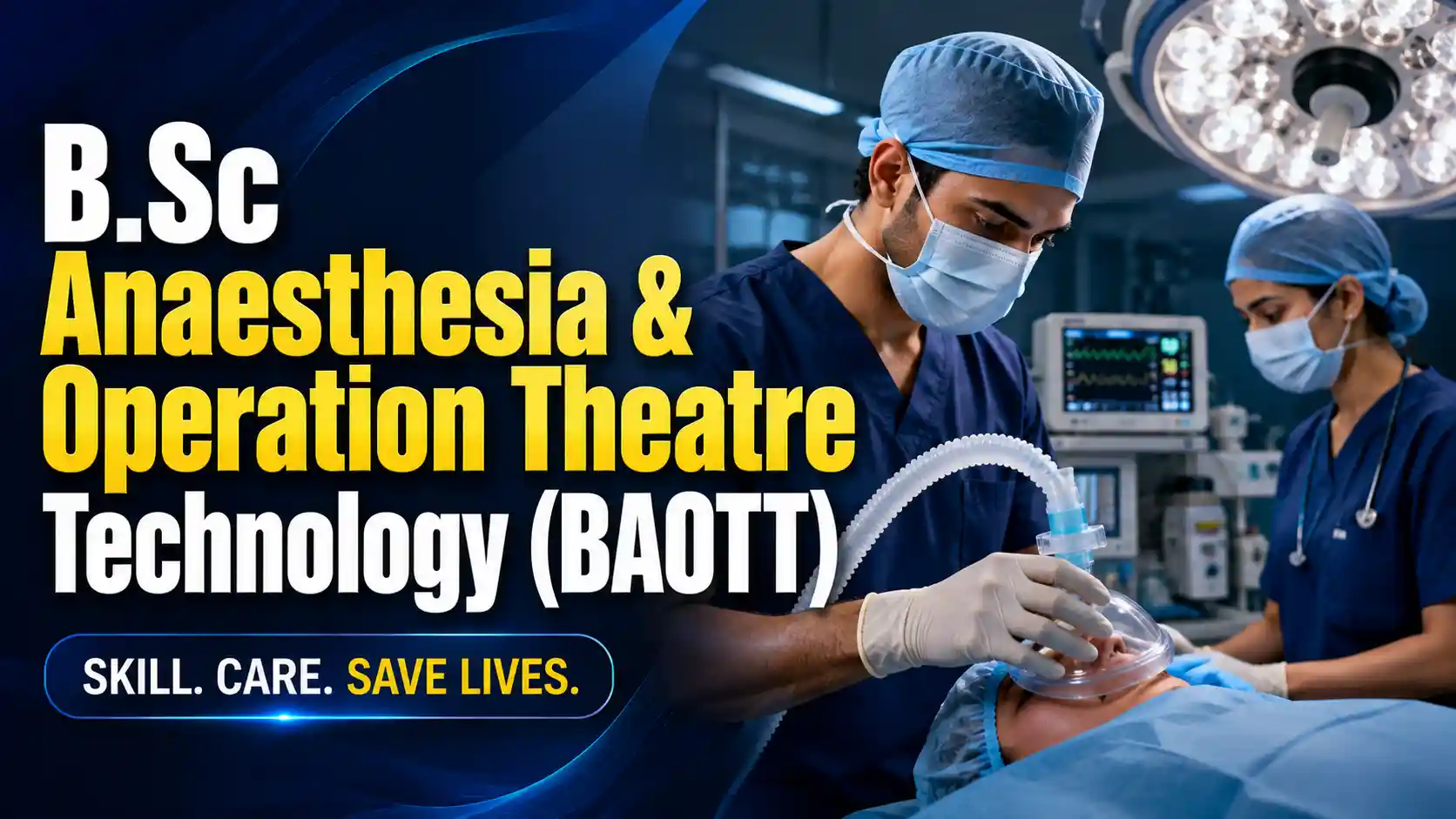

B.Sc Anaesthesia & Operation Theatre Technology (BAOTT) 2026 – Admission, Eligibility, Fees, Salary & Scope
BAOTT is a professional allied-health degree that trains students to support anaesthesiologists, surgeons and operating-room teams before, during and after surgical procedures.
Students learn operation-theatre preparation, anaesthesia equipment, patient monitoring, surgical instruments, sterilisation, airway equipment, ventilators, emergency support and OT management.
From the 2026-27 academic year, Anaesthesia and Operation Theatre Technology is among the allied-health disciplines covered by the NCAHP's mandatory competency-based curriculum framework. The revised national nomenclature is Baccalaureate/Bachelor in Anaesthesia & Operation Theatre Technology (BAOTT).
Students comparing different hospital careers should also understand B.Sc Nursing, because Nursing and BAOTT involve very different patient-care responsibilities.
BAOTT Course 2026 – Quick Facts
The current NCAHP curriculum specifies four years/eight semesters, approximately 2,140 theory hours, 920 practical hours and at least 1,440 internship hours, for a total of about 4,500 hours.
Quick Decision Snapshot
- BAOTT is one of the most surgery-focused allied-health courses.
- The current national course duration is 4 years.
- The student works around anaesthesia machines, OT equipment, surgical procedures and patient monitoring.
- BAOTT graduates assist anaesthesiologists and surgeons; they do not become anaesthesiologist doctors.
- The current NCAHP curriculum uses 50% PCB as the standard entry requirement.
- A good BAOTT college needs real operation theatres and regular surgical cases—not only a skills laboratory.
- Exposure to general surgery alone is not enough; stronger colleges provide rotations across orthopaedics, OBG, cardiac, neuro, paediatric and emergency surgery.
- Infection control, sterilisation and CSSD are important parts of the profession.
- Current private tuition examples range from about ₹1.10–₹1.15 lakh per year at some major universities before hostel and other costs.
- Students uncomfortable with surgery, blood, emergencies or high-pressure hospital environments should compare another allied-health course.
Planning BAOTT admission in 2026? WhatsApp “BAOTT 2026” to 9090171704 with your Class 12 subjects, percentage, preferred city and budget for free college-shortlisting support.
What Is BAOTT?
BAOTT combines two closely connected areas:
Anaesthesia Technology + Operation Theatre Technology
The Anaesthesia side trains students in:
- Anaesthesia workstation preparation
- Breathing circuits
- Airway equipment
- Ventilators
- Patient monitors
- Emergency equipment
- Defibrillators
- Anaesthesia-related consumables
- Assisting with invasive monitoring
- Supporting anaesthesiologists during procedures
The Operation Theatre side includes:
- Preparing OT before surgery
- Surgical instruments
- Operating tables
- Surgical lights
- Electrocautery
- Tourniquets
- Sterile techniques
- Infection control
- CSSD
- OT inventory
- Safe patient transfer
- Surgical positioning
The current NCAHP curriculum describes BAOTT professionals as part of the surgical system who prepare equipment for planned and emergency surgery and participate in management of patients, surgical equipment, anaesthesia tables and operation theatres.
Course Reality
BAOTT is not simply about passing instruments to the surgeon.
It is a technical clinical role involving equipment, sterility, patient safety, anaesthesia support and operation-theatre workflow.
What Is the Correct Name of the Course in 2026?
Students may find many course names online:
- B.Sc Operation Theatre Technology
- B.Sc Anaesthesia Technology
- B.Sc Anaesthesia & OT Technology
- BOTT
- B.Sc AOTT
- BAOTT
The NCAHP taskforce reviewed these different course structures and recommended the unified nomenclature:
Baccalaureate/Bachelor in Anaesthesia & Operation Theatre Technology (BAOTT)
because modern hospitals increasingly need professionals trained in both Anaesthesia and Operation Theatre Technology rather than only one side.
Important 2026 Rule
For a new 2026 admission, the programme should increasingly be judged against the current NCAHP BAOTT curriculum, not only an older three-year B.Sc OTT brochure.
BAOTT Course Duration 2026
BAOTT duration is 4 years or 8 semesters under the current national curriculum.
The NCAHP structure specifies:
Major institutions have also moved to the four-year structure.
Amrita Faridabad's 2026 prospectus describes BAOTT as:
3 Years + 1 Year Internship
while Manipal also currently publishes 3 years + 1 year internship.
Decision Insight
Do not choose a 2026 BAOTT college only because it advertises a shorter course.
For a clinical profession, the additional internship is valuable because it provides time inside actual operation theatres.
BAOTT Eligibility 2026
The current NCAHP BAOTT curriculum specifies:
- Class 12 / 10+2
- Physics
- Chemistry
- Biology
- Minimum 50% in PCB
- Mathematics may be optional/additional
- Medical fitness
- Entrance-based admission under the prescribed framework
Eligibility at a Glance
Important Eligibility Reality
Some university admission pages may still display older or broader eligibility rules during the transition to the new curriculum.
For example, Amrita Faridabad's 2026 prospectus accepts Physics, Chemistry and Biology/Mathematics with 50% for BAOTT, while the new NCAHP curriculum states PCB as mandatory with Mathematics optional.
For a student entering in 2026-27, the safer benchmark is the current NCAHP requirement.
Can PCM Students Do BAOTT?
This needs careful attention in 2026.
Older institutional rules sometimes allowed:
Physics + Chemistry + Biology/Mathematics
However, the current NCAHP BAOTT curriculum specifies Physics, Chemistry and Biology as mandatory, with Mathematics optional.
Admission Reality
A PCM-only student should therefore not assume eligibility merely because an older college page accepts Mathematics.
For a new 2026-27 BAOTT admission, the institution's programme should be aligned with the latest NCAHP curriculum.
Is NEET Required for BAOTT in 2026?
There is no single national NEET-only BAOTT admission system covering every institution in 2026.
The NCAHP BAOTT curriculum provides for an entrance test, while actual implementation can happen through the university or state/common allied-health entrance mechanism.
In Uttar Pradesh, ABVMU currently conducts allied-health bachelor admissions through CAHET 2026 – Common Allied Healthcare Entrance Test. Its 2026-27 academic section has also moved to the new BAOTT syllabus nomenclature.
Important Rule
BAOTT without NEET does not mean admission without an entrance process.
Always identify the exact admission system used for your target institution.
BAOTT Admission 2026 – How It Works
The basic admission flow is:
Class 12 PCB → Entrance/Application → Merit/Rank → Counselling or University Selection → Document Verification → Fee Payment → Admission
The exact authority differs between states and universities.
BAOTT Admission Process Step by Step
Step 1: Check Class 12 Eligibility
Confirm:
- Physics
- Chemistry
- Biology
- PCB percentage
- Age where prescribed
- Medical fitness
Step 2: Check the Current Course Name
Look for a 2026 programme aligned with:
Anaesthesia & Operation Theatre Technology / BAOTT
rather than automatically selecting an older standalone OTT programme.
Step 3: Identify the Entrance Route
It can include:
- State allied-health entrance
- University entrance
- CAHET
- Institution entrance
- Another officially notified system
Step 4: Check Hospital Infrastructure
Do not apply before checking whether students actually train in functioning operation theatres.
Step 5: Appear for Entrance/Selection
Entrance rank or merit can affect admission and college choice.
Step 6: Complete Counselling
Where counselling is used, fill preferences according to:
Hospital Exposure + Fees + Admission Chance + Location
Step 7: Check Full Course Cost
Add tuition, hostel and compulsory charges.
Step 8: Confirm Internship
Ask where the 1-year/minimum 1,440-hour internship will happen.
What Does a BAOTT Technologist Actually Do?
The current national curriculum assigns responsibilities across anaesthesia, operation theatre and critical-care support.
Typical duties can include:
- Checking anaesthesia machines
- Preparing monitors
- Checking ventilators
- Preparing airway equipment
- Preparing emergency equipment
- Supporting patient monitoring
- Maintaining anaesthesia equipment
- Assisting during emergencies
- Preparing operating tables
- Preparing cautery/tourniquets
- Maintaining sterile supplies
- CSSD procedures
- Ventilator/monitor support in ICU
- Assisting with safe patient movement
Professional Reality
BAOTT technologists work as part of the surgical and anaesthesia team.
They are not replacements for anaesthesiologists, surgeons or nurses.
Does a BAOTT Graduate Give Anaesthesia?
A BAOTT graduate is trained in anaesthesia technology and supports the anaesthesia team.
The profession involves preparing equipment, monitoring systems, airway devices and assisting anaesthesiologists in peri-operative patient management. The NCAHP postgraduate scope also describes Anaesthesia & OT Technologists as professionals who mainly assist anaesthesiologists and surgeons before, during and after surgery.
Important Rule
BAOTT ≠ Anaesthesiologist
An anaesthesiologist is a medical doctor with postgraduate medical training in anaesthesia.
A BAOTT graduate is an allied-health technologist.
BAOTT vs Anaesthesiologist
Student Mistake
Do not join BAOTT believing that four years later you will become an “anaesthesia doctor”.
The careers are different.
What Happens Before Surgery?
Before surgery, BAOTT professionals may help with:
- OT preparation
- Anaesthesia workstation checks
- Oxygen and gas systems
- Ventilator checks
- Patient monitor setup
- Airway trolley
- Emergency drugs/equipment readiness
- Surgical table
- Sterile equipment
- Patient transfer and positioning
Clinical Insight
A large part of OT safety happens before the surgeon makes the first incision.
That is why equipment checks and sterile preparation are serious professional responsibilities.
What Happens During Surgery?
During an operation, the technologist may assist the team with:
- Equipment readiness
- Patient monitoring systems
- Anaesthesia-related equipment
- Airway equipment
- Surgical instruments
- Positioning
- Consumables
- Emergency equipment
- Sterile workflow
The exact duties depend on hospital policy, speciality and supervision.
What Happens After Surgery?
Work does not end when the operation finishes.
The peri-operative system can include:
- Safe transfer to recovery
- Equipment cleaning
- Instrument counts
- Decontamination
- Sterilisation workflow
- OT preparation for the next procedure
- Documentation
- Equipment checks
BAOTT training also includes exposure to recovery and post-operative environments.
What Is CSSD?
CSSD means Central Sterile Supply Department.
It manages the cleaning, packing, sterilisation, storage and distribution of reusable sterile instruments and supplies used across the hospital.
The current BAOTT scope specifically includes:
- Packing equipment
- Linen
- Autoclaving
- Plasma sterilisation
- Disinfection
- Storage
- Dispatch of sterile supplies
Course Reality
Sterilisation may sound less exciting than anaesthesia equipment, but it is fundamental to preventing surgical infections.
BAOTT Syllabus 2026
The course combines basic medical science, surgical technology, anaesthesia technology and clinical training.
Major Subjects Can Include
Medical Foundations
- Anatomy
- Physiology
- Biochemistry
- Pathology
- Microbiology
- Pharmacology
Operation Theatre Technology
- OT layout and management
- Surgical instruments
- Surgical procedures
- OT equipment
- Surgical positioning
- Sterilisation
- CSSD
- Infection control
Anaesthesia Technology
- Anaesthesia equipment
- Breathing circuits
- Airway equipment
- Patient monitoring
- Ventilators
- Anaesthesia pharmacology
- Regional anaesthesia assistance
- Emergency support
Clinical & Professional Areas
- Critical care
- Emergency care
- Medical ethics
- Patient safety
- Research methodology
- Biostatistics
- Documentation
- Hospital management
The revised national curriculum was specifically designed as a skills- and competency-based course rather than an older theory-heavy OTT programme.
Surgical Specialities BAOTT Students May See
Clinical rotations can expose students to different types of surgery, including:
- General Surgery
- Orthopaedics
- Obstetrics & Gynaecology
- ENT
- Urology
- Neurosurgery
- Cardiac Surgery
- Paediatric Surgery
- Plastic/Reconstructive Surgery
- Laparoscopic Surgery
- Emergency/Trauma Surgery
The NCAHP curriculum specifically notes that OT professionals need familiarity with specialties such as general surgery, OBG, cardiac, orthopaedics and genito-urinary surgery.
College Selection Insight
A hospital doing only a small number of routine surgeries will provide a different learning experience from a tertiary hospital with multiple surgical specialties.
BAOTT Internship 2026
Internship is a major part of the revised programme.
The national curriculum requires at least 1,440 hours of internship within the four-year programme.
Major universities currently structure this as a full final clinical year.
Amrita and Manipal both publish:
3 years academic + 1 year internship.
Internship Reality
Before admission, ask:
Where will I spend my internship?
A BAOTT internship should expose students to functioning surgical and anaesthesia services, not just observation.
How to Choose the Best BAOTT College
Use this formula:
Current NCAHP-Aligned Programme + Busy OT + Anaesthesia Department + Multi-Speciality Surgery + Internship + Affordable Fee
1. Check the Number of Operation Theatres
More OTs can mean broader surgical exposure, but only when they are actively used.
2. Check Surgical Case Load
Ask whether students see:
- General surgery
- Orthopaedics
- OBG
- Laparoscopy
- Emergency procedures
3. Check Anaesthesia Equipment
Exposure should include modern:
- Anaesthesia workstations
- Ventilators
- Multi-parameter monitors
- Airway devices
- Defibrillators
4. Check ICU and Emergency Exposure
The NCAHP scope extends beyond the OT into critical-care and emergency support.
5. Check Internship Location
Hospital rotations matter more than campus photographs.
BAOTT College Example – Amrita Faridabad
Amrita Vishwa Vidyapeetham Faridabad is particularly relevant for Delhi/NCR students because its 2026 Allied Health Sciences prospectus specifically includes Bachelor of Anaesthesia & Operation Theatre Technology at the Faridabad campus.
For 2026, it lists:
The standard AEEL 2026 registration window ran from February to 10 May, with the examination held on 16–17 May 2026. Therefore, a student beginning the process in late August should not assume that the normal Amrita 2026 application stage is still available.
BAOTT College Example – Parul University
Parul University currently offers a 4-year Bachelor of Anaesthesia & Operation Theatre Technology programme.Its current 2026 information lists:
- Duration: 4 years
- Seats: 60
- Tuition: ₹1.15 lakh per year
- Eligibility: Physics, Chemistry and Biology/Mathematics under its published institutional criterion
- Applicable deadline shown: 25 August 2026
At the presently stated annual rate:
₹1.15 lakh × 4 years = approximately ₹4.60 lakh in tuition
before hostel and other charges.
Financial Reality
Do not assume ₹4.60 lakh is the complete education cost.
Add accommodation, mess and compulsory charges where applicable.
BAOTT College Example – Lingaya's Vidyapeeth Faridabad
Lingaya's Vidyapeeth Faridabad currently lists Bachelor of Anaesthesia and Operation Theatre Technology in its active course catalogue.
This can make it a relevant Delhi/NCR comparison option for students who want to stay around Faridabad.
2026 Comparison Rule
Before selecting it against another BAOTT college, compare:
- Exact 2026 curriculum
- Four-year structure
- Clinical hospital
- Surgical load
- Anaesthesia exposure
- Internship
- Complete fee
A course name alone is not enough for a clinical degree.
BAOTT College Example – MIT University Shillong
MIT University Shillong currently lists Bachelor in Anaesthesia and Operation Theatre Technology under its School of Allied Health Science for 2026-27. Its current brochure shows a four-year programme.
One important caution is that the same 2026 brochure currently describes a broad 10+2 eligibility threshold, while the new NCAHP BAOTT curriculum specifies 50% PCB as the national entry standard.
Eligibility Insight
When university marketing material and a new national professional curriculum differ, the safer admission decision is to follow the stricter current professional standard unless the university provides a valid updated framework.
BAOTT Fees 2026
Current private fees vary.
These figures should not be compared as though they include exactly the same components.
Correct Fee Formula
Total BAOTT Cost = Tuition + University Charges + Clinical Charges + Hostel + Mess + Transport + Uniform + Deposits − Confirmed Scholarship
Student Mistake
Never compare:
College A annual tuition
with
College B complete four-year fee.
How Much Should You Budget for BAOTT?
Suppose a university charges:
- Tuition: ₹1.20 lakh/year
- Hostel + mess: ₹1 lakh/year
- Other charges: ₹20,000/year
The real annual family cost can become:
₹2.40 lakh/year
Over four years:
approximately ₹9.60 lakh
before personal expenses.
Financial Insight
A nearby ₹1.5 lakh/year college can actually cost less than a distant ₹1.1 lakh/year college if hostel can be avoided.
Hospital Exposure Matters More Than Campus Size
BAOTT is one of the courses where the hospital can matter far more than the university lawn, cafeteria or sports complex.
Ask:
- How many functioning OTs?
- How many surgeries per day?
- Are emergency surgeries done?
- Is orthopaedic OT available?
- Is OBG available?
- Is ICU available?
- Is neuro/cardiac exposure available?
- What anaesthesia machines are used?
- Is CSSD functional?
- Where is the internship?
Decision Insight
Good Campus + Weak Surgical Exposure = Weak BAOTT Choice
BAOTT Jobs After Graduation
Possible job titles include:
- Anaesthesia Technologist
- Operation Theatre Technologist
- OT Technician
- Anaesthesia Technician
- Surgical Technologist
- OT Assistant
- Critical Care/Equipment Support roles
- CSSD-related supervisory pathway after experience
- OT Coordinator after suitable experience
- Clinical Instructor after higher qualification
The current NCAHP framework places BAOTT professionals across operating rooms, ICU, emergency and sterile-services environments.
Where Can BAOTT Graduates Work?
Employment settings include:
- Government hospitals
- Private hospitals
- Medical colleges
- Multi-speciality hospitals
- Surgical centres
- Trauma centres
- Day-care surgery centres
- IVF centres
- Endoscopy units
- Critical-care settings
- Cardiac catheterisation environments
- Medical-equipment companies after suitable experience
The postgraduate NCAHP scope also includes support for anaesthesia/surgical procedures outside traditional OTs, including CT/MRI suites, dental clinics, labour theatres, IVF centres, burn centres and endoscopy rooms.
BAOTT Salary in India 2026
There is no guaranteed BAOTT salary.
Current Indian OT-technician job listings show a wide range depending on hospital and experience.
Examples in August 2026 include:
- Fresher OT Technician role from around ₹20,000/month
- Hospital roles around ₹22,000–₹30,000/month
- Some experienced/specialised OT roles advertising ₹25,000–₹50,000/month or more
These are current job advertisements—not a guaranteed salary for every BAOTT graduate.
Salary Reality
Salary can depend on:
Hospital + City + Experience + Surgical Speciality + Anaesthesia Skills + Emergency/ICU Exposure
A fresh graduate and a technologist with five years of cardiac/neuro/advanced surgery experience are very different profiles.
Can BAOTT Graduates Get Government Jobs?
Potentially yes.
Government hospitals and medical institutions employ allied-health personnel in OT, anaesthesia and technical roles.
However, each recruitment can specify:
- Exact qualification
- Degree/diploma
- Experience
- Professional registration
- Age
- Selection examination
Important Rule
BAOTT degree ≠ automatic eligibility for every OT Technician vacancy
Read the qualification specified in the actual recruitment notice.
Is BAOTT Good for Girls?
Yes.
BAOTT is suitable for eligible students of any gender.
The more relevant questions are whether the student is comfortable with:
- Blood
- Surgery
- Emergencies
- Long procedures
- Standing for extended periods
- Shift duties
- Patient care
Is BAOTT Good for Boys?
Yes.
There is no general gender restriction on the profession.
Male and female BAOTT graduates can work in surgical, anaesthesia, ICU and emergency-care environments.
Is BAOTT Difficult?
BAOTT can feel difficult for a student who dislikes:
- Anatomy
- Pharmacology
- Equipment
- Surgery
- Emergencies
- Strict infection-control rules
It requires:
Medical Knowledge + Technical Skill + Sterile Discipline + Ability to Work Under Pressure
Course Reality
Small mistakes in an operating theatre can matter.
Students need to become disciplined, alert and comfortable working as part of a team.
Is BAOTT Stressful?
Operation theatres can be high-pressure environments.
Students may see:
- Emergency surgeries
- Trauma
- Critically ill patients
- Complications
- Long surgical procedures
- Night/emergency duties
Someone who wants a predictable desk-based healthcare job may not enjoy this environment.
BAOTT vs B.Sc Nursing
Students who specifically like the surgical environment may find BAOTT more suitable.
BAOTT vs BPT
Students interested in rehabilitation, sports injuries and movement should explore Bachelor of Physiotherapy (BPT).
BAOTT vs BMRIT
BAOTT and Medical Imaging are both technical hospital careers, but their environments are completely different.
BAOTT
Works around:
- Surgery
- Anaesthesia
- OT instruments
- Ventilators
- Patient monitoring
- Sterilisation
BMRIT
Works around:
- X-ray
- CT
- MRI
- Imaging equipment
- Diagnostic procedures
Students attracted to machines and diagnostics rather than surgery can compare B.Sc Radiology & Medical Imaging Technology.
Simple Difference
BAOTT = Surgical Technology
BMRIT = Diagnostic Imaging Technology
BAOTT vs BMLT/BMLS
BMLT/BMLS is mainly laboratory-based.
Students work around:
- Blood
- Samples
- Pathology
- Microbiology
- Laboratory equipment
BAOTT students work directly in surgical environments.
Students who like diagnostics but prefer the laboratory over the operating theatre can explore B.Sc Medical Laboratory Technology / BMLS.
BAOTT vs Optometry
Optometry focuses primarily on:
- Eyes
- Vision
- Refraction
- Optical correction
- Eye-care services
BAOTT focuses on surgical and anaesthesia support.
BAOTT vs Dialysis Technology
Dialysis Technology focuses on:
- Kidney failure
- Dialysis machines
- Renal-care patients
BAOTT focuses on:
- Surgery
- OT
- Anaesthesia
- Peri-operative care
BAOTT vs Emergency Medical Technology
Both can involve emergency situations.
But their main workplaces differ.
BAOTT: Surgery and peri-operative areas.
Emergency Medical Technology: Pre-hospital, emergency department and acute emergency response.
Someone who enjoys ambulance/emergency-care environments more than operation theatres may prefer Emergency Medical Technology.
Higher Studies After BAOTT
The revised professional pathway also supports postgraduate study.
A common higher-study route is:
BAOTT → M.AOTT / Master's in Anaesthesia & Operation Theatre Technology
Parul currently offers a 2-year M.AOTT, and the NCAHP postgraduate curriculum describes advanced roles in OT supervision, education, research and specialised anaesthesia/operation-theatre practice.
What Can You Do After M.AOTT?
With appropriate postgraduate qualification and experience, roles can move towards:
- Clinical Supervisor
- OT Manager
- Senior Technologist
- Academic/Teaching roles
- Clinical training
- Research
- Advanced speciality support
The NCAHP postgraduate scope specifically identifies OT clinical supervision, teaching and research pathways.
Can BAOTT Graduates Do MBA?
Yes, subject to the MBA institution's graduation eligibility.
Students who later want to move away from hands-on OT work towards:
- Hospital administration
- Healthcare operations
- Hospital quality
- Healthcare business
- Medical-device management
can explore an MBA in Healthcare Management.
Can BAOTT Graduates Work Abroad?
Potentially, but an Indian BAOTT degree does not automatically create professional permission to work overseas.
Requirements may involve:
- Credential verification
- Professional registration
- Employer assessment
- Clinical experience
- English-language requirements
- Visa/work permission
Student Mistake
Do not pay an unusually high college fee because someone promises a:
“Guaranteed UK/Dubai/Canada OT job.”
International employment depends on the destination country's rules.
How to Future-Proof a BAOTT Career
During the course, try to gain real exposure to:
- Modern anaesthesia workstations
- Ventilators
- Airway equipment
- Multiparameter monitoring
- Difficult-airway support
- General surgery
- Orthopaedic surgery
- Laparoscopy
- OBG surgery
- Neuro/cardiac speciality exposure where available
- ICU
- Emergency
- CSSD
- Infection control
Career Strategy
Do not complete four years knowing the theory of advanced surgery but having seen only a limited number of real operations.
BAOTT Admission Status – 25 August 2026
The 2026-27 admission cycle is already advanced.
Amrita Faridabad's normal AEEL registration/examination stage was completed in May 2026.
Parul University's current BAOTT page was displaying 25 August 2026 as the applicable admission deadline when verified.
In Uttar Pradesh, ABVMU is operating its CAHET 2026 Allied Healthcare admission system, while its academic portal now lists the 2026-27 BAOTT curriculum.
Admission Reality
A student searching in late August should ask:
Which strong BAOTT colleges are still genuinely available through a valid 2026 route?
not simply:
Which are the top BAOTT colleges in India?
Common BAOTT Admission Mistakes
Joining an Old OTT Course Without Checking the 2026 Curriculum
The national system is moving to unified BAOTT.
Thinking BAOTT Makes You an Anaesthesiologist
It does not.
Ignoring Biology Eligibility
The current NCAHP standard uses PCB.
Believing No NEET Means No Entrance
A state/university entrance process may still apply.
Choosing the College With the Best Campus
Surgical case exposure matters much more.
Ignoring the Hospital
A BAOTT college without strong OT exposure is a major concern.
Not Checking Internship
The revised curriculum requires substantial internship training.
Comparing Annual Fee With Complete Fee
Use the same basis.
Choosing Only by Starting Salary
Clinical skill and speciality experience influence later growth.
Paying for Guaranteed Overseas Placement
Foreign employment has separate professional requirements.
Who Should Choose BAOTT?
BAOTT can be a strong fit if you:
- Like Biology
- Are interested in surgery
- Are comfortable seeing blood
- Enjoy medical equipment
- Can work under pressure
- Want a hospital career
- Like technical healthcare
- Prefer OT over general wards
- Are comfortable with shifts/emergencies
- Want to work closely with surgical teams
Who May Struggle in BAOTT?
Think carefully if you:
- Feel faint around blood
- Strongly dislike surgery
- Want a desk-only career
- Do not like medical equipment
- Cannot handle emergency situations
- Want predictable 9-to-5 work only
- Think you will become an anaesthesia doctor
- Are choosing the course only because MBBS was unavailable
Profile Fit
BAOTT is not a generic “paramedical degree”.
It suits students who genuinely want to work inside the surgical system.
FAQs – B.Sc Anaesthesia & Operation Theatre Technology 2026
1. What is BAOTT?
BAOTT is an undergraduate allied-health programme covering Anaesthesia Technology and Operation Theatre Technology.
2. What is the full form of BAOTT?
BAOTT stands for Baccalaureate/Bachelor in Anaesthesia & Operation Theatre Technology.
3. Is BAOTT the same as B.Sc Operation Theatre Technology?
Older BOTT/OTT programmes overlap with the field, but the revised NCAHP curriculum combines Anaesthesia and Operation Theatre Technology under the BAOTT nomenclature.
4. How many years is BAOTT?
The current NCAHP course duration is 4 years / 8 semesters.
5. Does BAOTT have an internship?
Yes. The revised curriculum includes at least 1,440 internship hours.
6. Is BAOTT 3 years or 4 years?
The current national BAOTT framework is four years. Major universities also use three academic years plus one internship year.
7. What is the eligibility for BAOTT?
The current NCAHP curriculum specifies 10+2 with Physics, Chemistry and Biology and minimum 50% PCB.
8. Is Biology compulsory for BAOTT?
Under the revised national curriculum, yes—PCB is mandatory, with Mathematics optional.
9. Can PCM students do BAOTT?
Students with PCM but no Biology should not assume eligibility under the current NCAHP standard.
10. Is NEET required for BAOTT?
There is no single national NEET-only BAOTT route in 2026. Admission can use state or university allied-health entrance systems.
11. Can I get BAOTT admission without NEET?
Yes, where another valid entrance or selection system applies.
12. Which entrance is used for allied-health admission in Uttar Pradesh?
ABVMU currently uses CAHET 2026 for its Allied Healthcare bachelor admissions.
13. What does an Anaesthesia Technologist do?
They assist the anaesthesia team with equipment preparation, monitors, airway devices, ventilators and peri-operative support.
14. Does BAOTT make me an anaesthesiologist?
No. An anaesthesiologist is a medical doctor.
15. Can BAOTT graduates independently give anaesthesia?
BAOTT graduates work within the allied-health scope and assist anaesthesiologists and surgical teams; they are not anaesthesiologist physicians.
16. What subjects are taught in BAOTT?
Subjects include Anatomy, Physiology, Pharmacology, Microbiology, Anaesthesia Technology, Surgery, OT Technology, equipment, infection control, CSSD and critical-care-related training.
17. Does BAOTT include ICU training?
The NCAHP scope includes management/support of ICU and emergency equipment such as ventilators, monitors, infusion pumps and defibrillators.
18. What is CSSD?
CSSD is the Central Sterile Supply Department responsible for sterilising, storing and distributing sterile instruments and supplies.
19. What is the BAOTT fee in 2026?
It varies. Current examples include ₹1.10 lakh annual tuition at Amrita Faridabad and ₹1.15 lakh/year at Parul University before additional expenses.
20. What is Amrita Faridabad BAOTT fee?
Its 2026 prospectus lists ₹1.10 lakh tuition plus ₹39,400 other first-year fees, giving a first-year amount of ₹1,49,400, plus a refundable caution deposit.
21. What is Parul University BAOTT fee?
Parul currently lists ₹1.15 lakh per year.
22. Does Amrita Faridabad offer BAOTT in 2026?
Yes. Its official 2026 Allied Health prospectus lists Bachelor of Anaesthesia & Operation Theatre Technology at Faridabad.
23. Does Lingaya's Vidyapeeth offer BAOTT?
Its current course catalogue lists Bachelor of Anaesthesia and Operation Theatre Technology.
24. Does MIT University Shillong offer BAOTT?
Yes. Its 2026-27 Allied Health programme list includes Bachelor in Anaesthesia and Operation Theatre Technology.
25. What jobs can I get after BAOTT?
Roles can include Anaesthesia Technologist, OT Technologist, OT Technician and other surgical-support positions.
26. What is the salary after BAOTT?
Current OT Technician job advertisements show wide variation, with some fresher roles around ₹20,000/month and experienced/specialised positions reaching ₹30,000–₹50,000+ in some hospitals.
27. Can BAOTT graduates work in ICU?
The professional training includes critical-care and emergency equipment exposure, though exact job scope depends on the employer.
28. Can BAOTT graduates work in emergency departments?
Yes, their training can include support roles around emergencies and critical equipment.
29. Is BAOTT better than B.Sc Nursing?
Neither is universally better. Nursing provides broader patient care; BAOTT is more specialised around surgery and anaesthesia.
30. Is BAOTT better than BPT?
BAOTT suits surgery-focused students. BPT suits rehabilitation and movement-focused students.
31. Is BAOTT better than BMRIT?
BAOTT focuses on surgery and anaesthesia; BMRIT focuses on X-ray, CT and MRI.
32. Is BAOTT better than BMLT?
BAOTT is OT-based, while BMLT/BMLS is laboratory-based.
33. Can BAOTT graduates pursue a Master's degree?
Yes. M.AOTT/Master's-level Anaesthesia & OT Technology programmes are available.
34. How long is M.AOTT?
Parul currently lists its M.AOTT programme as 2 years.
35. Can BAOTT graduates become teachers?
With appropriate postgraduate qualification and institutional eligibility, academic and teaching pathways can become available.
36. Can BAOTT graduates work abroad?
Potentially yes, but professional recognition, experience, employer and immigration requirements vary by country.
37. Is BAOTT suitable for girls?
Yes.
38. Is BAOTT suitable for boys?
Yes.
39. Is BAOTT a good career in 2026?
It can be a strong allied-health career for students who want surgical, anaesthesia and operation-theatre work and receive high-quality clinical training.
40. What is most important while choosing a BAOTT college?
The strongest combination is:
Current NCAHP-Aligned Programme + Active Multi-Speciality OT + Anaesthesia Exposure + Internship + Affordable Total Fee
Final Decision – Is BAOTT Worth It in 2026?
BAOTT can be one of the strongest allied-health choices for students who enjoy surgery, medical equipment and high-intensity hospital environments.
Its career identity is clear:
Anaesthesia Support + Operation Theatre Technology + Patient Monitoring + Surgical Equipment + Sterilisation + Critical-Care Exposure
The biggest 2026 development is the national standardisation of the field under the NCAHP competency-based curriculum, with a four-year BAOTT structure and substantial clinical internship requirement.
Before taking admission, prioritise:
PCB Eligibility + Valid 2026 Admission + Current BAOTT Structure + Multi-Speciality Operation Theatres + Anaesthesia Department + Internship + Complete Four-Year Cost
Do not choose the college simply because it uses words such as “advanced OT lab”.
For this course, the real question is:
How much genuine surgery, anaesthesia and patient exposure will I receive during four years?
For personalised BAOTT admission guidance, use Free Nursing & Allied Health Counselling or WhatsApp “BAOTT 2026” to 9090171704 with your Class 12 subjects, percentage, preferred city and maximum budget.