
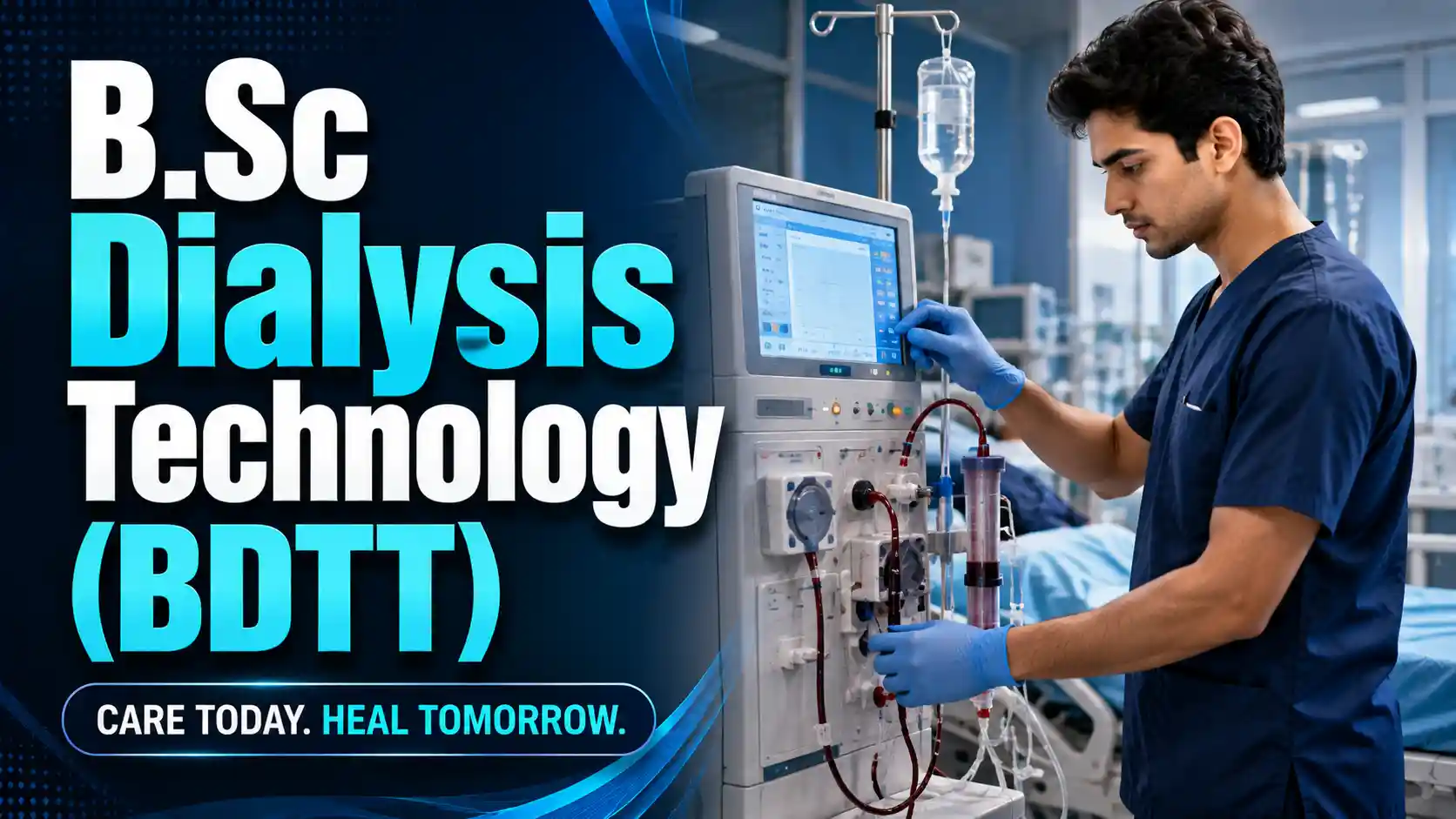

B.Sc Dialysis Technology (BDTT) 2026 – Admission, Eligibility, Fees, Syllabus, Salary & Scope
B.Sc Dialysis Technology is a professional allied-health degree for students who want to work with kidney patients who require dialysis and renal-replacement therapy.
The course is increasingly offered under the standard name Bachelor of Dialysis Therapy Technology (BDTT). Dialysis Therapy Technology is one of the allied-health disciplines covered under NCAHP's competency-based curriculum framework for 2026-27.
Students learn how dialysis machines work, how patients are prepared and monitored, how vascular access is handled within professional competency, how dialysis complications are recognised, and how infection control and water quality affect patient safety.
The national model curriculum uses a 4-year programme with at least 1,440 hours of internship, giving a total curriculum of approximately 4,680 hours.
B.Sc Dialysis Technology 2026 – Quick Facts
The Ministry of Health's Dialysis Therapy Technology curriculum defines the bachelor's programme as four years/eight semesters, including 900 theory hours, 2,340 practical hours and at least 1,440 hours of internship.
Quick Decision Snapshot
- BDTT is one of the most specialised renal-care allied-health degrees.
- The current course structure is 4 years including a full clinical internship component.
- Students work directly with dialysis machines and kidney-failure patients.
- Training includes haemodialysis, peritoneal dialysis, vascular access, dialysis complications and water-treatment systems.
- A dialysis technologist is not a nephrologist doctor.
- Strong practical training matters more than a large university campus.
- The best college should have an active dialysis unit + nephrology department + ICU dialysis exposure.
- Private tuition can be around ₹1–2 lakh per year at current universities, before hostel and other costs.
- Fresher salaries are generally moderate, so very expensive colleges need careful ROI comparison.
- Students uncomfortable with repeated long-term patient care, needles, blood access or hospital shifts should compare another allied-health course.
Planning B.Sc Dialysis Technology admission in 2026? WhatsApp “DIALYSIS 2026” to 9090171704 with your Class 12 subjects, percentage, preferred city and budget for free college-shortlisting support.
What Is B.Sc Dialysis Technology?
Dialysis Therapy Technology focuses on caring for patients whose kidneys cannot adequately remove waste products and excess fluid from the blood.
A Dialysis Therapy Technologist works with nephrologists, nurses and other healthcare professionals in the dialysis unit.
The national curriculum describes responsibilities including:
- Setting up dialysis machines
- Operating haemodialysis equipment
- Monitoring patients
- Maintaining dialysis equipment
- Dialysis in ICU settings
- Maintaining treatment records
- Supporting infection-control procedures
- Managing machine-related problems
- Recognising dialysis complications
- Escalating complications to the physician/nephrologist
Course Reality
This is not merely a machine-operation course.
A dialysis technologist works with seriously ill patients whose treatment may continue several times every week for years.
Patient care and technology are equally important.
What Is the Correct Course Name in 2026?
Students may find several names online:
- B.Sc Dialysis Technology
- B.Sc Dialysis Therapy Technology
- B.Sc Renal Dialysis Technology
- Bachelor of Dialysis Therapy Technology
- BDTT
- B.Sc DTT
The current course naming increasingly used by institutions is:
Bachelor of Dialysis Therapy Technology – BDTT
Parul University and Amrita Vishwa Vidyapeetham both currently use this programme name for their 2026 admissions.
Important Rule
When comparing colleges, do not reject a programme merely because it says BDTT instead of B.Sc Dialysis Technology.
Check the curriculum, duration and professional training rather than only the title.
B.Sc Dialysis Technology Course Duration 2026
BDTT duration is 4 years.
The national model structure uses:
6 Semesters Academic & Clinical Training + 2 Semesters Internship
The internship totals at least 1,440 hours, calculated on approximately 180 working days at eight hours per day.
Duration Structure
Amrita's current programme and Parul's current 2026 programme also list BDTT as four years.
Student Mistake
Do not choose a college merely because it advertises a shorter three-year Dialysis degree.
For a new 2026 student, a proper clinical internship can make a major difference in employability.
B.Sc Dialysis Technology Eligibility 2026
Eligibility can vary between universities.
The Ministry of Health's national model curriculum uses:
- 10+2 Science
- Minimum 50%
- PCM/B under the model framework
- Or an eligible Diploma in Dialysis Therapy Technology for lateral-entry consideration
However, current major 2026 BDTT programmes such as Amrita and Parul specifically use PCB for fresh Class 12 admissions.
Practical 2026 Eligibility Position
Eligibility Insight
For a student planning BDTT admission in 2026, PCB is the safest subject combination.
Do not rely on an old generic “Science students eligible” page.
Can PCM Students Do B.Sc Dialysis Technology?
Some older national model material refers to PCM/B, but current universities may use stricter eligibility.
For example:
- Amrita requires Physics, Chemistry and Biology with minimum 50%.
- Parul currently requires PCB for BDTT.
Therefore, a PCM-only student should check the exact 2026 institution before applying.
Admission Reality
National model eligibility and individual university admission eligibility are not always identical.
Use the rule applicable to the college where admission is being sought.
Is NEET Required for B.Sc Dialysis Technology?
There is no single national NEET-only admission system for BDTT in 2026.
Individual admission routes can include:
- University entrance
- Allied-health entrance examination
- Class 12 merit
- State counselling
- Institution-specific selection
Amrita, for example, uses its AEEL entrance system for its allied-health programmes including BDTT.
Important Rule
No NEET ≠ automatic direct admission.
The college may still require another valid entrance examination or selection process.
B.Sc Dialysis Technology Admission 2026
A typical admission pathway is:
Class 12 Science → Application → Entrance/Merit → Counselling/Selection → Document Verification → Fee Payment → Admission
The exact process depends on the university.
BDTT Admission Process Step by Step
Step 1: Check Your Subjects
Confirm whether the university requires:
- PCB
- PCM/B
- Minimum percentage
- Medical fitness
Step 2: Check the Current Course
Look for:
Bachelor of Dialysis Therapy Technology / B.Sc Dialysis Therapy Technology
with a clear four-year structure.
Step 3: Identify the Admission Route
Check whether admission uses:
- Entrance examination
- University merit
- State counselling
- Another officially notified route
Step 4: Check the Hospital
Before paying, find out where students receive dialysis training.
Step 5: Check the Dialysis Unit
Ask:
- How many dialysis machines?
- How many patients per day?
- Is ICU dialysis available?
- Is peritoneal dialysis available?
- Is a nephrologist available?
Step 6: Complete Counselling/Selection
Follow the correct university or state process.
Step 7: Check Fees
Calculate the full four-year cost.
Step 8: Confirm Internship
Ask exactly where the 1,440-hour internship is completed.
B.Sc Dialysis Technology Admission Status – August 2026
The 2026-27 admission cycle is already advanced.
Parul University's current BDTT page lists:
- 4 years
- 60 seats
- ₹1.15 lakh per year
- PCB eligibility
- 25 August 2026 as its applicable admission deadline when verified.
Amrita's 2026 BDTT admissions operate through its AEEL system and currently list both Kochi and Faridabad among the programme locations.
Admission Reality
A student searching now should ask:
“Which good BDTT colleges still have a valid 2026 admission route?”
not merely:
“Which colleges offer Dialysis Technology?”
What Do Students Study in B.Sc Dialysis Technology?
BDTT combines:
Medical Science + Kidney Science + Dialysis Machines + Patient Monitoring + Clinical Training
Major subjects can include:
- Anatomy
- Physiology
- Biochemistry
- Pathology
- Microbiology
- Pharmacology
- Renal diseases
- Dialysis principles
- Dialysis machines
- Haemodialysis
- Peritoneal dialysis
- Vascular access
- Dialysis nutrition
- Infection control
- Water treatment
- Dialysis complications
- Research methodology
- Patient safety
The Ministry curriculum also includes recent advances in nephrology, transplantation concepts, telemedicine in dialysis practice and specialised renal-replacement therapies.
B.Sc Dialysis Technology Year-Wise Learning
First Stage – Healthcare Foundation
Students build knowledge in:
- Healthcare systems
- Medical terminology
- Patient safety
- Basic emergency care
- Infection control
- Communication
- Ethics
Medical Science Stage
Students study:
- Anatomy
- Physiology
- Biochemistry
- Pathology
- Microbiology
Renal & Dialysis Stage
Training moves into:
- Kidney disease
- Dialysis principles
- Nutrition
- Pharmacology
- Dialysis machines
- Haemodialysis
- Peritoneal dialysis
Advanced Clinical Stage
Students learn:
- Vascular access
- Dialysis complications
- Advanced dialysis modalities
- Transplantation basics
- ICU dialysis
- Infection control
- Clinical problem solving
Internship
The final year focuses heavily on supervised clinical practice.
What Is Haemodialysis?
Haemodialysis removes waste products and excess fluid from a patient's blood using a dialysis machine and dialyser.
The process requires knowledge of:
- Dialyser
- Blood tubing
- Dialysate
- Blood-flow rates
- Ultrafiltration
- Vascular access
- Anticoagulation
- Patient monitoring
- Machine alarms
Students are trained in starting, monitoring and completing haemodialysis under the appropriate clinical framework.
Course Reality
A haemodialysis session can last several hours.
The technologist must remain alert throughout treatment because patient condition can change during dialysis.
What Is Peritoneal Dialysis?
Peritoneal dialysis uses the patient's peritoneal membrane inside the abdomen rather than an external dialyser membrane to remove waste and fluid.
BDTT training can include:
- Continuous Ambulatory Peritoneal Dialysis – CAPD
- Automated Peritoneal Dialysis
- Peritoneal access
- Fluid exchange
- Infection prevention
- Peritonitis
- Dialysis adequacy
The national curriculum includes both acute and chronic peritoneal dialysis and related complications.
Haemodialysis vs Peritoneal Dialysis
Career Insight
A stronger Dialysis Technology programme should teach students both major renal-replacement approaches, not only routine haemodialysis.
What Is a Dialysis Machine?
A haemodialysis machine manages the movement of:
- Blood
- Dialysate
- Ultrafiltration
- Pressure
- Temperature
- Conductivity
It also monitors multiple safety parameters.
The national curriculum covers machine components including:
- Blood pump
- Air detector
- Arterial/venous pressure
- Conductivity
- Temperature
- Ultrafiltration control
- Blood-leak detection
Technical Reality
A Dialysis Technologist needs to understand why an alarm occurs, not simply how to silence it.
What Is RO Water in Dialysis?
Dialysis requires highly controlled water quality.
Dialysis units use reverse osmosis or RO water-treatment systems because large quantities of treated water indirectly interact with the patient's blood during treatment.
Students should learn:
- RO system basics
- Water-quality monitoring
- Dialysate quality
- Disinfection
- Maintenance records
The national curriculum includes RO-water standards and water-treatment maintenance within Dialysis Technology practice.
Patient Safety Insight
A college with dialysis machines but weak training in water quality and infection control is not providing complete Dialysis Technology education.
What Is Vascular Access in Dialysis?
Haemodialysis requires reliable access to the bloodstream.
Common access types include:
- AV fistula
- AV graft
- Central venous catheter
The national professional scope includes handling vascular access and associated monitoring within competency and supervision requirements.
Important Rule
Vascular access is not just a technical procedure.
Poor access handling can create:
- Bleeding
- Infection
- Thrombosis
- Treatment failure
What Complications Can Happen During Dialysis?
Patients can develop complications during treatment.
These can include:
- Low blood pressure
- Muscle cramps
- Bleeding
- Nausea
- Headache
- Allergic reactions
- Access problems
- Machine-related problems
The Dialysis Technologist must monitor the patient, recognise problems and escalate appropriately to the nephrology/clinical team.
Professional Reality
This is why BDTT needs students who can remain calm around sick patients and respond quickly when something changes.
Does BDTT Include ICU Dialysis?
Yes.
The national professional scope specifically includes ICU dialysis and more complex renal-replacement therapies.
Advanced modalities referenced in the curriculum include:
- CRRT
- SLED
- Haemoperfusion
- Plasmapheresis
- Isolated ultrafiltration
Career Insight
A graduate with exposure only to routine outpatient dialysis has a different skill profile from someone trained in ICU and advanced renal-replacement therapy.
What Is CRRT?
CRRT means Continuous Renal Replacement Therapy.
It is commonly used for critically ill patients who may not tolerate conventional intermittent haemodialysis well.
Exposure to CRRT can be especially valuable for students interested in:
- ICU
- Critical care
- Large tertiary hospitals
College Selection Insight
Ask whether the hospital's nephrology/critical-care team actually performs:
ICU Dialysis + SLED + CRRT
If yes, the clinical environment may offer broader learning.
B.Sc Dialysis Technology Internship
The internship is one of the most important parts of the programme.
The national bachelor's framework specifies:
Minimum Internship = 1,440 hours
spread across the seventh and eighth semesters.
During internship, students should progressively become more confident in:
- Machine setup
- Priming
- Patient preparation
- Monitoring
- Documentation
- Infection control
- Dialysis-unit workflow
- Handling complications under supervision
- Equipment cleaning and maintenance
- Advanced-treatment observation
Internship Reality
A good internship should turn:
“I studied dialysis”
into:
“I can safely work in a dialysis unit under the required clinical supervision.”
How to Choose a Good B.Sc Dialysis Technology College
Use:
Current BDTT Programme + Nephrology Department + Busy Dialysis Unit + ICU Exposure + Internship + Affordable Fee
1. Check the Dialysis Unit
Ask how many operational machines exist.
2. Check Patient Load
A dialysis unit with regular patients provides more practical experience.
3. Check the Nephrology Department
Dialysis training is stronger when students work around qualified nephrology teams.
4. Check ICU Dialysis
This can broaden clinical skills.
5. Check Peritoneal Dialysis
Do not learn only conventional haemodialysis.
6. Check RO Water Training
Water quality is central to patient safety.
7. Check Internship
The final year should provide genuine clinical responsibility under supervision.
Hospital Exposure Matters More Than Campus Size
For Dialysis Technology, compare:
- Number of dialysis machines
- Patients per day
- Nephrologists
- Dialysis shifts
- ICU dialysis
- Emergency dialysis
- CRRT/SLED exposure
- Peritoneal dialysis
- RO plant
- Infection-control system
Decision Insight
Large University Campus + Small Dialysis Unit
can be a weaker choice than:
Simple Campus + Strong Nephrology & Dialysis Department
B.Sc Dialysis Technology Fees 2026
Private-college fees vary significantly.
Current examples include:
Parul University currently publishes ₹1.15 lakh per year for its four-year BDTT programme.
Amrita's current 2026 programme lists ₹1.20 lakh annual tuition at Faridabad, with ₹39,400 additional first-year charges, while Kochi has separate scholarship and non-scholarship fee categories.
How Much Can the Complete BDTT Course Cost?
Do not calculate tuition only.
Use:
Total BDTT Cost = Tuition + Academic Charges + Clinical Charges + Hostel + Mess + Transport + Deposits − Confirmed Scholarship
Example
Suppose:
Tuition = ₹1.15 lakh/year
Hostel + mess = ₹1 lakh/year
Other charges = ₹20,000/year
Hostel + mess = ₹1 lakh/year
Other charges = ₹20,000/year
Approximate annual cost:
₹2.35 lakh
Across four years:
about ₹9.4 lakh
before personal expenses.
Financial Reality
A nearby ₹1.4 lakh/year college can cost less overall than a distant ₹1.15 lakh/year college if hostel can be avoided.
BDTT College Example – Parul University
Parul University currently offers the exact Bachelor of Dialysis Therapy Technology programme.For 2026, it lists:
- Duration: 4 years
- Seats: 60
- Fee: ₹1.15 lakh/year
- Eligibility: PCB
- Current applicable deadline when verified: 25 August 2026
At the presently published annual tuition rate:
₹1.15 lakh × 4 years = approximately ₹4.60 lakh
before hostel and additional expenditure.
Financial Insight
Do not treat ₹4.60 lakh as the final family cost until the internship-year billing and residential costs are confirmed.
BDTT College Example – Amrita Faridabad
Amrita Vishwa Vidyapeetham Faridabad currently offers Bachelor of Dialysis Therapy Technology.
Its current programme information lists:
- Duration: 4 years
- Eligibility: PCB with minimum 50%
- Minimum age: 17 years
- Selection: AEEL 2026
- Faridabad intake: 10 seats
- Annual tuition: ₹1.20 lakh
- First-year other fee: ₹39,400
- First-year total: ₹1,59,400
- Refundable caution deposit: ₹5,000 additional
Clinical Insight
For Dialysis Technology, the value of a medical-campus environment depends on the nephrology and dialysis workload students actually experience.
Amrita Kochi BDTT Fee Example
Amrita Kochi's 2026-27 allied-health fee structure lists:
- Scholarship tuition: ₹1.50 lakh/year
- Non-scholarship tuition: ₹2 lakh/year
- Other fee: ₹41,000
- Admission processing charge: ₹2,500
- Hostel/mess listed separately in its programme information
Scholarship Reality
Do not calculate your four-year cost using the scholarship rate unless that scholarship is actually confirmed.
For budgeting:
Unconfirmed Scholarship = ₹0
What Does a Dialysis Therapy Technologist Actually Do?
A trained technologist can be involved in:
- Preparing the dialysis station
- Checking dialysis machines
- Priming tubing and dialyser
- Preparing patients
- Monitoring vital signs
- Operating dialysis systems
- Monitoring treatment parameters
- Maintaining aseptic precautions
- Recognising complications
- Cleaning/disinfecting machines
- Maintaining treatment records
- Checking supplies
- Supporting RO-system monitoring
- Coordinating with nephrologists and nurses
The national curriculum also describes responsibilities in advanced dialysis, patient education and equipment maintenance.
Dialysis Technologist vs Nephrologist
Important Rule
BDTT does not make you a kidney doctor.
A nephrologist and Dialysis Technologist work together but have different professional responsibilities.
Dialysis Technologist vs Dialysis Nurse
A dialysis nurse is a Nursing professional with Nursing education and renal/dialysis experience.
A Dialysis Therapy Technologist comes through the allied-health Dialysis Technology pathway.
Both can work in a dialysis unit, but their education and professional scopes are different.
Career Insight
Students who want a broader Nursing career beyond kidney care should consider B.Sc Nursing.
Students specifically attracted to dialysis machines and renal-replacement therapy may prefer BDTT.
Jobs After B.Sc Dialysis Technology
Common job titles include:
- Dialysis Therapy Technologist
- Dialysis Technologist
- Dialysis Technician
- Haemodialysis Technologist
- Renal Dialysis Technologist
- Dialysis Unit Technologist
- ICU Dialysis Technologist
- Dialysis Equipment/Application Support roles after suitable experience
- Dialysis Unit Supervisor after experience
- Clinical Instructor after higher qualification
Where Can BDTT Graduates Work?
Employment areas include:
- Government hospitals
- Private hospitals
- Medical colleges
- Dialysis centres
- Nephrology hospitals
- Kidney-care centres
- ICU/critical-care departments
- Home-dialysis services
- Dialysis-equipment companies
- Clinical research
- Academic institutions after higher education
Career Reality
Unlike very broad healthcare degrees, BDTT is highly specialised.
Most core employment remains connected to kidney care and renal-replacement therapy.
B.Sc Dialysis Technology Salary in India 2026
There is no guaranteed salary after BDTT.
Indeed's India salary tracker currently reports an average Dialysis Technician base salary of approximately ₹16,433 per month, based on 78 salary reports and updated in January 2026.
Current job advertisements show examples such as:
- Around ₹18,000–₹20,000/month
- ₹20,000–₹25,000/month at some renal-care employers
- Higher pay for experienced/senior Dialysis Technicians
Salary Reality
A new graduate working routine haemodialysis and an experienced technologist skilled in ICU dialysis, CRRT and advanced modalities can have very different earning potential.
Can Dialysis Technologists Earn More With Experience?
Yes.
Career growth can come from developing expertise in:
- ICU dialysis
- CRRT
- SLED
- Peritoneal dialysis
- Advanced machine troubleshooting
- Dialysis-unit supervision
- Quality management
- Equipment/application support
Career Strategy
Do not spend four years learning only:
routine machine start → routine dialysis → machine shutdown
Develop broader renal-care skills.
Government Jobs After B.Sc Dialysis Technology
Government hospitals and medical institutions can recruit Dialysis Technicians or Technologists.
However, every recruitment can specify its own:
- Degree/diploma requirement
- Experience
- Registration
- Age limit
- Selection examination
Important Rule
A four-year BDTT degree does not automatically mean eligibility for every vacancy using the words “Dialysis Technician.”
Always read the exact qualification requirement.
Is B.Sc Dialysis Technology Good for Girls?
Yes.
Dialysis Technology is suitable for eligible students of any gender.
The more important questions are whether the student is comfortable with:
- Blood
- Needles/vascular access
- Sick patients
- Long dialysis sessions
- Shift duties
- Repeated patient interaction
Is B.Sc Dialysis Technology Good for Boys?
Yes.
There is no general gender restriction on the profession.
Male and female professionals can work across dialysis centres, hospitals and critical-care units.
Is Dialysis Technology Difficult?
The course can be challenging because it combines:
Human Biology + Kidney Physiology + Machines + Patient Care
Students need to understand:
- Fluid balance
- Electrolytes
- Blood pressure
- Dialysis principles
- Vascular access
- Anticoagulation
- Infection prevention
- Machine alarms
Course Reality
This course rewards students who are both technically careful and patient-focused.
Is Dialysis Technology Stressful?
It can be.
Dialysis patients may have serious chronic kidney disease and multiple health problems.
During treatment, the technologist may need to respond quickly to:
- Low blood pressure
- Bleeding
- Access problems
- Machine alarms
- Emergency situations
Profile Fit
Students wanting a low-pressure, non-clinical desk job should not choose BDTT only because it sounds technical.
B.Sc Dialysis Technology vs B.Sc Nursing
Decision Insight
B.Sc Nursing = broader healthcare career
BDTT = deeper renal/dialysis specialisation from undergraduate level
B.Sc Dialysis Technology vs BMRIT
Students attracted more to diagnostic machines than long-term renal patient care should compare B.Sc Radiology & Medical Imaging Technology.
B.Sc Dialysis Technology vs BAOTT
Dialysis Technology
Works mainly around:
- Kidney patients
- Dialysis machines
- Renal replacement
- Nephrology
- ICU dialysis
BAOTT
Works mainly around:
- Surgery
- Anaesthesia
- Operation theatres
- Ventilators
- Surgical equipment
Simple Difference
BDTT = Renal Treatment Technology
BAOTT = Surgical & Anaesthesia Technology
B.Sc Dialysis Technology vs BMLT/BMLS
BMLT/BMLS focuses more on laboratory diagnostics.
A laboratory student may work with:
- Blood samples
- Microbiology
- Pathology
- Biochemistry
- Laboratory instruments
A Dialysis Technology student works directly with patients during treatment.
Students who prefer samples and laboratory testing over repeated patient treatment can compare B.Sc Medical Laboratory Technology / BMLS.
B.Sc Dialysis Technology vs BPT
BPT focuses on movement and rehabilitation.
BDTT focuses on kidney-failure treatment technology.
Students interested in:
- Exercise
- Rehabilitation
- Sports
- Orthopaedics
- Neurology
B.Sc Dialysis Technology vs Optometry
Optometry focuses on:
- Eyes
- Vision
- Refraction
- Contact lenses
- Visual rehabilitation
Dialysis Technology focuses on kidney patients and renal-replacement treatment.
Higher Studies After B.Sc Dialysis Technology
The natural postgraduate route can include:
Master of Dialysis Therapy / M.DT
or related master's-level renal/dialysis programmes.
Parul University currently lists a 2-year Master of Dialysis Therapy, while Amrita also lists a 2-year Master of Dialysis Therapy pathway for eligible BDTT graduates.
What Can You Do After a Master's in Dialysis Therapy?
Higher education and experience can support progression towards:
- Senior Dialysis Technologist
- Dialysis Unit Supervisor
- Clinical Instructor
- Academic roles
- Quality management
- Research
- Advanced renal-replacement therapy roles
Career Insight
A bachelor's degree can start the professional career.
A master's can become more valuable for students targeting supervision, academics and advanced practice environments.
Can BDTT Graduates Do MBA?
Yes, subject to MBA admission eligibility.
Students who later want to move from hands-on dialysis towards:
- Hospital administration
- Healthcare management
- Operations
- Medical-device companies
can explore MBA in Healthcare Management.
Can Dialysis Technologists Work Abroad?
Potentially yes.
But overseas work can require:
- Qualification verification
- Professional registration
- Employer requirements
- Clinical experience
- Language tests
- Visa/work permission
Student Mistake
Do not pay an excessive fee merely because a college promises:
“Guaranteed Gulf/UK dialysis job.”
International employment has a separate professional process.
Will Dialysis Machines Replace Dialysis Technologists?
Dialysis machines automate many technical functions.
But they cannot independently replace professionals responsible for:
- Patient preparation
- Vascular-access handling
- Patient monitoring
- Complication recognition
- Infection control
- Machine troubleshooting
- Documentation
- Emergency response
Career Insight
The future profile is likely to be:
Dialysis Technologist + Advanced Machines + ICU Skills + Digital Monitoring
rather than basic machine operation alone.
How to Future-Proof a Dialysis Technology Career
During college, try to gain real experience in:
- Conventional haemodialysis
- Modern dialysis machines
- Peritoneal dialysis
- Vascular access
- ICU dialysis
- CRRT
- SLED
- RO water treatment
- Infection control
- Machine troubleshooting
- Dialysis complications
- Emergency response
Career Strategy
Do not graduate after four years having seen only a handful of routine dialysis sessions.
Who Should Choose B.Sc Dialysis Technology?
BDTT may suit you if you:
- Like Biology
- Are interested in kidney care
- Enjoy medical technology
- Want direct patient interaction
- Can handle blood/needles
- Are comfortable with hospital shifts
- Like working with machines
- Want a specialised healthcare career
- Can build long-term relationships with chronic-care patients
- Are comfortable working under a nephrology team
Who May Not Enjoy Dialysis Technology?
Think carefully if you:
- Strongly dislike blood
- Fear needles
- Do not like direct patient contact
- Want a broad healthcare degree
- Want a desk job
- Dislike machines
- Do not want hospital shifts
- Want to become a kidney doctor
- Are choosing the course only because admission is easy
Profile Fit
BDTT is a specialised chronic-care profession.
That can be a major strength if you like renal healthcare, but it can feel narrow if you want to move freely between unrelated hospital departments.
Common B.Sc Dialysis Technology Admission Mistakes
Choosing Only by Course Name
Check the actual four-year curriculum.
Ignoring the Dialysis Unit
This is the biggest clinical mistake.
Checking Only the Number of Machines
Machines without sufficient patients do not provide strong training.
Ignoring ICU Dialysis
Critical-care exposure can strengthen the profile.
Ignoring Peritoneal Dialysis
A complete course should go beyond conventional haemodialysis.
Choosing by Fee Alone
A weak dialysis unit cannot be fixed by cheap tuition.
Comparing Annual Fee With Total Fee
Use the same four-year basis.
Ignoring Internship
The national curriculum requires substantial internship experience.
Thinking You Become a Nephrologist
BDTT is an allied-health degree, not MBBS.
Trusting Guaranteed Foreign Job Claims
Overseas professional requirements remain separate.
FAQs – B.Sc Dialysis Technology 2026
1. What is B.Sc Dialysis Technology?
It is an undergraduate allied-health programme that trains students in dialysis machines, kidney-care technology, haemodialysis, peritoneal dialysis and renal patient monitoring.
2. What is BDTT?
BDTT stands for Bachelor of Dialysis Therapy Technology.
3. Is BDTT the same as B.Sc Dialysis Technology?
They refer to the same broad professional field, although current institutions increasingly use the BDTT nomenclature.
4. How many years is B.Sc Dialysis Technology?
The national bachelor's structure is 4 years / 8 semesters, including internship.
5. How long is the BDTT internship?
The national curriculum requires at least 1,440 hours of internship.
6. What is the eligibility for B.Sc Dialysis Technology?
Current major programmes generally require Class 12 Science, commonly PCB, with the required university percentage.
7. What percentage is required for BDTT?
Many current programmes use around 50%, but exact eligibility depends on the institution.
8. Is Biology compulsory for Dialysis Technology?
Many current 2026 BDTT programmes, including Amrita and Parul, require PCB.
9. Can PCM students do B.Sc Dialysis Technology?
Some older model eligibility refers to PCM/B, but current university requirements vary. PCM-only students should verify the specific 2026 programme before applying.
10. Is NEET compulsory for BDTT?
No single nationwide NEET-only admission system applies to every BDTT college.
11. Can I get B.Sc Dialysis Technology admission without NEET?
Yes, where another valid entrance or university admission process applies.
12. What entrance exam does Amrita use for BDTT?
Amrita uses AEEL for its current allied-health admissions.
13. What is haemodialysis?
Haemodialysis filters a patient's blood through an external dialyser and dialysis machine to remove excess waste and fluid.
14. What is peritoneal dialysis?
Peritoneal dialysis uses the abdominal peritoneal membrane for renal-replacement therapy.
15. Does B.Sc Dialysis teach both haemodialysis and peritoneal dialysis?
Yes. Both are covered in the national curriculum.
16. Does BDTT include ICU dialysis?
Yes. ICU dialysis is included in the professional scope.
17. What is CRRT?
CRRT is Continuous Renal Replacement Therapy, an advanced renal-replacement method commonly used in critically ill patients.
18. Does the course teach CRRT?
Advanced renal-replacement therapies such as CRRT and SLED are included in the professional curriculum.
19. What is RO water in dialysis?
Reverse-osmosis water treatment provides highly purified water required for safe dialysis processes.
20. Does a Dialysis Technologist handle dialysis machines?
Yes. Machine setup, operation, monitoring, disinfection and troubleshooting are core professional skills.
21. Does BDTT make me a nephrologist?
No. A nephrologist is a medical specialist doctor.
22. What is the difference between a nephrologist and Dialysis Technologist?
The nephrologist diagnoses and medically manages kidney disease. The technologist operates and supports dialysis treatment within the allied-health professional role.
23. What is the B.Sc Dialysis Technology fee?
It varies. Current private examples include approximately ₹1.15 lakh/year at Parul and ₹1.20 lakh annual tuition at Amrita Faridabad.
24. What is Parul University BDTT fee?
Parul currently lists ₹1.15 lakh per year.
25. What is Amrita Faridabad BDTT fee?
Amrita currently lists ₹1.20 lakh annual tuition plus ₹39,400 in first-year other fees.
26. Does Amrita Faridabad offer Dialysis Technology?
Yes. Amrita currently offers Bachelor of Dialysis Therapy Technology at Faridabad and Kochi.
27. What jobs can I get after BDTT?
Common roles include Dialysis Technologist, Dialysis Technician, Haemodialysis Technologist and other renal-care technical positions.
28. What is the salary after B.Sc Dialysis Technology?
Indeed currently reports an average Dialysis Technician base salary of around ₹16,433 per month in India, though actual pay varies significantly.
29. Can Dialysis Technologists earn ₹25,000 per month?
Yes, some current jobs advertise ₹20,000–₹25,000 or higher depending on experience and employer, but it is not guaranteed for every fresher.
30. Can BDTT graduates get government jobs?
Yes, subject to the qualification, experience and other conditions specified in each recruitment.
31. Is B.Sc Dialysis Technology better than B.Sc Nursing?
It depends on career goals. Nursing offers broader healthcare opportunities, while BDTT specialises in renal and dialysis care.
32. Is Dialysis Technology better than Radiology?
BDTT suits renal-care students. BMRIT suits students more interested in X-ray, CT and MRI.
33. Is Dialysis Technology better than BAOTT?
BDTT focuses on kidney treatment; BAOTT focuses on surgery and anaesthesia.
34. Is Dialysis Technology better than BMLT?
BDTT involves direct treatment and repeated patient contact, while BMLT/BMLS is mainly laboratory diagnostics.
35. Is Dialysis Technology better than BPT?
BDTT focuses on renal treatment. BPT focuses on rehabilitation and movement.
36. Can I do a Master's after BDTT?
Yes. Master of Dialysis Therapy and related postgraduate programmes are available.
37. How long is Master of Dialysis Therapy?
Current programmes at Parul and Amrita are generally 2 years.
38. Can BDTT graduates work abroad?
Potentially yes, subject to qualification recognition, registration, experience and immigration requirements of the destination country.
39. Is B.Sc Dialysis Technology suitable for girls?
Yes.
40. Is B.Sc Dialysis Technology suitable for boys?
Yes.
41. Is Dialysis Technology difficult?
It can be demanding because it combines patient care, kidney physiology, machine operation, vascular access, emergency response and infection control.
42. Is B.Sc Dialysis Technology worth doing in 2026?
It can be a strong specialised allied-health course for students genuinely interested in renal care and dialysis technology, particularly when studied in a college with high patient volume and advanced dialysis exposure.
Final Decision – Is B.Sc Dialysis Technology Worth It in 2026?
B.Sc Dialysis Technology / BDTT can be a strong allied-health career for students who want a specialised combination of patient care and medical technology.
Its professional pathway is very clear:
Kidney Care + Haemodialysis + Peritoneal Dialysis + Dialysis Machines + Patient Monitoring + ICU Renal-Replacement Therapy
The current national bachelor's framework provides four years of education with extensive clinical learning and at least 1,440 hours of internship.
But college selection matters greatly.
Before paying fees, compare:
Current BDTT Programme + Active Nephrology Department + Busy Dialysis Unit + Patient Load + Haemodialysis + Peritoneal Dialysis + ICU/CRRT Exposure + RO Water Training + Internship + Complete Four-Year Cost
Do not choose a college simply because its brochure shows a dialysis machine.
The real question is:
How many actual dialysis patients, procedures and complications will I learn to manage during four years?
For personalised B.Sc Dialysis Technology admission guidance, WhatsApp “DIALYSIS 2026” to 9090171704 with your Class 12 subjects, percentage, preferred city and maximum budget.